“The world is a book and those who do not travel read only one page.” ― St. Augustine
February 8 – 22, 2024
It’s always hard to start writing about a country, a first my thoughts are all jumbled but usually once I get started the words begin to flow. I hope that’s the case here. My time was spent mostly in Kota Kinabalu (KK) in the state of Sabah on the island of Borneo and in Kuala Lumpur (KL), the Malaysian capital on the Malay Peninsula. I also took day trips to Mt. Kinabalu and the Goring hot springs, Melaka-a historic Portuguese city, and the Cameron Highlands, near Ipoh. Unfortunately I missed going to Sarawak, another Malaysian state on Borneo, to see the organutans. I thought I could see them in Sabah. I guess I didn’t plan well, as Borneo and Sumatra are the only places in the world to see them in the wild and I missed a great opportunity. The other area that seemed interesting and probably deserved a couple days was Penang, a former English colony.

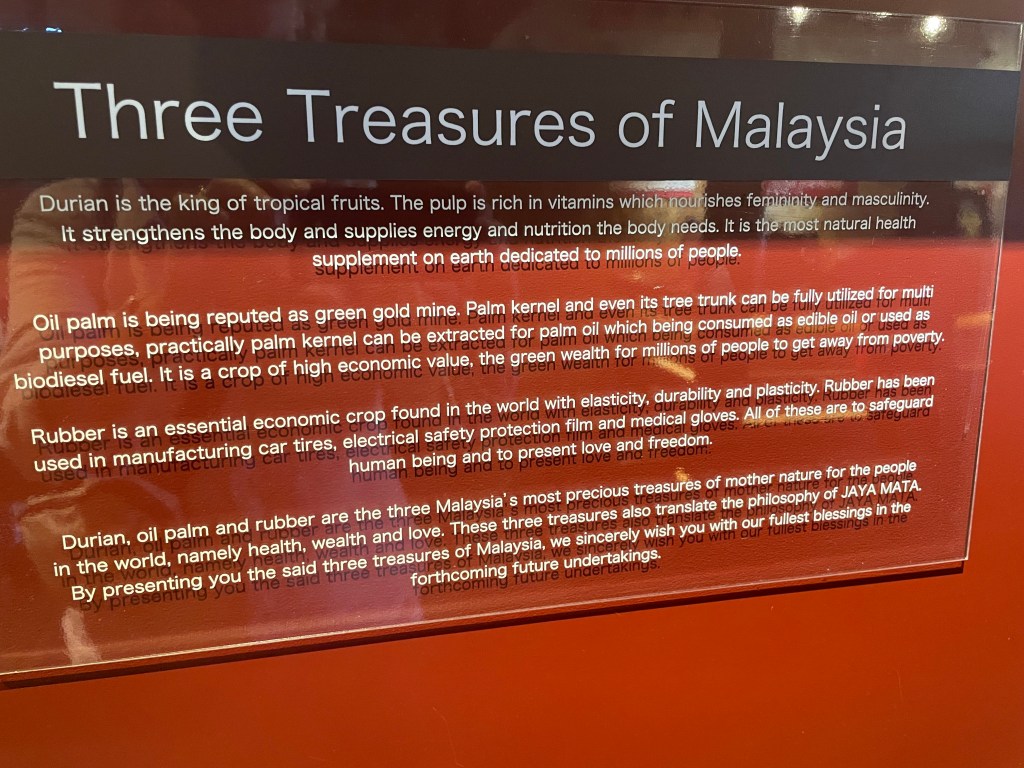

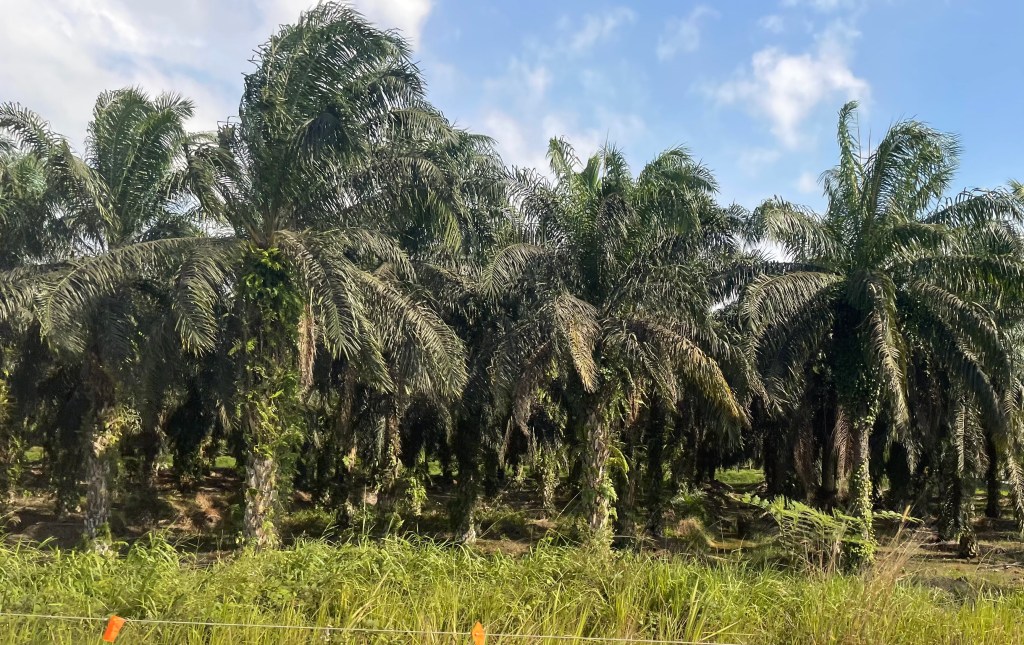
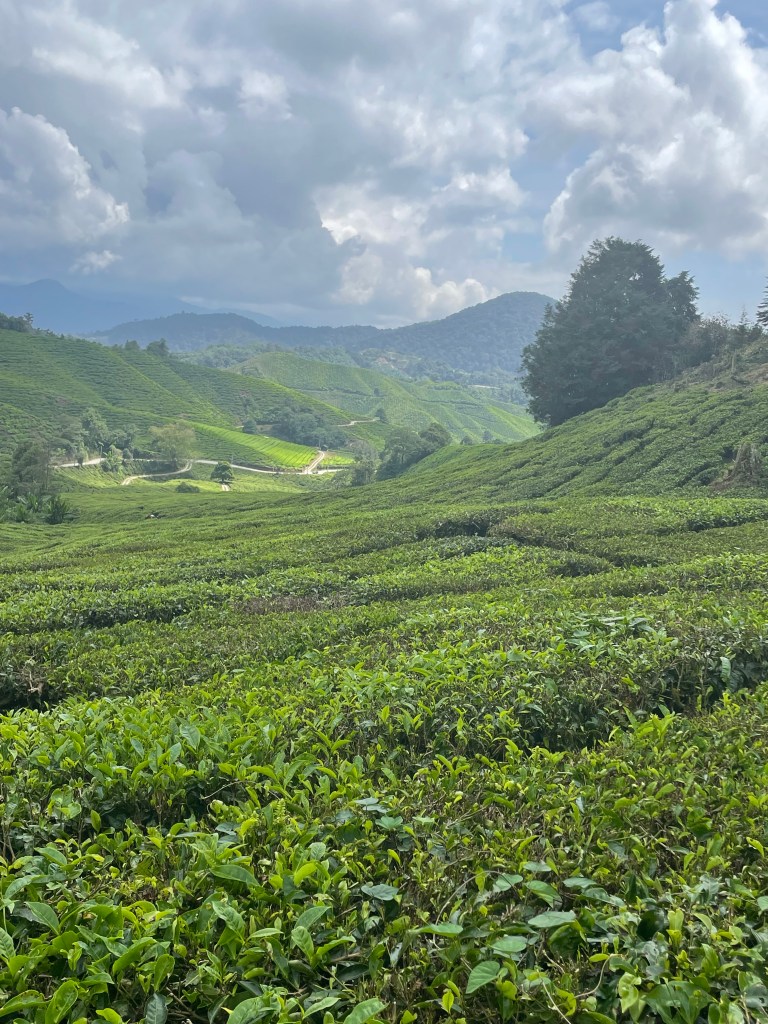
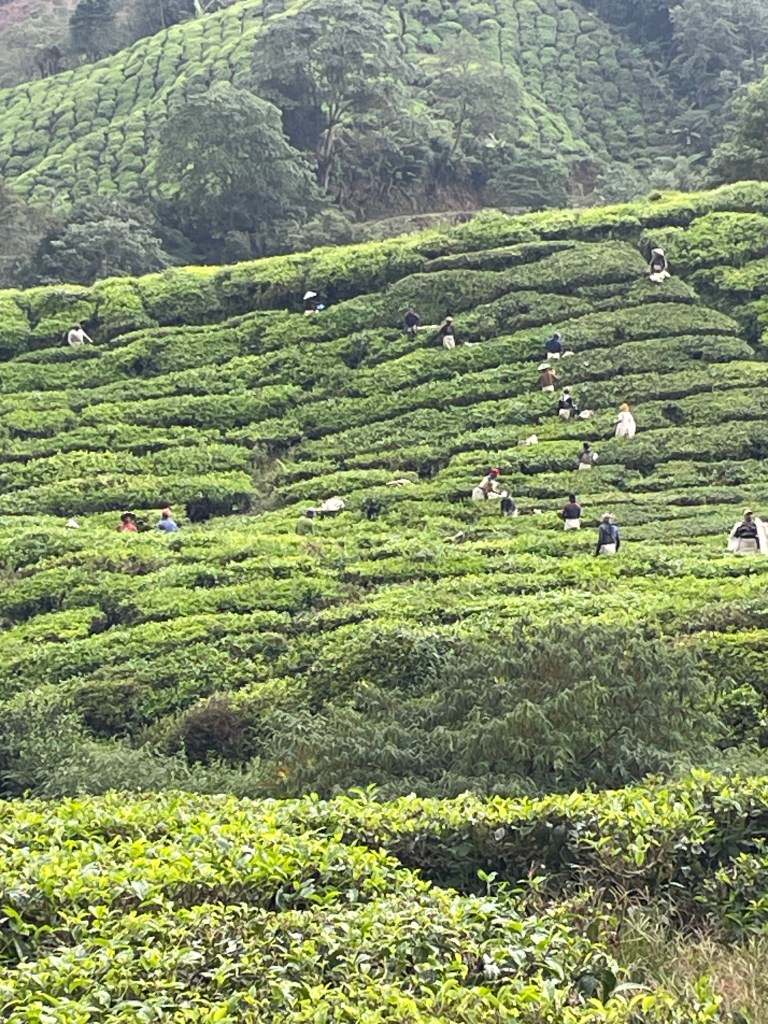
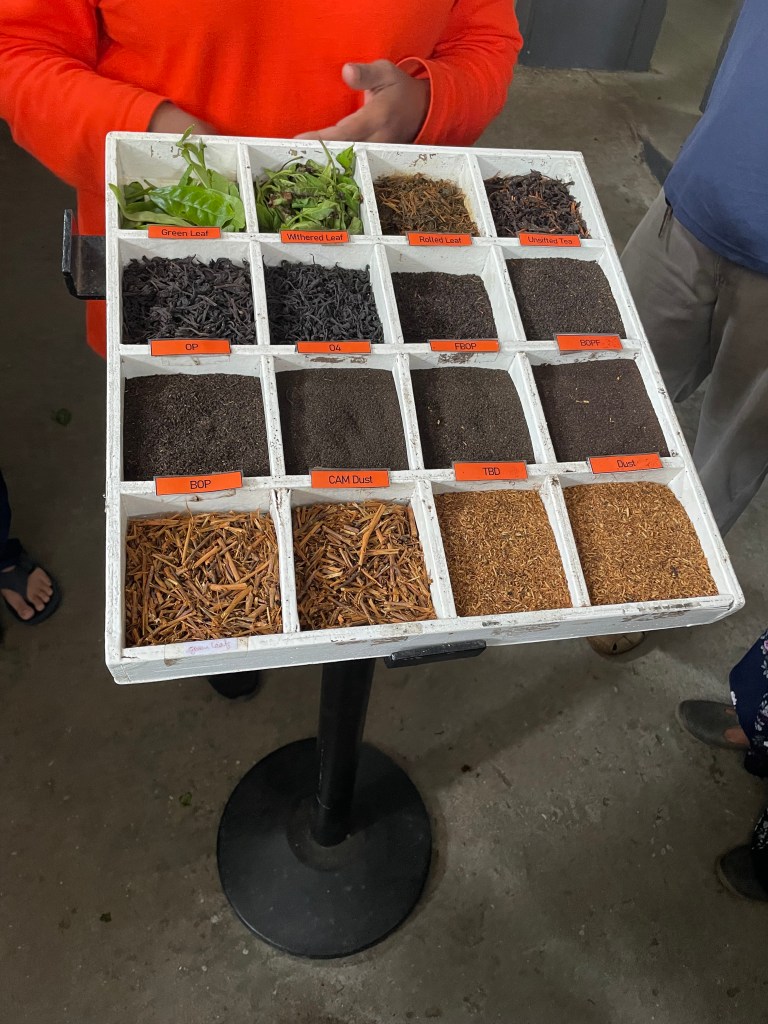
The majority of the country is covered in rainforest, some accounts up to 70% so most of the population, over 75%, live in urban areas. Driving through the country, the rainforest was very dense and extremely green. Palm oil is one of their biggest industries, they’re second in the world, so there are miles of palm oil trees as well. However, the rainforest is chopped down to plant the trees, taking away habitat from animals like the orangutan. The flip side is, it is a very sustainable business. Palm oil trees grow berries, from which the oil is harvested, and produce for over thirty years. The trees are easily replaced when they stop producing. Palm oil is used all over Asia for cooking as well as around the world in cosmetics and soaps. Also, very green are the tea plantations in the Cameron Highlands, hectares and hectares of rolling hills covered with squat bushes with verdant leaves shining in the sun. Here the tea is harvested by hand as no machinery can operate on the steep and undulating hills. The tea trees naturally grow up to 40 feet tall but they’re keep short for easy harvesting. I’m not a tea drinker but my daughter, Jane, is, so she’ll get some of the tea grown here on the original Cameron planation. Both in Malaya and in Sabah, the highlands are garden zones. Acres and acres of vegetables are grown on steep hills on small family farms – boy chow, cabbage, carrots, cauliflower, green beans, long beans, okra, pumpkin, etc. The highlands provide all the vegetables needed here and in Singapore, which does not have land for farming.
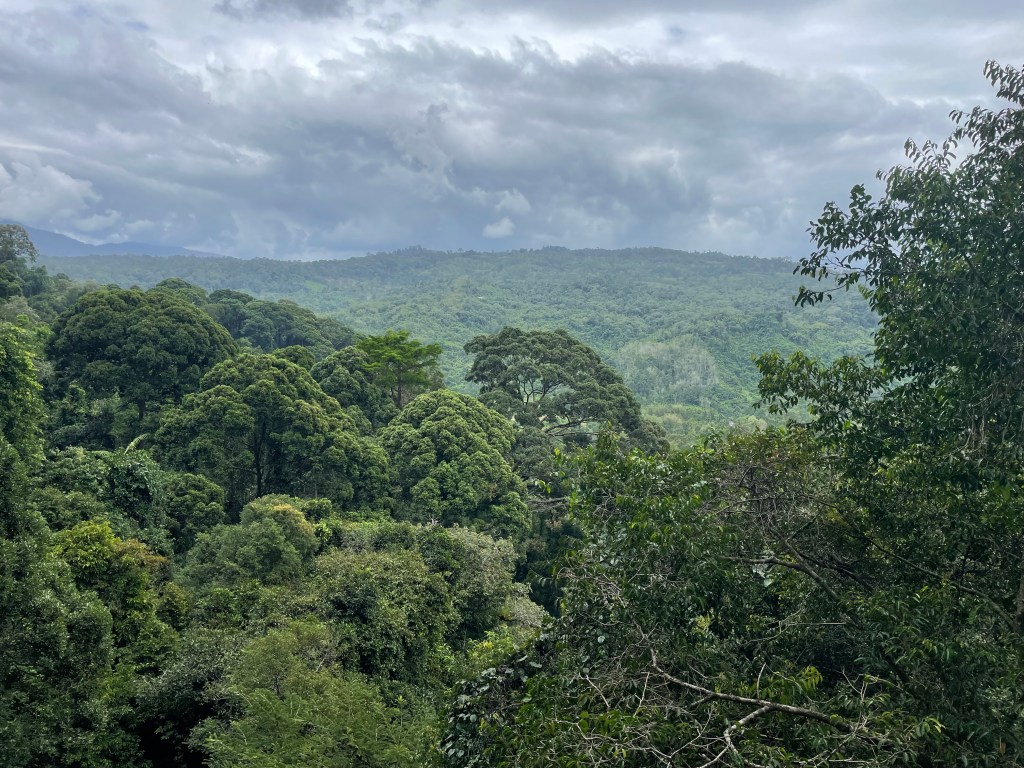
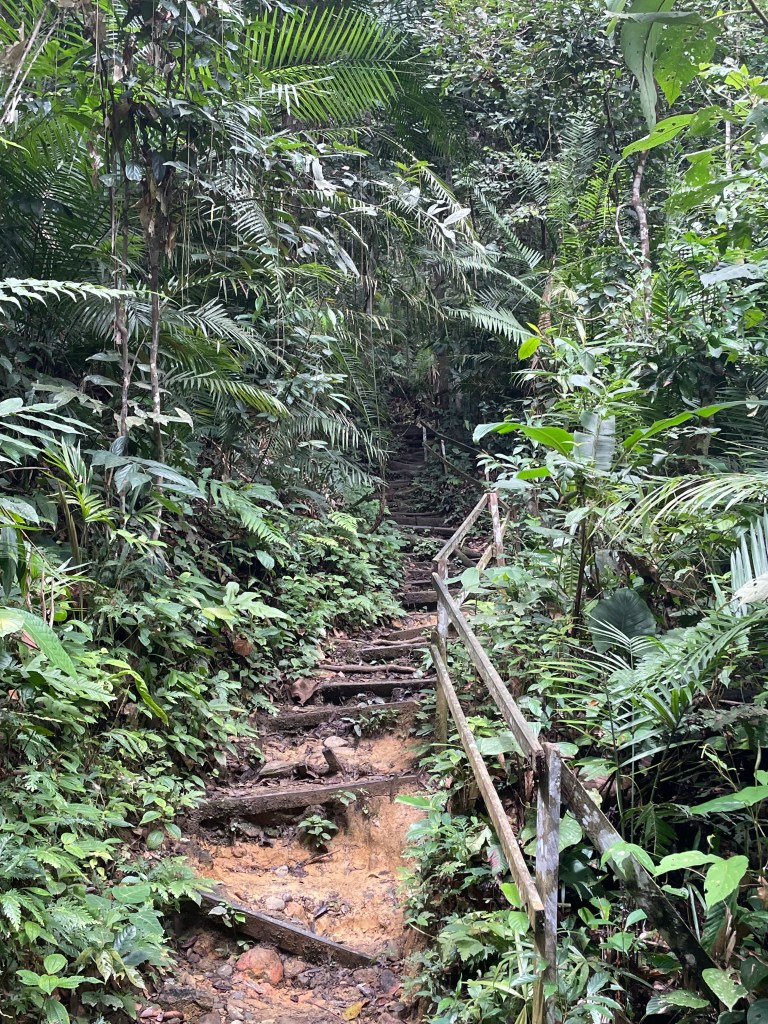
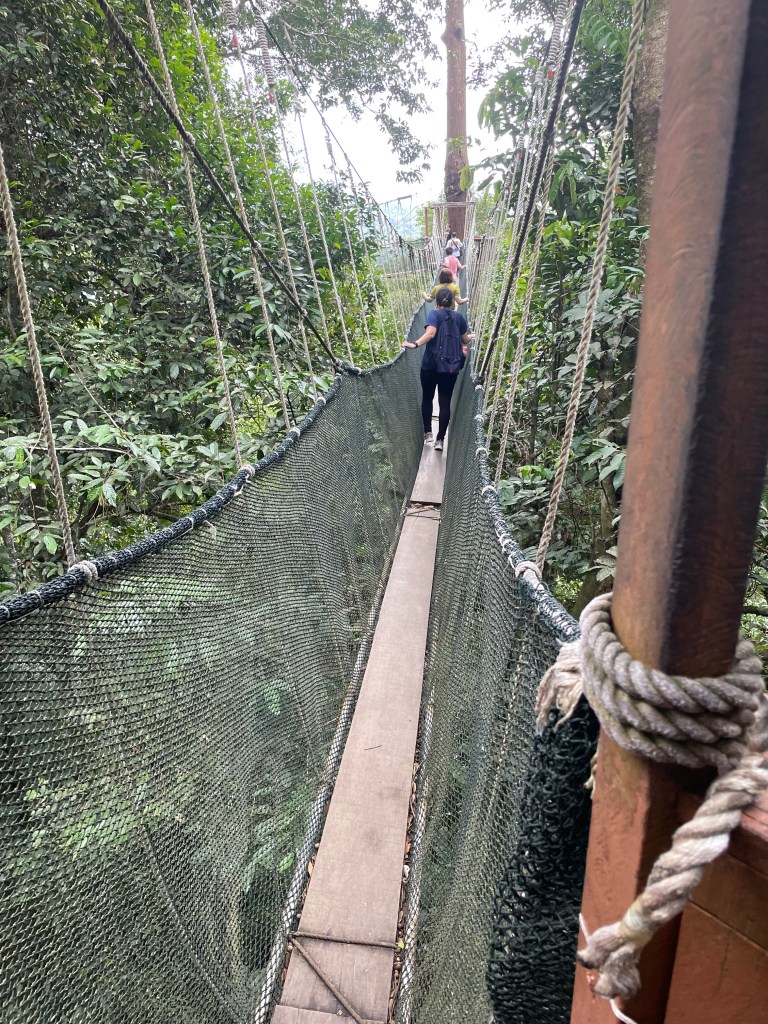
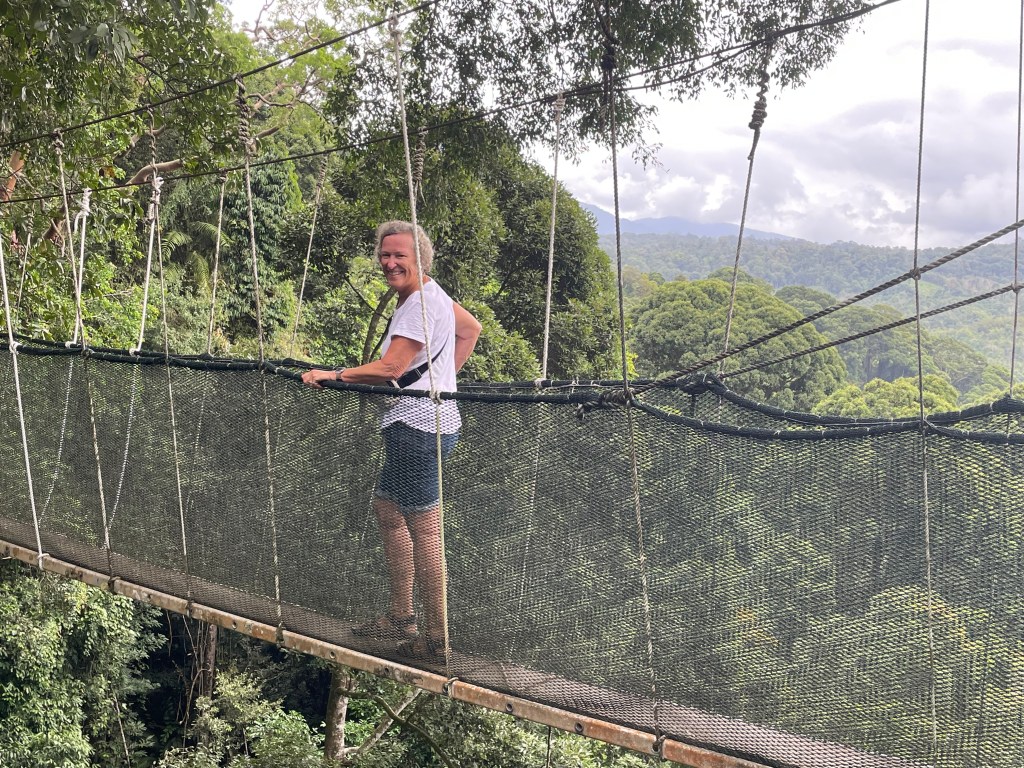
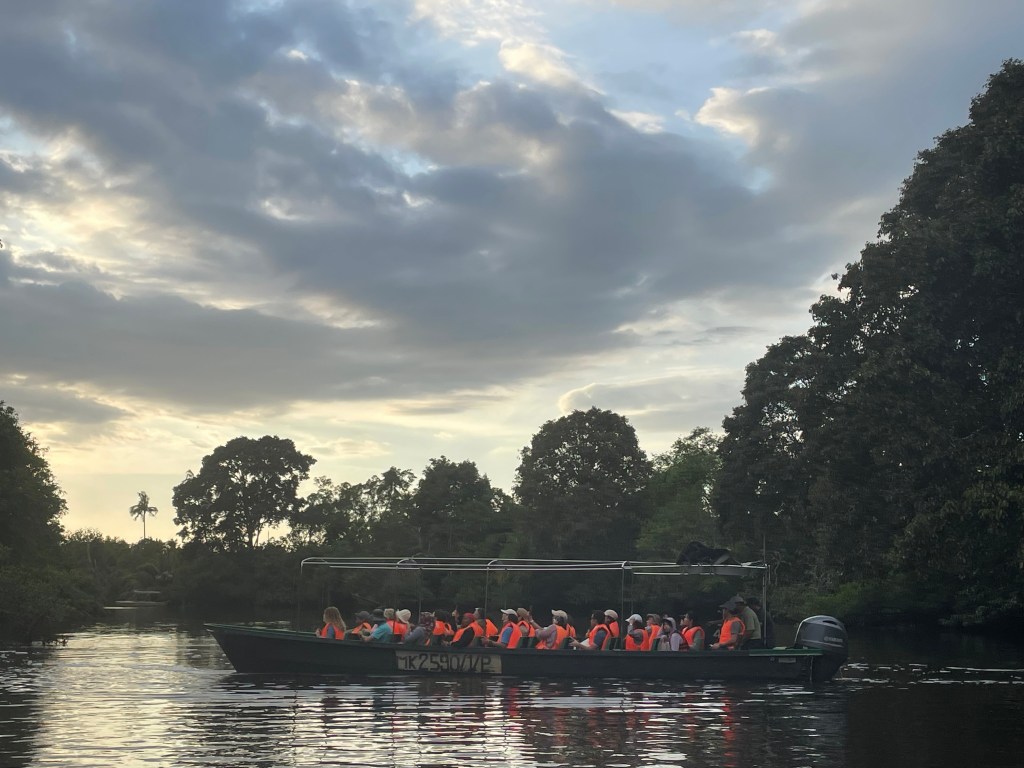
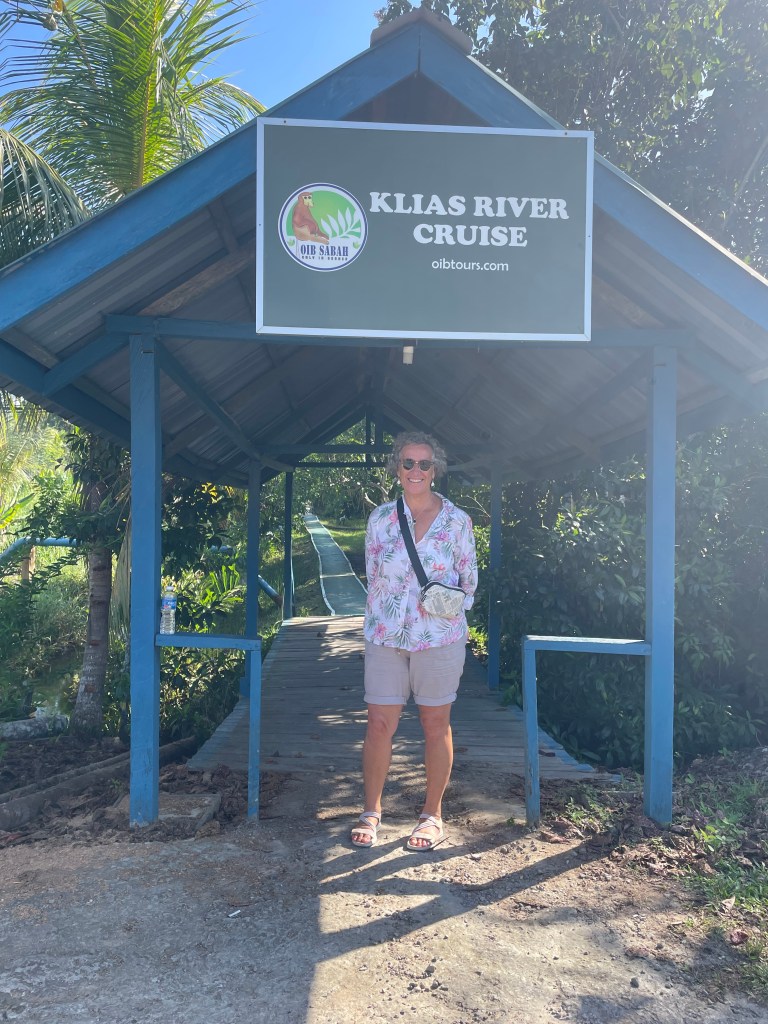
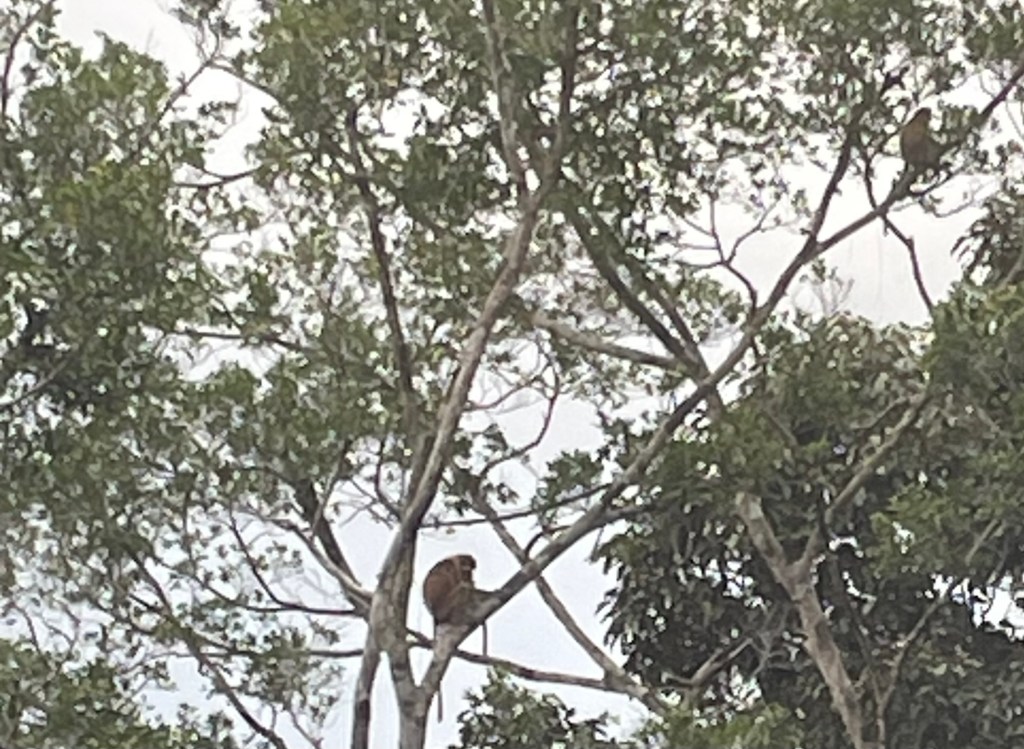
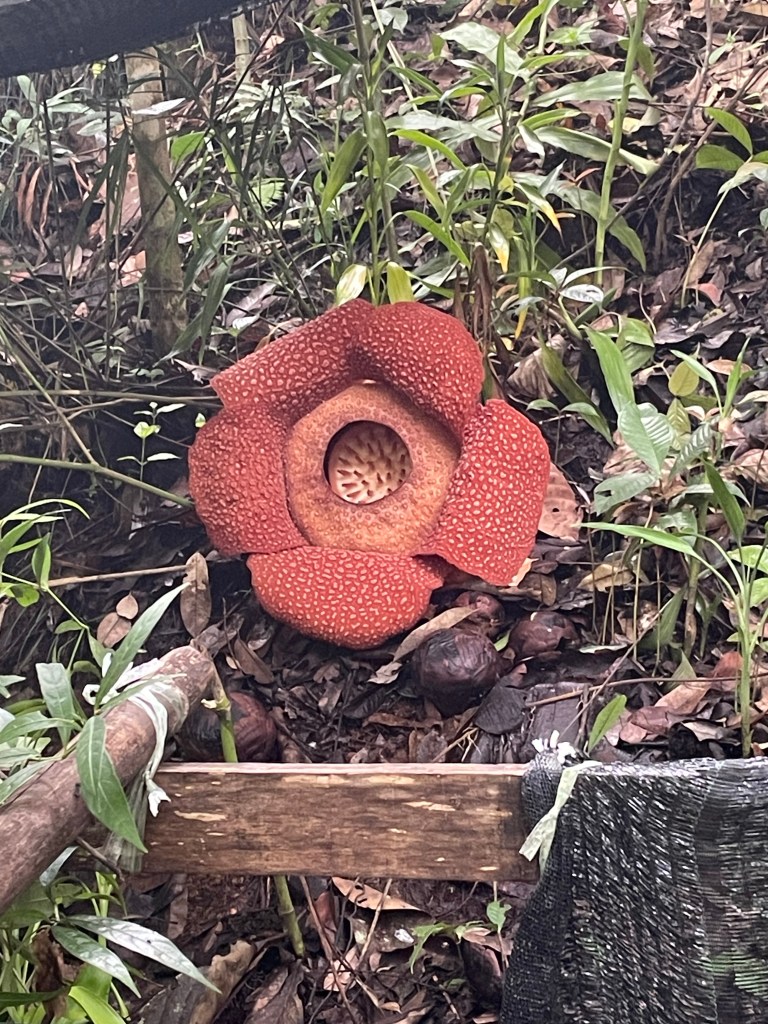
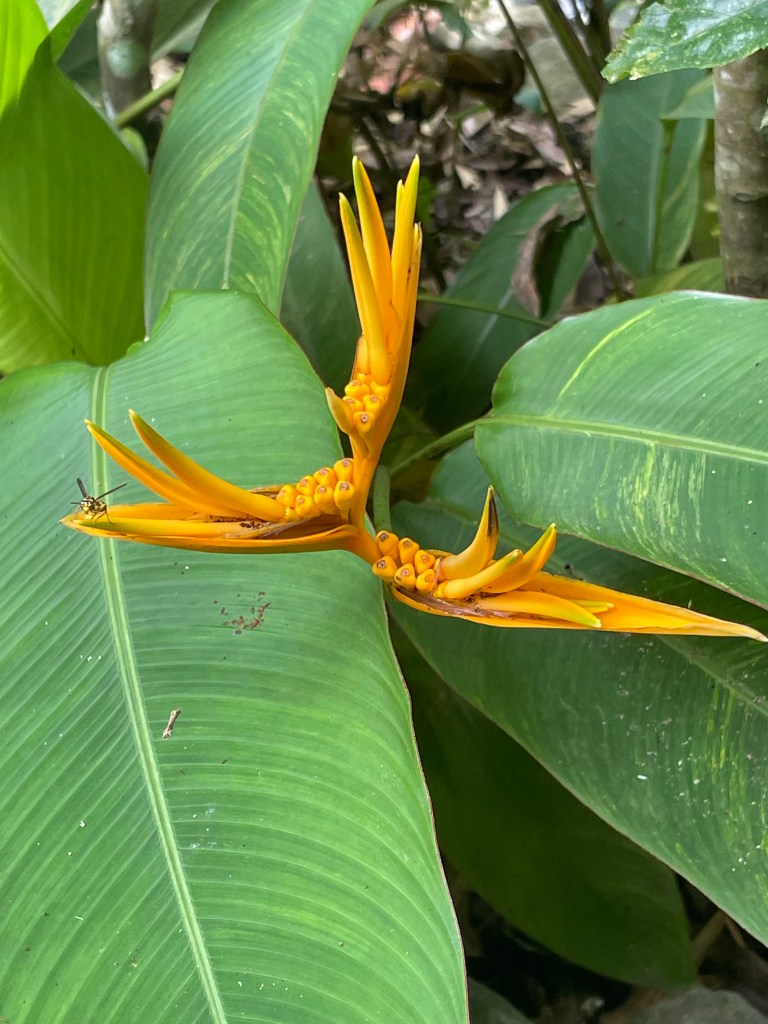
Keeping on the theme of trees and the rain forest, on my trip up Mt. Kinabalu, I did a canopy walk over the jungle. I’m not afraid of heights, but it was a little scary! We were 60 to 130 feet from the jungle floor, on a narrow plank of wood, suspended by netting that came to just above our waists, and then ropes into the trees. The plank swayed just enough to make you feel a little unsteady, especially when the people in front of you got off and the ones behind you got on. The walkway was 500 feet long with 3 stable platforms at intervals along the way. You wanted to hug the tree that held up each perch. One hundred plus feet doesn’t sound too far, until you’re wobbling high above the ground. Tightrope walkers in comparison are usually only about 20 feet into the air. Kudos to Jonathan, a young man from Angola, who was afraid of heights but made the trek anyway – slowly, slowly. On a river cruise in Sabah, I did see Proboscis monkeys high up in the trees, too far away to see their oversized noses however. Then once it got dark, we again ventured onto the flowing water to see fireflies, of all things. I mean, I think fireflies are magical but never thought they would be a tourist attraction. But fireflies do not exist around the world. A couple from New Zealand, took the tour especially to see the tiny insects light up the night. Here they hang out high up in the trees, covering the branches and flickering like Christmas lights. Pretty cool. The jungle is also home to over 2,500 species of orchids. I didn’t get to see them all, but I saw a few. I did see the rafflesia, the biggest flower in the world that doesn’t have a stem or leaves, an interesting species. It’s supposed to smell like rotten meat but luckily for me, the odor wasn’t emanating the day I visited.

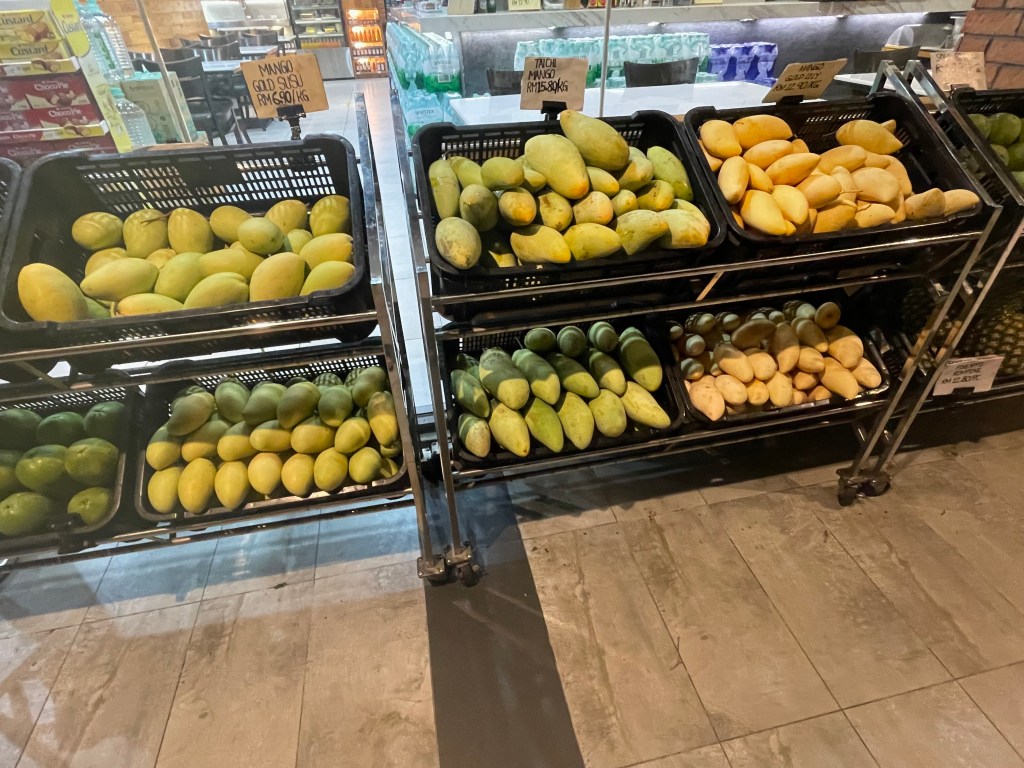
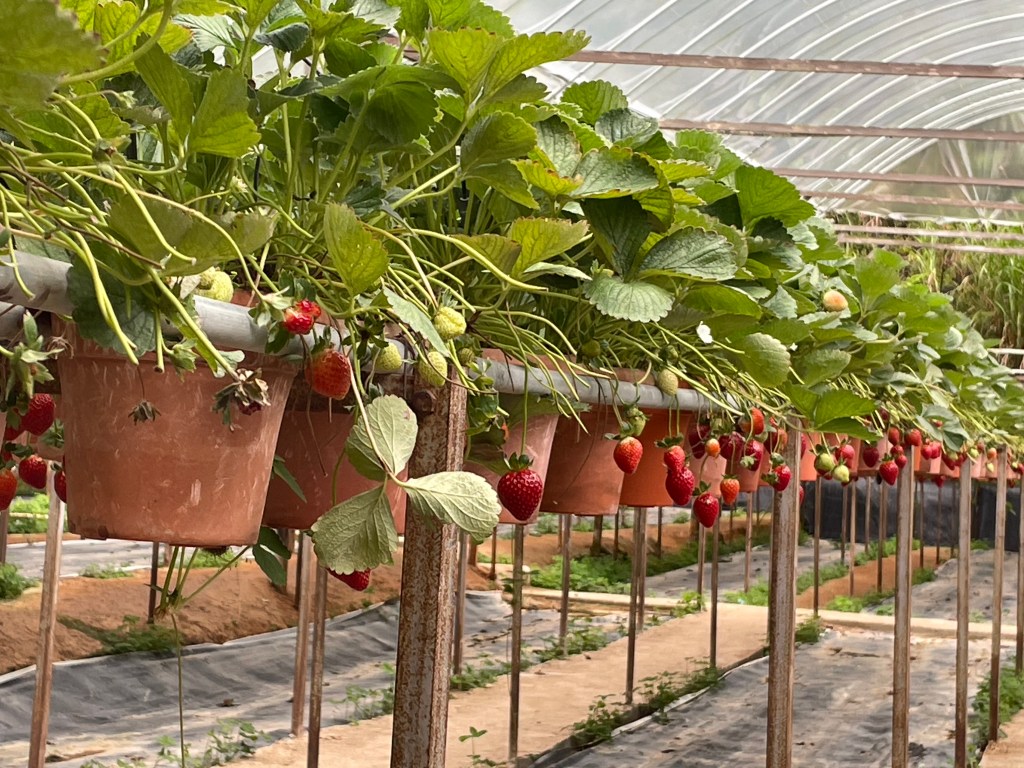
Malaysians who own property will almost always plant mango, jackfruit, coconut and banana trees in their yards. Mangosteens are a possibility as well. Most of these exist in the wild too if you like to forage, as many of the Malays do that live in and near the jungle. I love mangos so continued to enjoy those here. Coconuts are served everywhere, the top chopped open with a straw set inside to sip out the water. I know it’s good for you but it’s not my favorite on its own. I eat jackfruit at home as a meat substitute but never had it as a fruit before. I learned that the young jackfruit is what is chopped up and canned for our store shelves. The mature fruit is something different though. First, it’s huge, two plus feet long and almost a foot wide and has a very tough, knobby peel. The inside is made up of dozens of bright creamy yellow pods, held together with a fibrous structure. Each pod has a big seed that you eat around. The flesh is juicy and not terribly sweet, I liked it. Mangosteens, on the other hand are small, about the size of a tangerine. They have a hard purple outer shell with a white petal like top. You break them open by digging your nails around the middle and then twisting. Inside are small white pods with a black seed inside. They are very creamy and sweet to eat. I also had a pink guava which is shaped liked a small bell pepper. You bite into it like you would an apple, and it’s crisp like an apple but more fibrous and not quite as juicy. Not grown on trees but still wonderful were the strawberries I bought while in the Cameron Highlands. Now, I wouldn’t normally bring strawberries up as they’re easily purchased at home but here they’re different – they have red and white strawberries. The red ones are kind of tart, but the white ones are sweet and creamy. When I first looked at them I thought they were just unripe and was surprised to see them for sale. I had to buy some after trying one, they were so good. The one fruit I didn’t try, which is sold all over south east Asia but is very prominent in Malaysia, is durian. I just couldn’t get past the sour milk, extremely rotten something smell the permeates the air surrounding the stalls that sell it. It’s not allowed in taxis or hotels because the odor lingers for days. I heard mixed reviews on how good it tastes. It looks similar to jackfruit, inside and out – though the knobs are spikier, and they’re rounder and smaller.



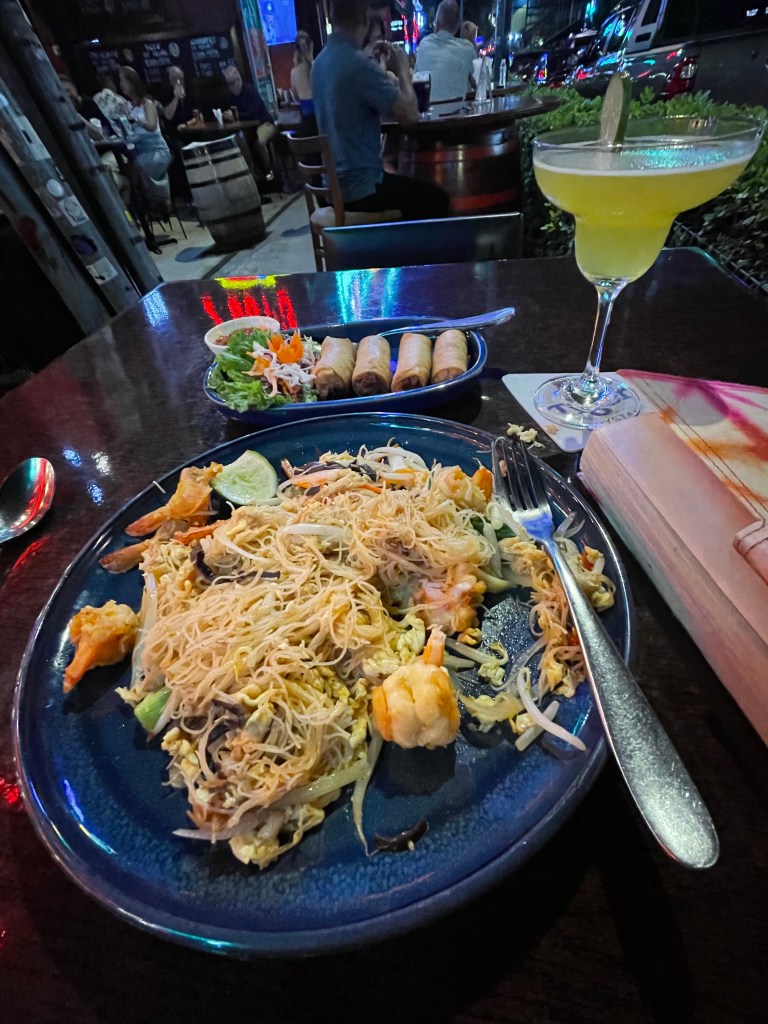
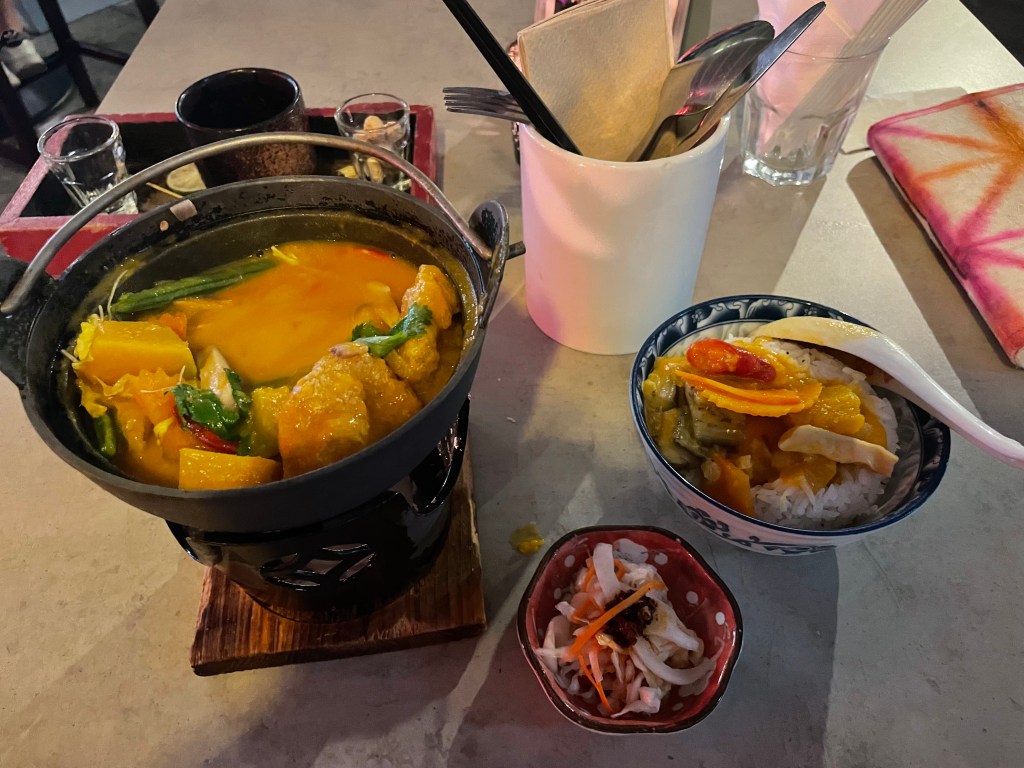
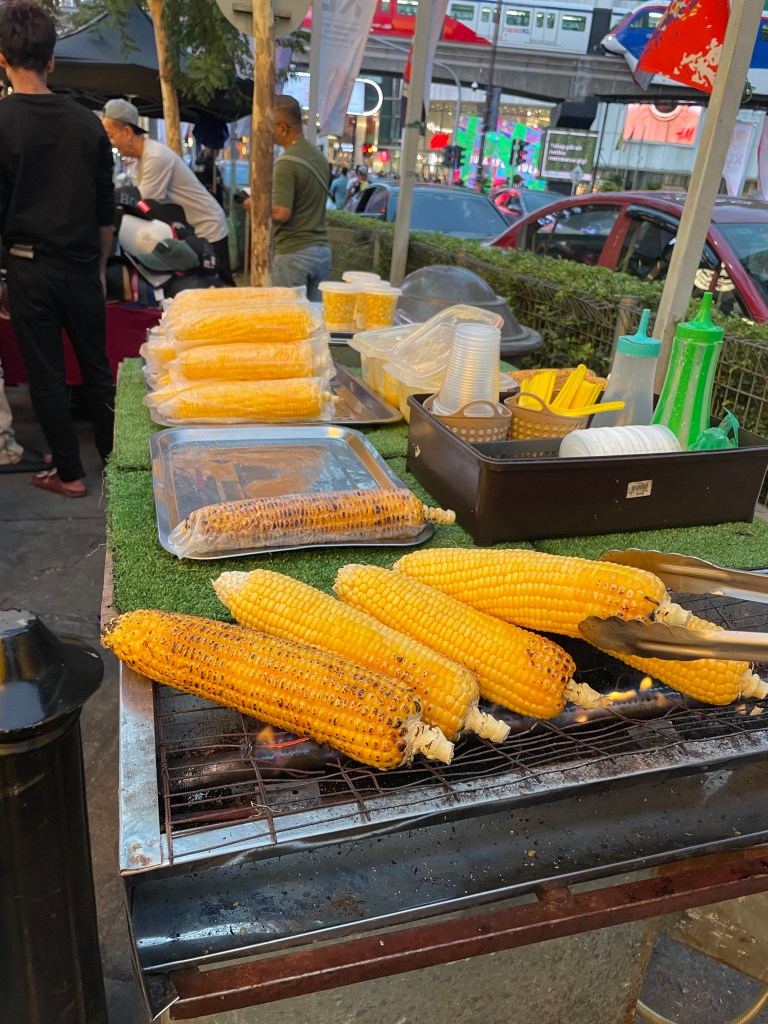
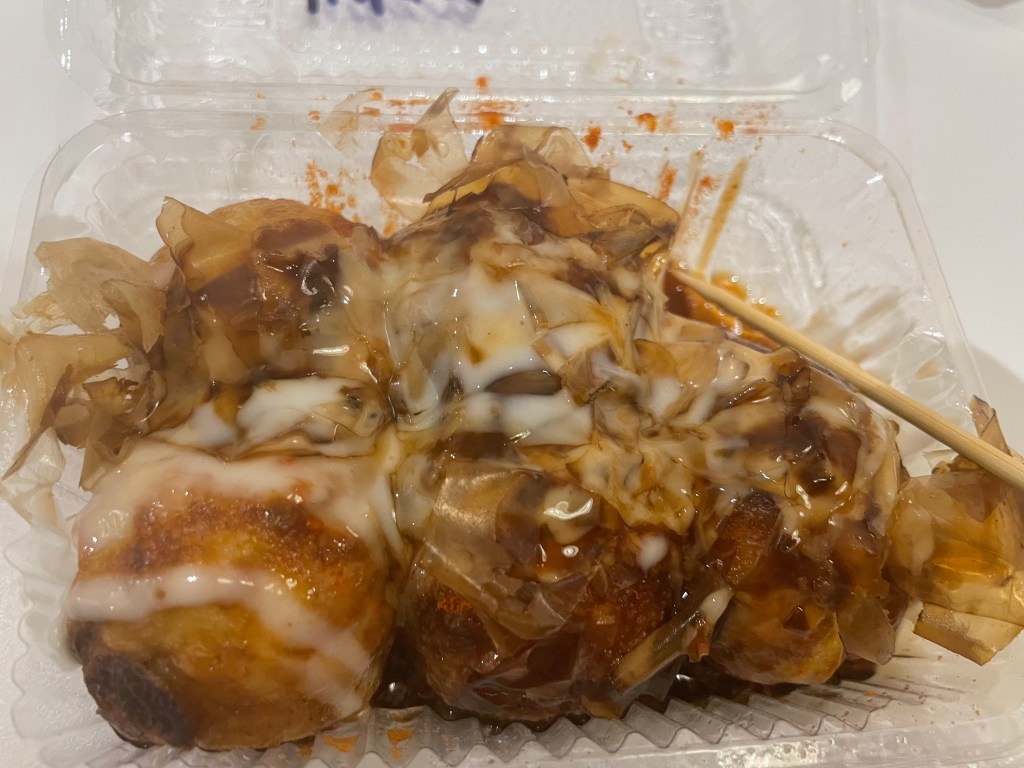
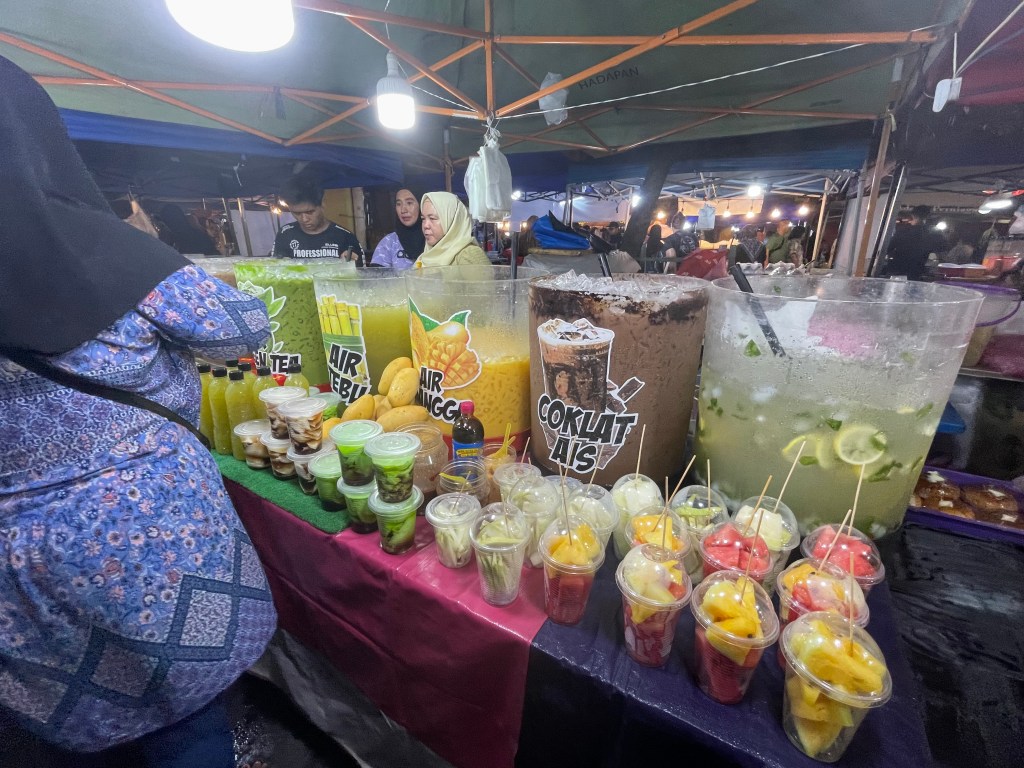
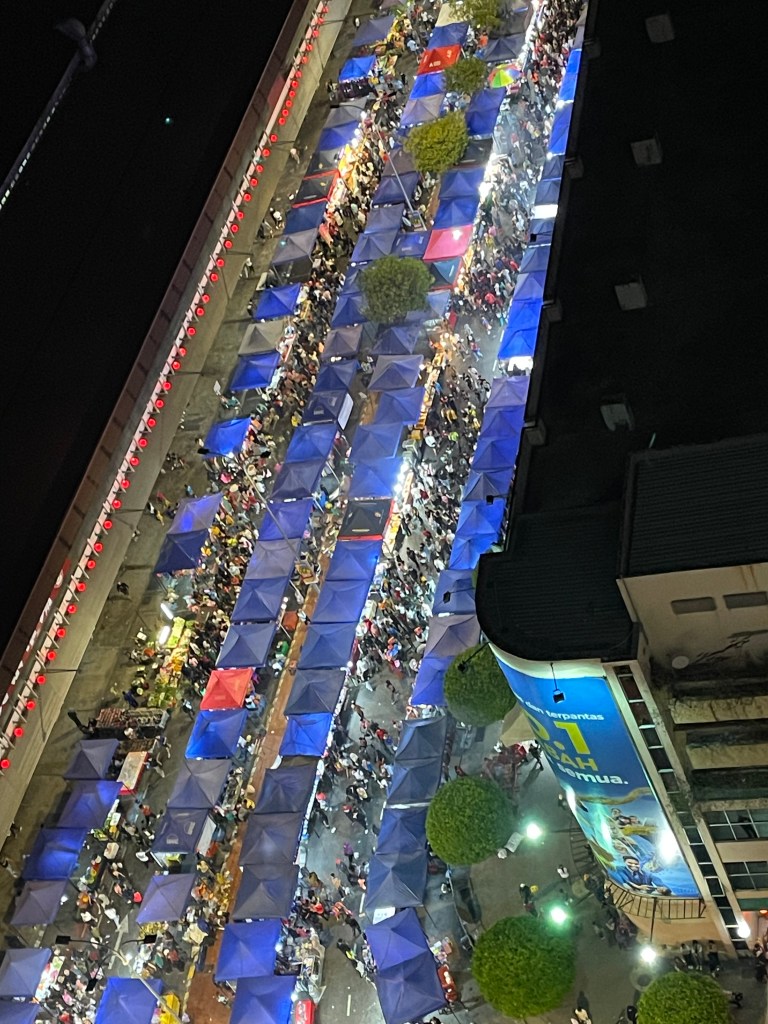
Well, now that we’re on the subject of food, I’m going to be honest – I’m getting tired of noodles and rice. And I have 3 more Asian countries to go! Although I haven’t had them for breakfast since Thailand and Laos they have pretty much been lunch and dinner for weeks. My routine has been, if I had rice for lunch, I’ll have noodles for dinner and visa versa. Granted there are so many different kinds of noodle and rice dishes which helps, but that only goes so far. There are usually a nice assortment of veggies to go with them, lately it’s been okra or lady fingers as they’re called here. I’m not going hungry by any means. And meals are very inexpensive. At one restaurant, I got rice and three sides of vegetables which fed me for two meals for $1.25! On my day trips, lunch was included and served family style with up to seven different dishes – rice of course, two kinds of veggies, a chicken dish, a beef concoction, fish of some kind, calamari once as well as an omelet- always plenty of food. Pork is never served in these settings, as Malaysia is a Muslim country. The reason I’ve eaten so much rice and noodles is because I have been eating at the street markets a lot and that’s what’s available other than satay and meat filled dumplings. I’ve also nibbled on a few other things to get a broader feel for the food. Once I had six little dough balls, about the size of a ping pong ball, which had a hint of shrimp flavor, smothered in two different sauces -I’m not sure what they were. It was interesting. They had lots of donuts at one of the markets, so I had to get one of those, almost got one sprinkled with shredded cheese – I thought it was coconut. I thought it interesting the sweet corn is so popular here. The night markets serve it roasted on the cob, as the filling for waffles, and in cups with evaporated milk. I wasn’t sure where they grew it as in the US it’s on big flat fields across the plains. But here it’s grown on the hillside as many of their other crops. I was sorry that I only found the fish market on my last night in KK, even though it was right across from my AirBnB. Stall after stall of beautiful fresh seafood- different kinds of fish, lobster, shrimp, clams. etc. But I just wasn’t hungry for seafood that night. I wish I had found it sooner. My last night in KL, I splurged and went and had chili crab again. It was a different recipe but just as good. It’s a pain to eat, and you make a big mess which is all kind of fun. They serve it with mantou, a Parker house roll sized yeast bun. Great for soaking up the sauce. Yum.







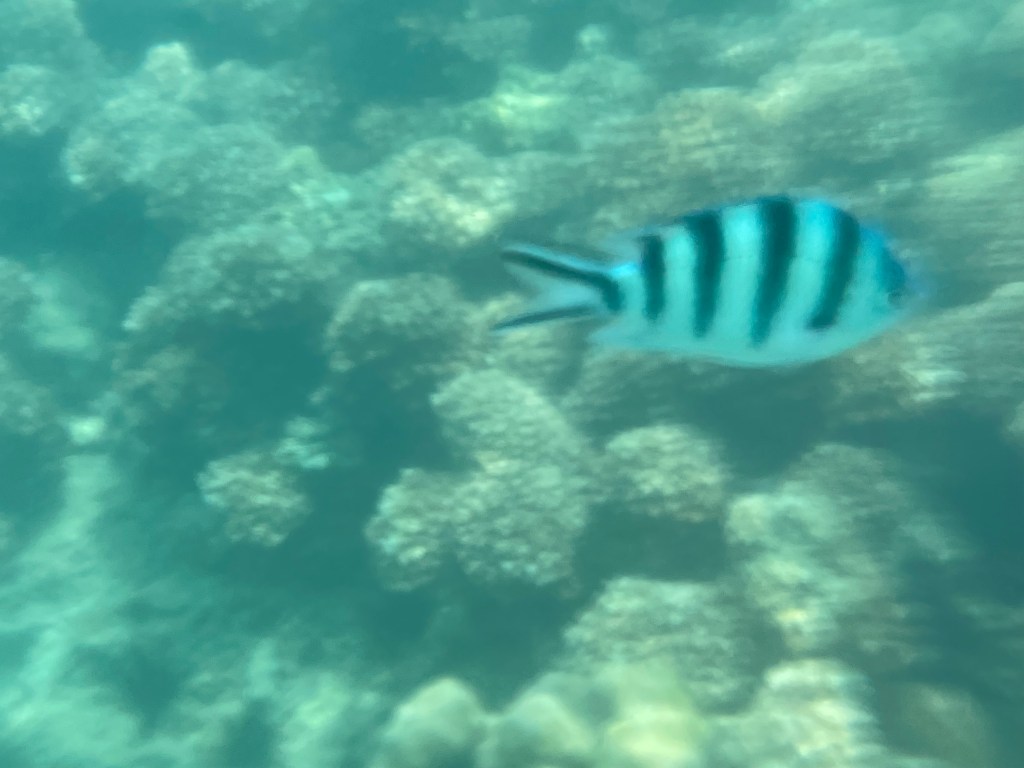
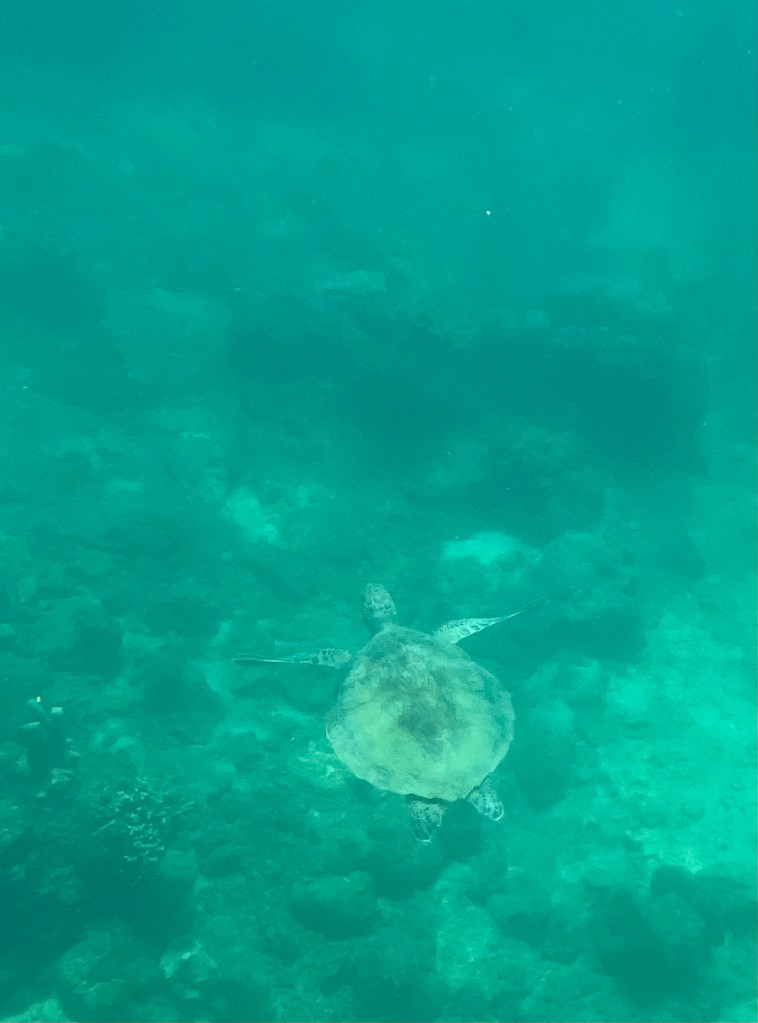
Speaking of fish, I finally got to do some snorkeling. My first day of snorkeling was less than stellar. First they took us out to an island and tried to get us to rent jet skis or ATV’s, neither of which I wanted to do. Second, our snorkel for the morning was canceled because they needed the boat to take some people off the island. I wonder how much they made on that, cynic that I am. While I waited, I snorkeled near the shore but there wasn’t much to see and then combed the beach, finding a unique shell for my Borneo souvenir. I chit chatted with Emma, an English lass teaching school in Hong Kong; her friend, Toffy from Morocco; and Korey, from Arizona, while we enjoyed our lunch. Korey was just forced to sell his business, so at 43 was figuring out what was next in life for him, with a three month trip to southeast Asia. Finally, we got to get into the water with our gear on Nemo’s Reef. It was a circular reef that we could swim around twice in our 45 minutes in the South China Sea. I did see some nice fish and coral even though the water was pretty murky from recent storms. Two day later I went out again. On the boat with me were two ladies from New York, two young women from New Jersey doing a school project abroad in Thailand, and a couple from Australia. We did three stints of 45+ minutes in the water, which was maybe a little chilly but refreshing given how hot the air was. Here we saw lots of fish in so many colors- tiny electric bright blue, iridescent, black and white striped, yellow and white striped, black with white spots and more; and coral- bright green, brown, blue, and orange. Some growing like moss on the rocks and others waving with the movement of the water. We also saw big blue starfish, a black tipped shark, turtles, a small sting ray, a puffer fish and more. I was really tired that day. I actually wondered why I got in the water the 3rd time. Back on the boat, one of the young ladies, who was 25, said she wondered the same thing. I guess it wasn’t because I’m old, whew! I was hesitant to take my phone underwater as I need it every day for navigation, pictures, reservations, airline tickets, and research but I took a risk. The photos aren’t great but they are better than nothing.



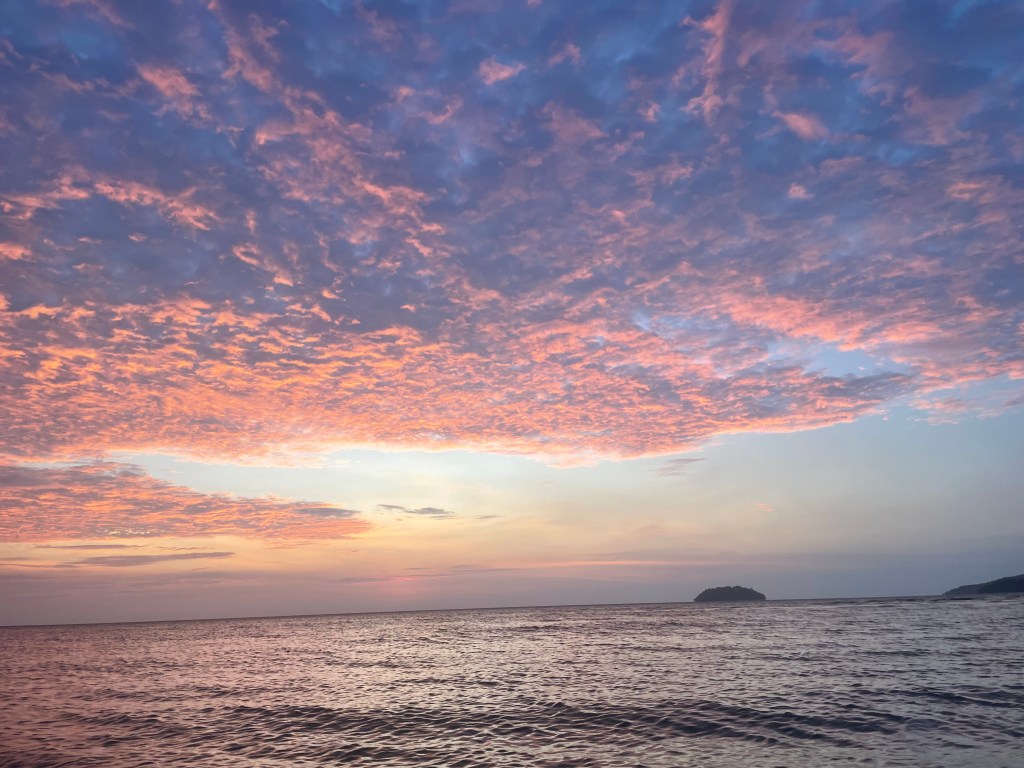
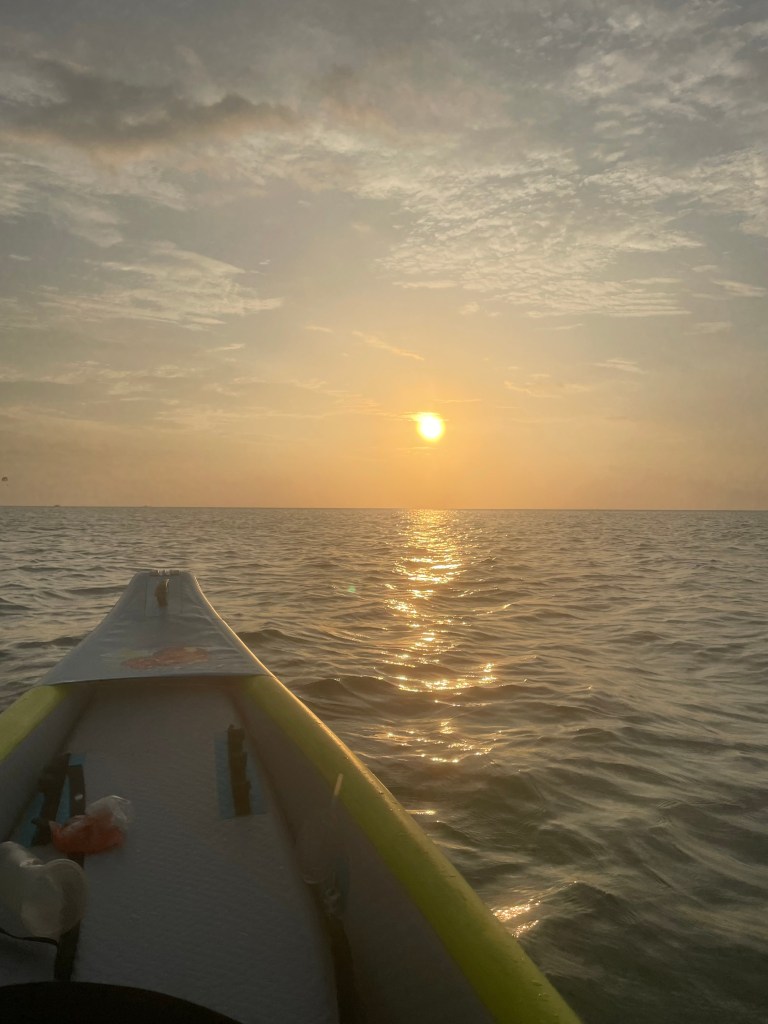
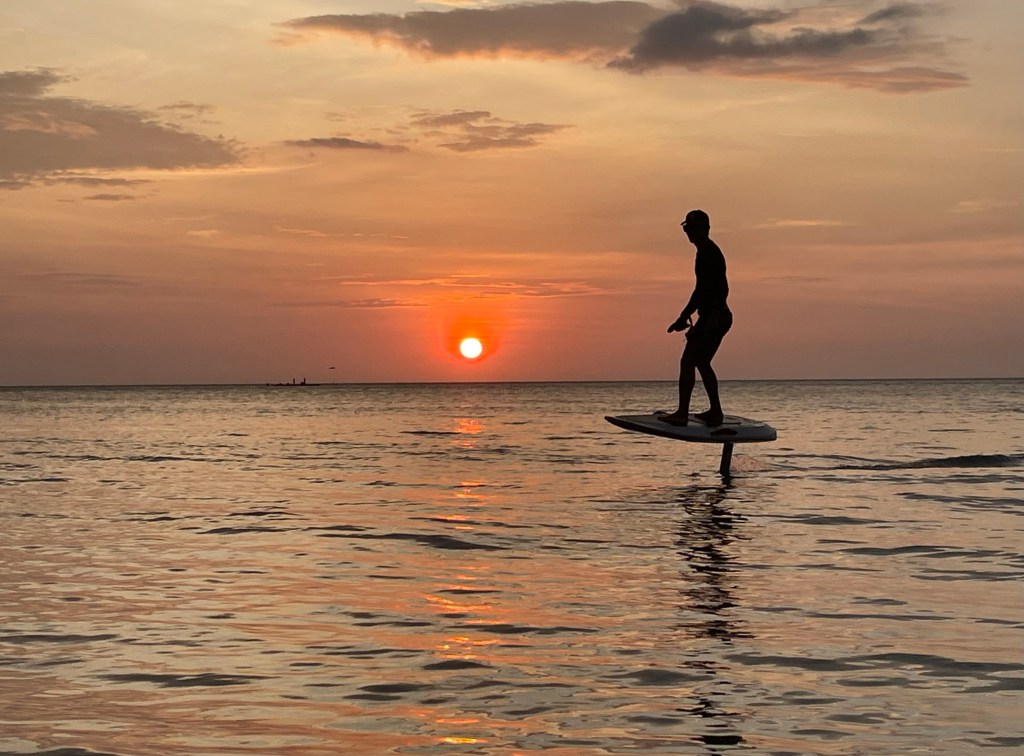
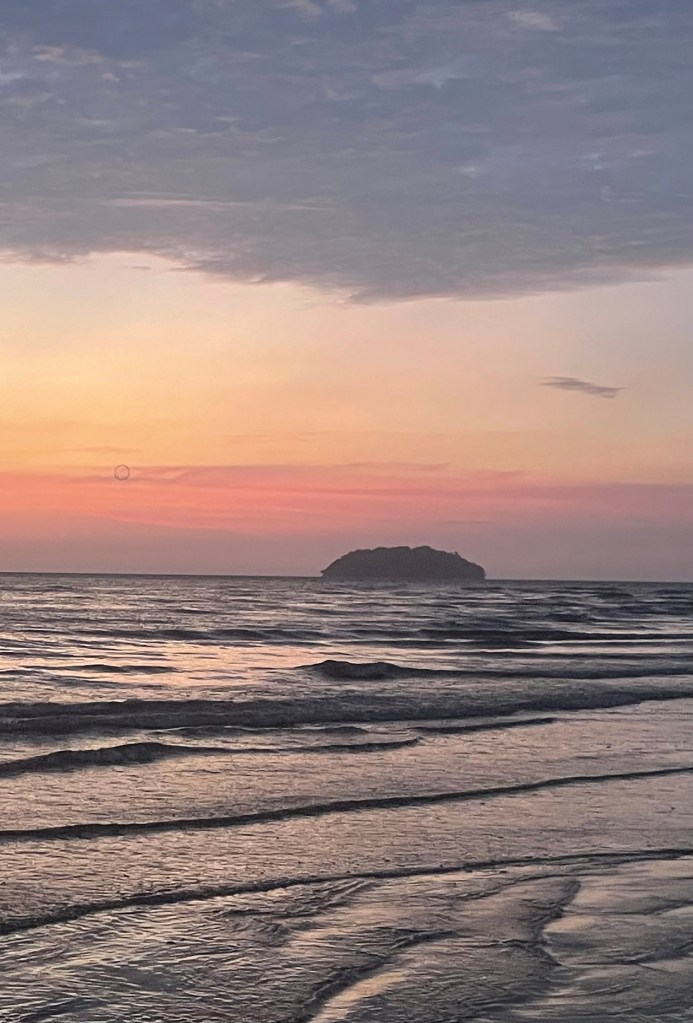
The water sports was the main reason I went to KK. My first foray into the water was kayaking. I signed up for a group paddle – I thought. But when I got there they gave me a kayak, a paddle, pointed out the bay I was to play around in and said they’d see me in two hours. I was pretty unhappy as kayaking back and forth across the sound didn’t seem like much fun. And by myself besides. But I ended up loving it. It was a tough paddle as the water was very choppy and I was in a double inflatable kayak, so the prow was high in the air and caught the wind. It only took about 20 minutes or so to go across the area outlined for me, with the wind at my back, but almost 90 minutes to return. Now, I did stop and take a lot of pictures of the sunset and sit quietly and enjoy the solitude. Then I didn’t know where I was supposed to put out as I didn’t mark the spot when I left. That was a little worrisome but I ended up where I was supposed to be, tired but happy. Once I decided to come to KK, I thought I would hike Mt Kinabalu, only to find out you needed to reserve a bunk at the hostel at least 4 months in advance. It’s a two day hike and if you don’t have a place to stay you don’t go up the mountain.
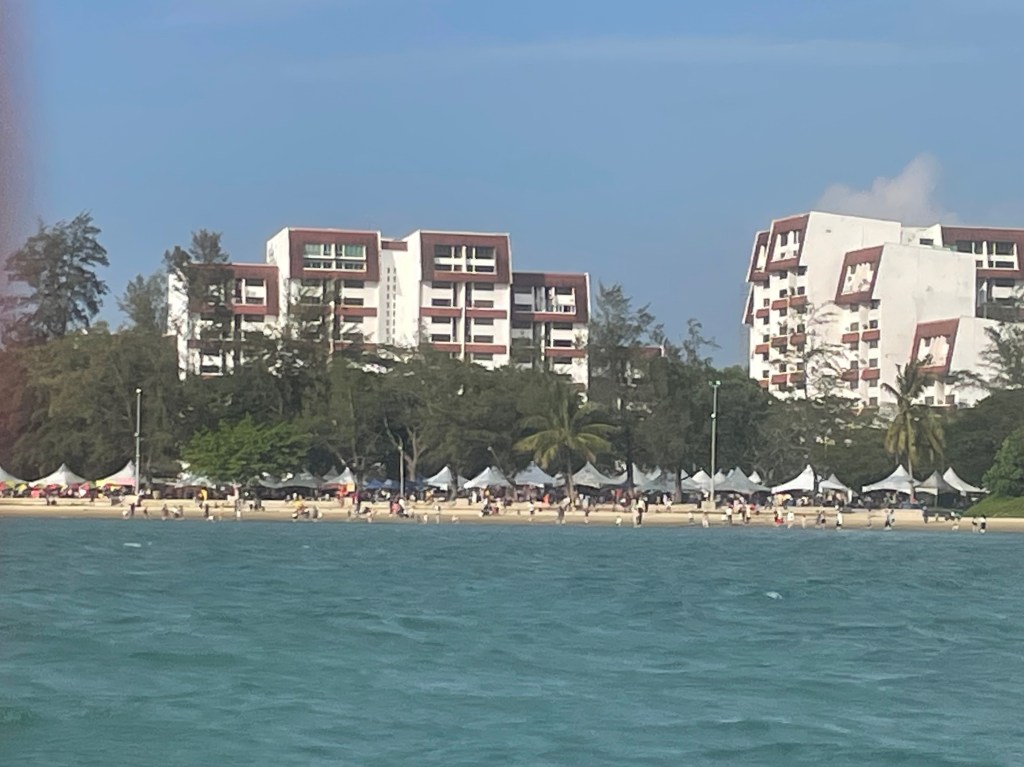

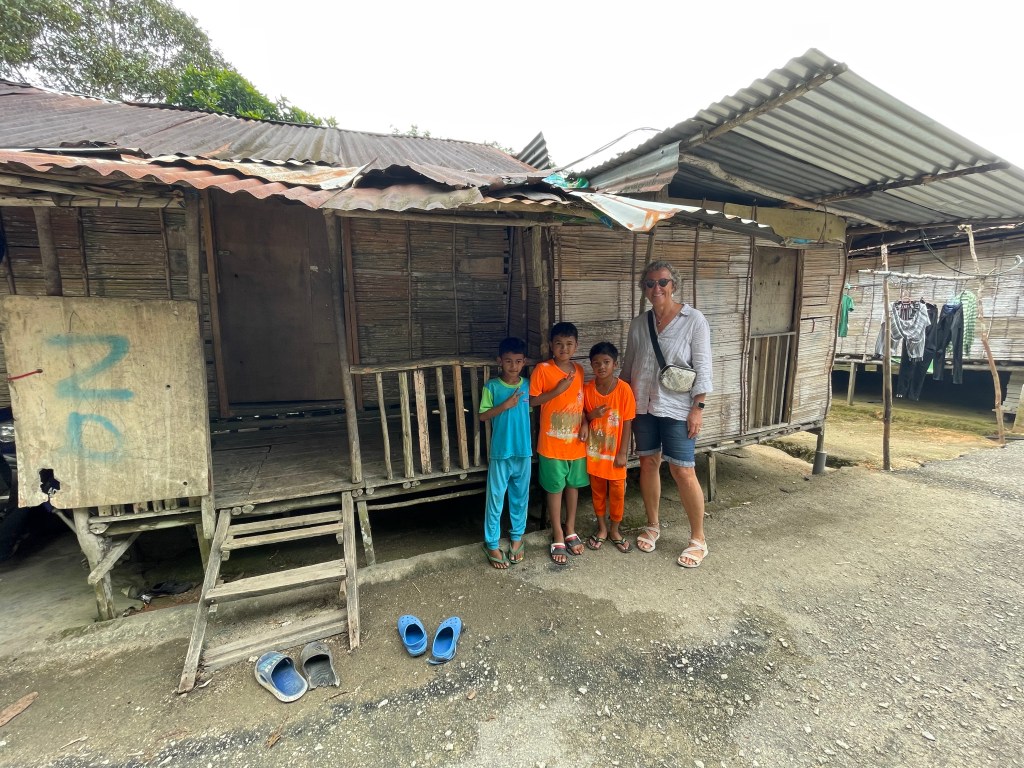
I really enjoyed meeting everyone on my day trips. Korey and I went out for Mexican food after our day of snorkeling and had a nice conversation about life and what’s next. Jonathan, the gentleman from Angola, and I talked for hours on the bus to Mt. Kinabalu about the state of the world, prejudice and power, and swimming. I got to know a little bit about Helissa, a native Malay, who sat next to me on my boat ride. She was very engaging. Her and her family were enjoying the island as a get away day, it was a holiday and they did not have to work. She was well traveled and the CEO of her family business which I got the impression was very prosperous. I met another native Malay on the Mt. Kinabalu tour while I was waiting for the bus to pick us up at a stop at a dairy. She started the conversation even though she was on the phone, her curiosity got the better of her. She was there with friends but had seen the dairy too many times to tour again. It was funny when she compared our skin colors, which were almost exactly the same. She thinks she’s too dark. My AirBnB in KK was very crowded. Sometimes I’d have to wait for the second or third elevator to get a ride up to the 20th floor. So many people were traveling during the Chinese New Year holidays. I’d smile at all the kids- some would smile back and some would hide in their father’s shoulder or behind their mother’s legs. But all of them would peer at me as if some strange being was in their mist. And I guess I was, as I again was much taller than anyone around and the only Caucasian. I would ask their parents if it was my gray, curly hair? And they would smile.
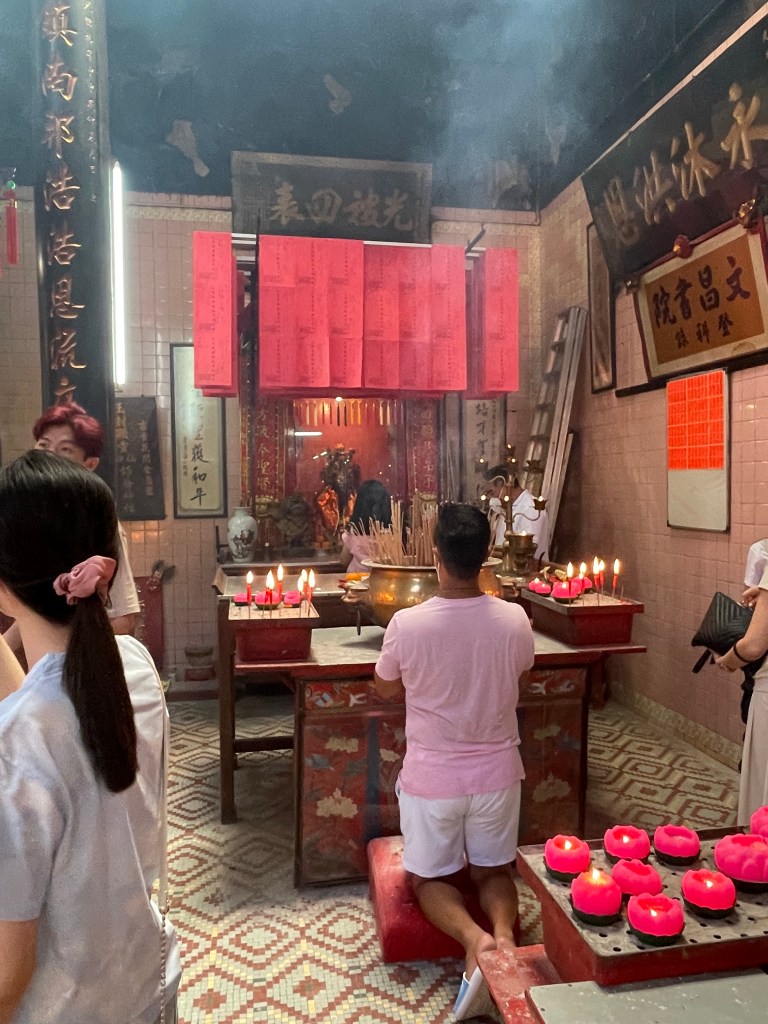

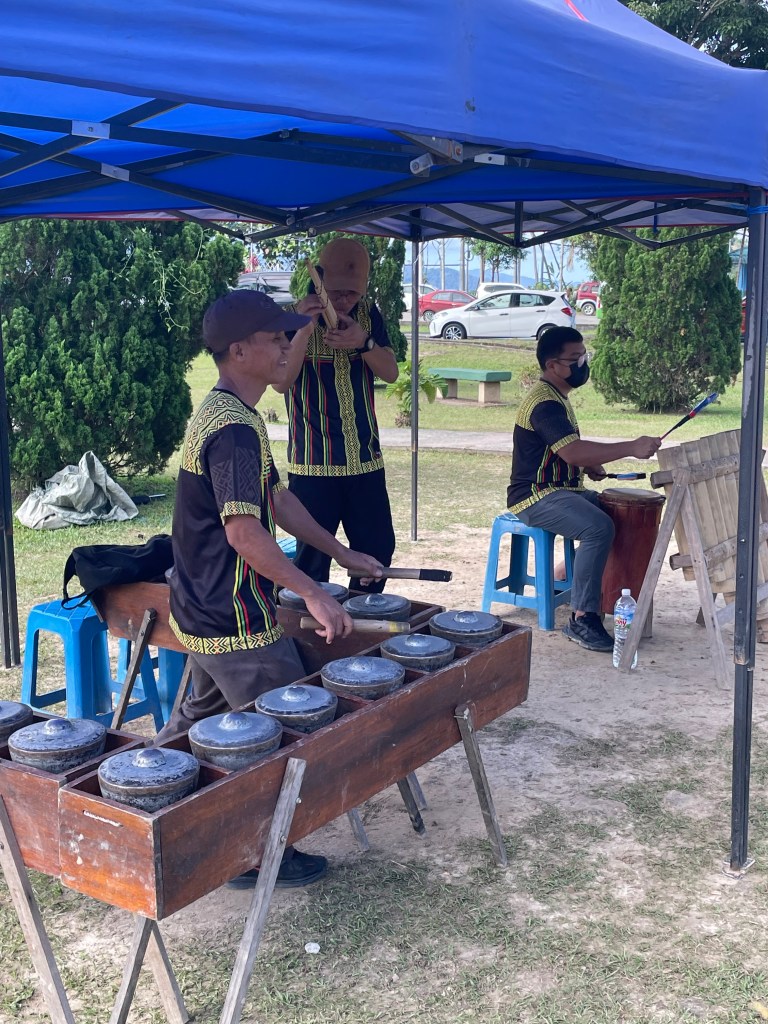
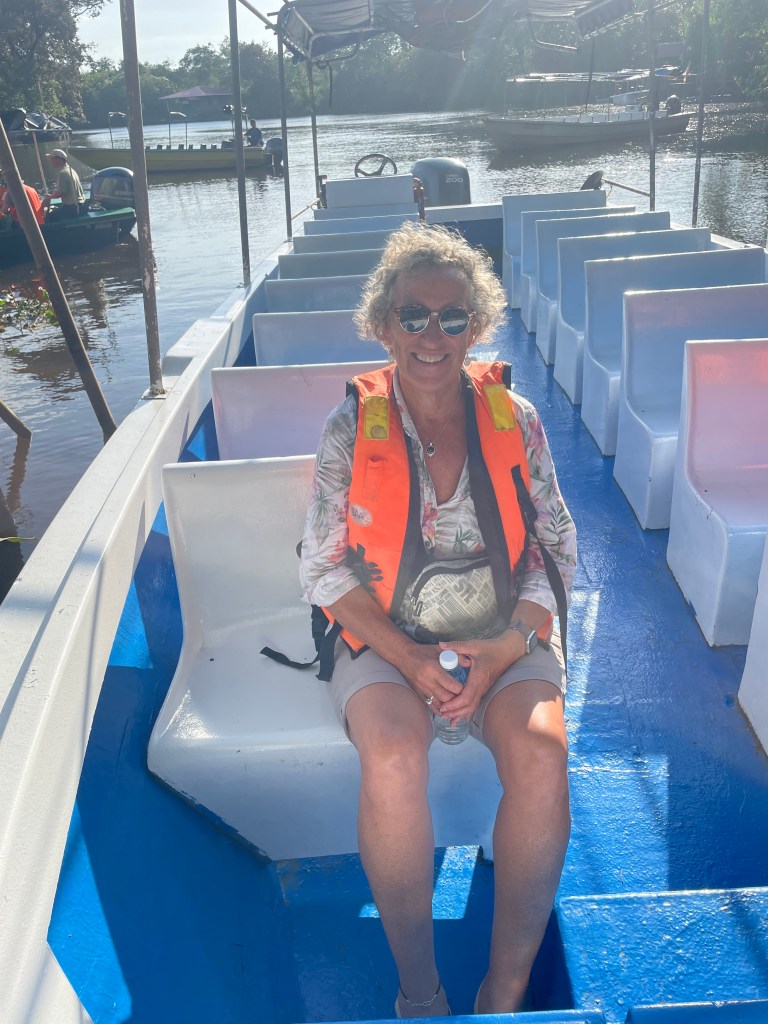
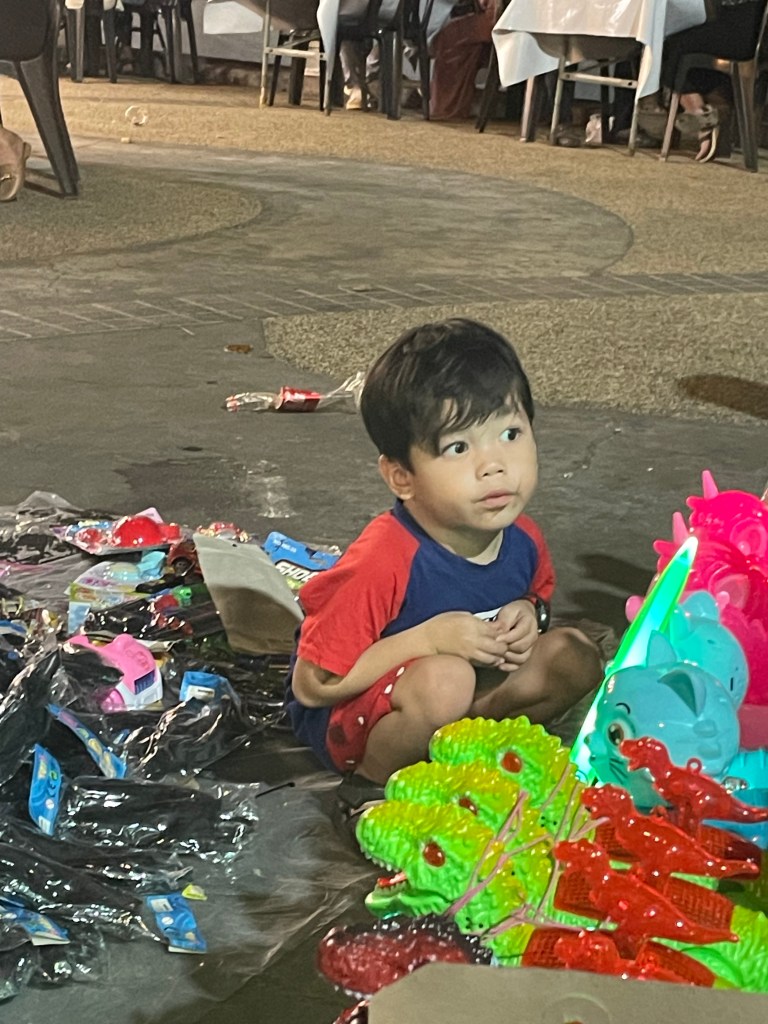
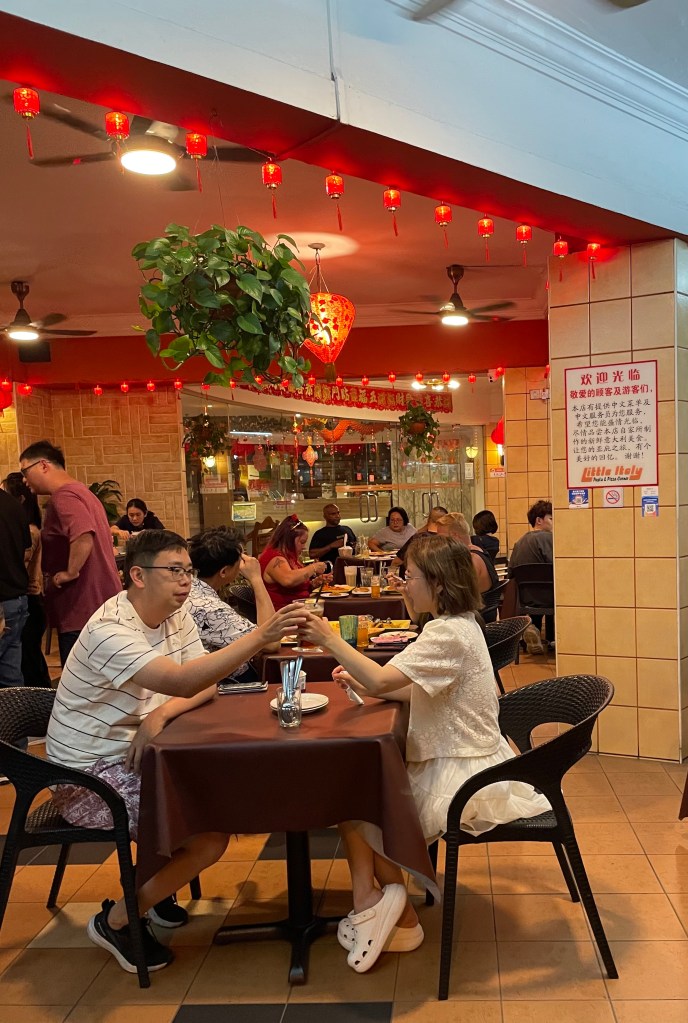
I try to smile at people when I catch their eye and for the most part, wherever I have gone they have smiled back. Here though the Malaysians often smile at me first and then follow up with ‘where are you from?” And they don’t stop at smiling, your Grab driver – even if he’s been a curmudgeon, tour guide, AirBnB host, and servers all say think you for coming to Malaysia. Followed up with “I hope you come back very soon.” This is the first country I have been in where I have been consistently thanked for supporting their economy. Malaysia is a big tourist spot for other Asians as shopping is cheap here and there is lots of it-luxury brands to bargain basements. The streets are lined with mall after mall, even in KK, a city of 500,000. And although many Asians live here, especially Chinese and Indians, I don’t get the impression they’re well liked by the locals. And I can somewhat understand it. But a former Prime Minister explains it better than I can- “The Malays are spiritually inclined, tolerant, and easy-going. The non-Malays, and especially the Chinese, are materialistic, aggressive, and have an appetite for work.” – Mahathir Mohamad. I saw the aggression played out as they pushed their way into the elevators, not even waiting for those inside to come out. One fun and rather incongruous moment, was going to an Italian restaurant in KK and seeing tables full of Asians eating pasta and pizza. Similar, I guess, to southerners enjoying Italian food in Nashville.
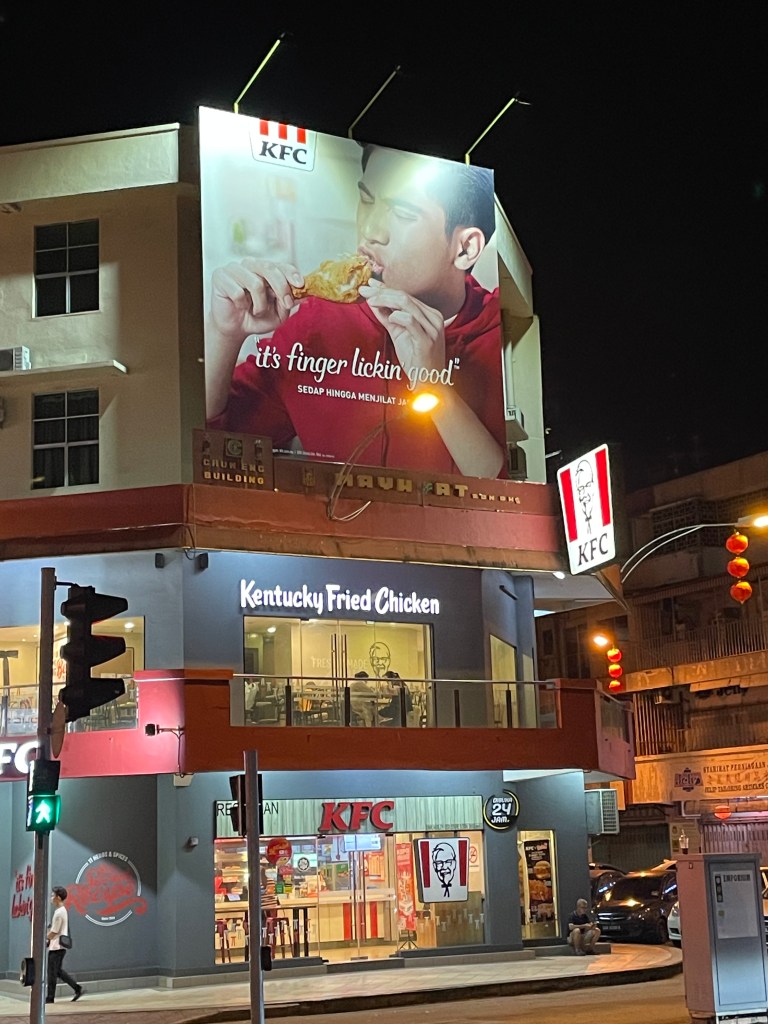


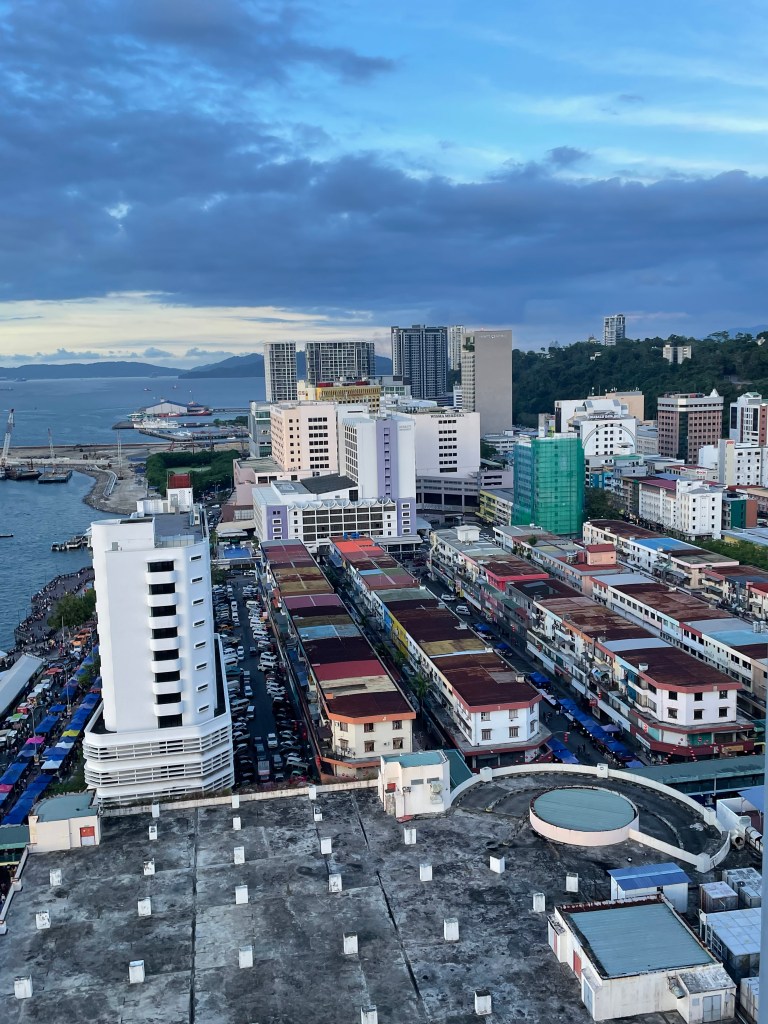
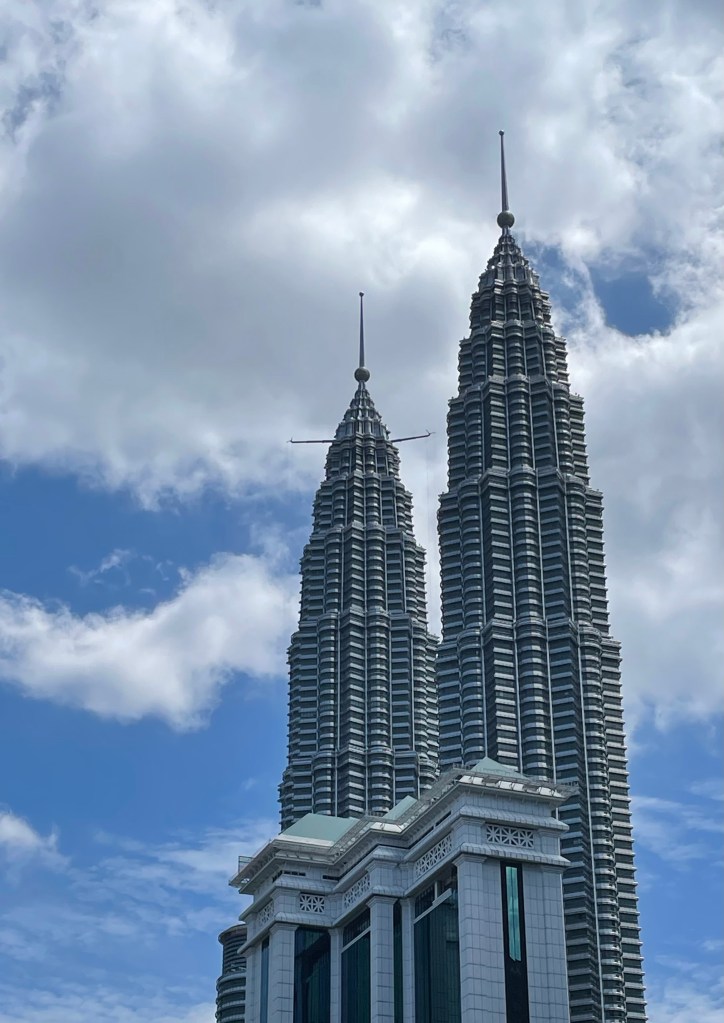
In the tourist parts of KK and KL, there was a very exciting energy, lots of lights, lanterns, neon, and a great congregation of people from many parts of Asia, with an occasional European thrown in for good measure. Chinese New Year added a level of buzz that may not always exist in these cities. Both KK and KL had a weird mix of brand new fancy towers and high end shopping malls intermixed with two to three story run down structures and older malls that had seen better days. It was a stark difference from Singapore which was generally new, clean and shiny though had the same energetic vibe. I think in America we tend to segregate our ‘low-end’ areas – kind of out of sight, out of mind. Where here those areas were not easily avoided, you walked through them everywhere you went. I never felt unsafe, even in the areas where large numbers of homeless had congregated. Crimes are severely punished here with very little leniency. We’ve had numerous tough on crime eras in the US but it never seemed to make an impact like it does here. Korey and I talked about this and his thought was that our justice system is not as quick to act and mete out punishment due to lots of appeals, etc – sound familiar? I guess that’s true in some circumstances but it also seems that a lot of people, especially those of color and without resources, are thrown in jail or prison with very little, if any, evidence. I’m not sure why it works here, but the cities feel very safe and its citizens are aware of what will happen to them if they commit a crime. A lot of people in America, including some of my friends that live in very nice areas of town, worry about the crime in their neighborhoods and in the country.
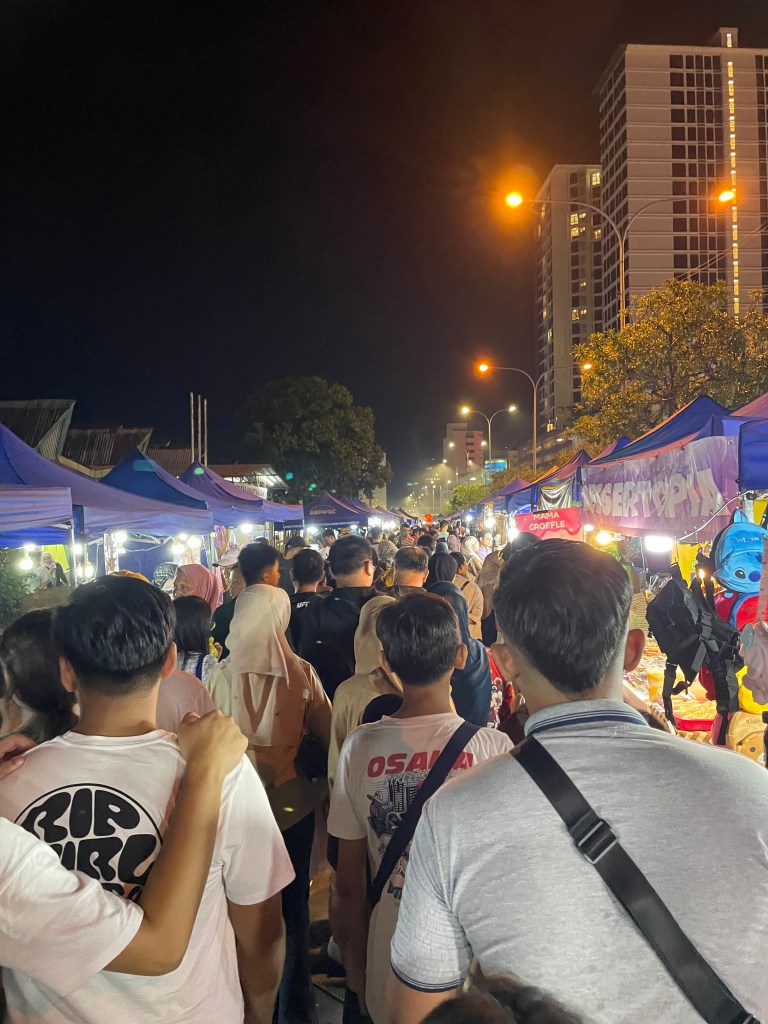
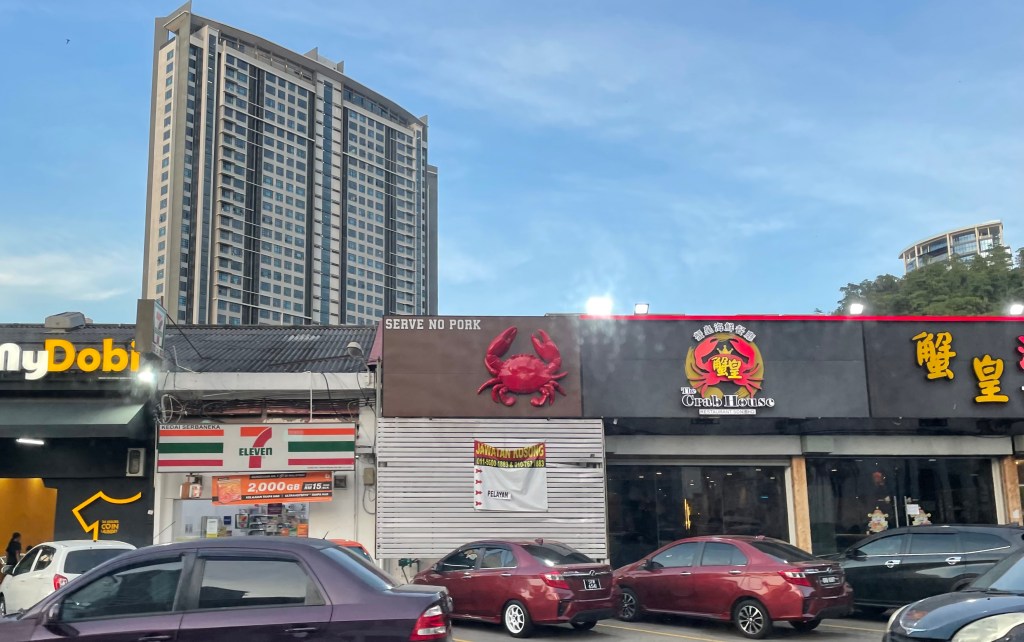


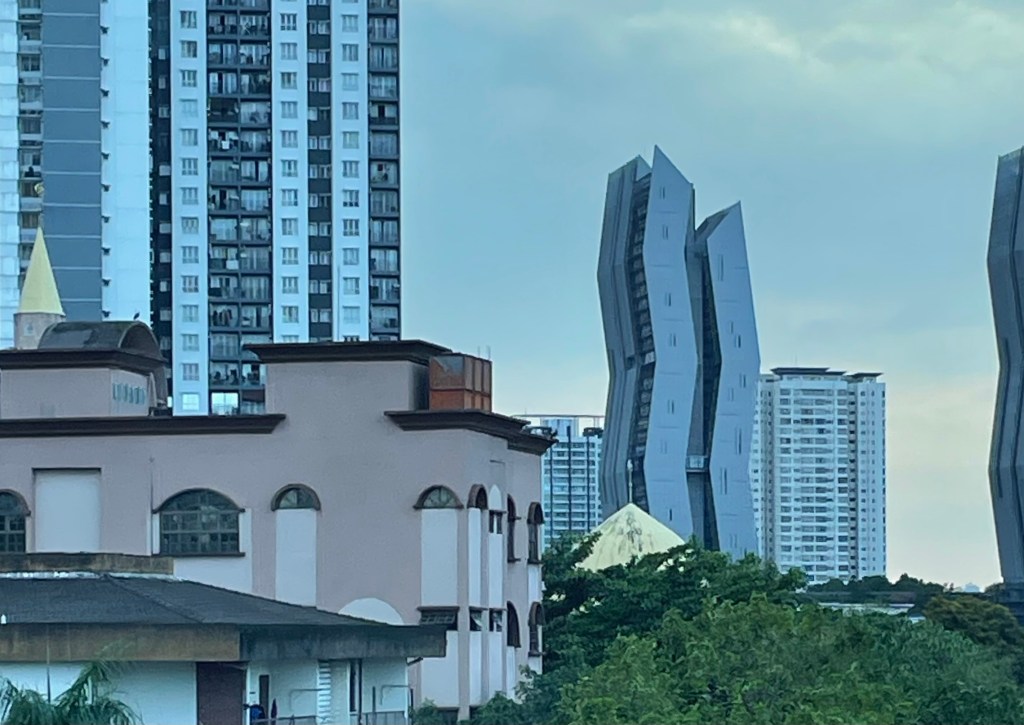


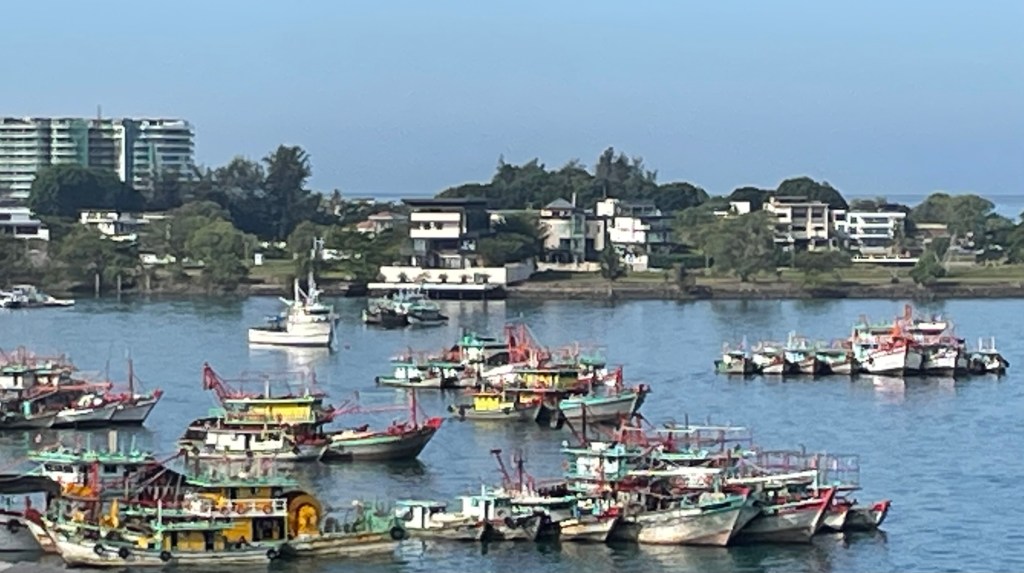
To round out my time, I started out with bike tour in KL, riding 14 km in 4 hours. Almost 9 miles in the heat and humidity. I hiked through Chinatown, the Central Market and several night markets in KL. I walked a lot in both cities actually, wandering through streets just to get the feel of the areas. I purchased two new suitcases. One, because the airport busted the new one I bought in Australia and the other one to store somethings at my hotel in Osaka while I climb the Komano Kodo trail. They were relatively inexpensive here, but feel a little flimsy. I climbed 272 steps to reach the Hindu temples at Batu caves. I continued to work on my taxes and am getting very close to being finished. I took a batik class and produced a masterpiece to take home. Batik is one of the well-known crafts of Malaysia. My AirBnBs were very nice. I especially loved my one in KK as it overlooked the sea and I could watch the boats dart across the sound to distance islands, looking like fireflies in the night. I had a little balcony where I ate my breakfast and sometimes my dinner, enjoying the calm above the busy city beneath me.





A few more fun facts. There are 36 million people in Malaysia, 60-65% are Malaysian Muslims, 25% Chinese- mostly Buddhist and 7% Indian. Malaya – this is the peninsula, was first ‘founded’ by the Portuguese, then the Dutch and English. They were occupied by the Japanese during WWII. They gained their independence in 1957 and then formed the Malaysia Federation in 1963, combining Malaya, Sabah, Sarawak and Singapore. Singapore left the alliance in 1965 over political and religious differences. The English came when tin was found and it became a major export product until the price dropped and it became too expensive to mine. The English planted rubber trees as well, another industry that thrived and then plummeted. Besides palm oil, Malaysia is first in the world in producing latex gloves and a large percentage of their population is engaged in the assembly of electronics, shoes and other items. Almost everyone in Malaysia is dressed in the ubiquitous jeans and t-shirts, the exception being a small percentage of woman in long gowns. There are a lot of head scarfs to be seen however. In several hotels there was no floor 14, like 13 in the US it s an unlucky number.


Reading List:
The Ghost Cave by Elsie Sze
The House of Doors by Tan Twan Eng
Next Up: Japan by way of Hong Kong (which I’ll write about when I finish my time in China)


 Where in the World is Debra Grimes?