“You find things when you’re looking hard for other things. The trick is to be awake- which, granted is harder than it seems.” – Linda Leaming
November 12-22, 2023
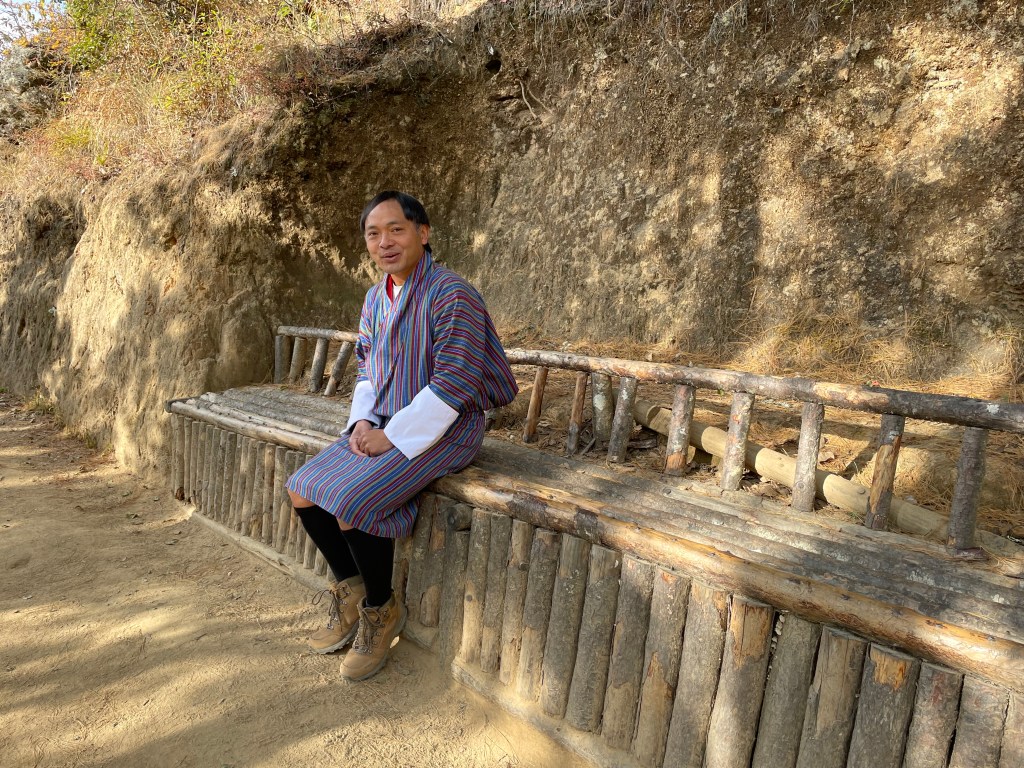
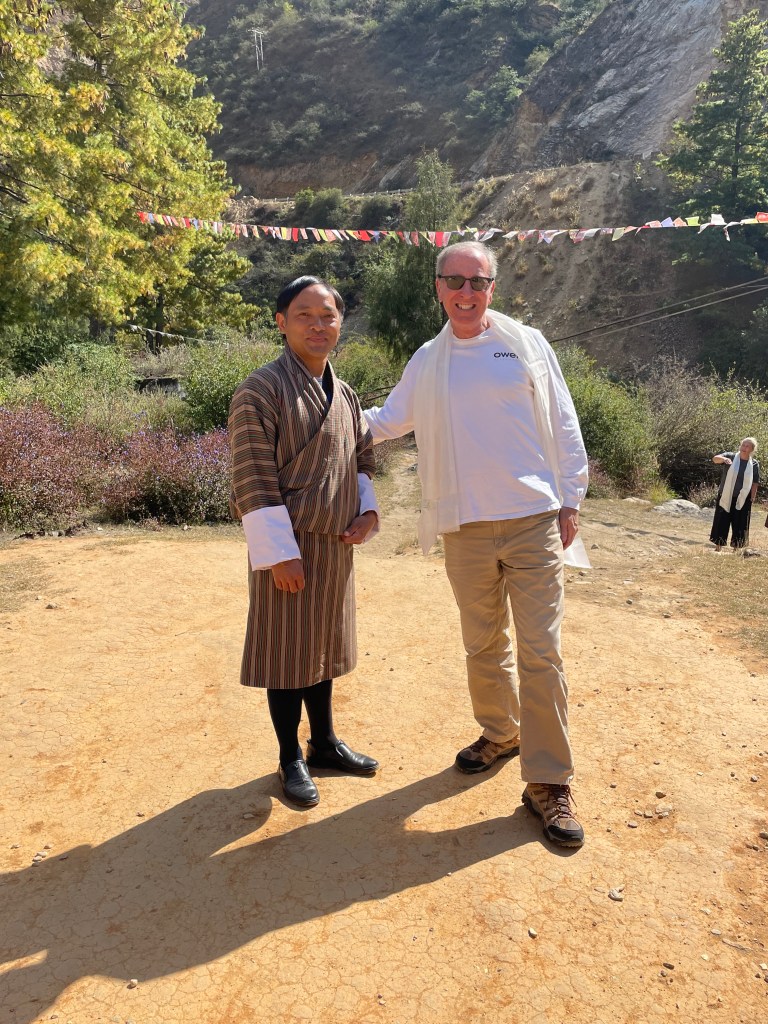
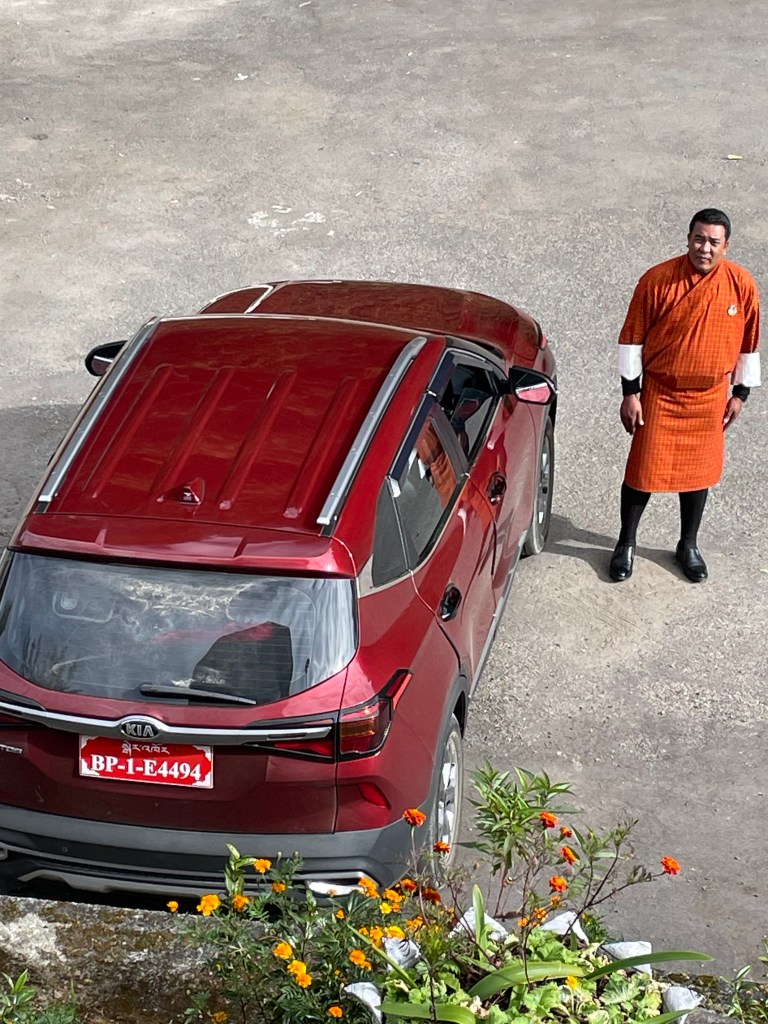
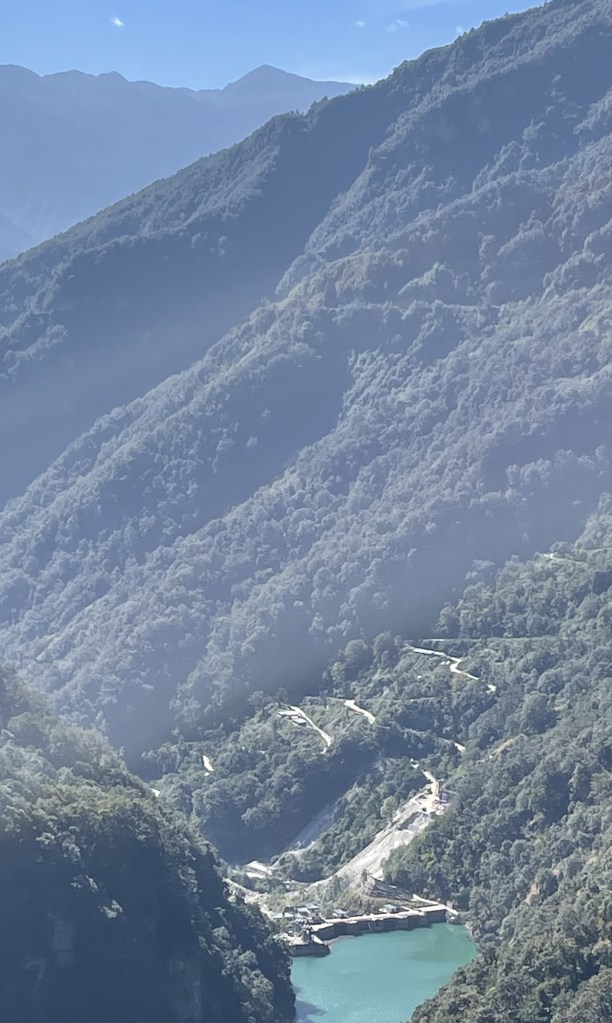
I had a wonderful 12 days in Bhutan with three awesome men. I was pleasantly surprised when a classmate, from the Owen School of Business at Vanderbilt University, decided to join me here. It was a pleasure to travel with Brad Eskind, a true Southern gentleman. He was funny, energetic – after the jet lag wore off, entertaining, a great partner in each of our adventures and I loved learning more about him. Chungdu, our guide, a very gentle soul, was full of marvelous stories at each of our stops, extremely patient and accommodating. No questions went unanswered, even what he wrote under his gho. I think I may have embarassed him more than once. I wish I could share his stories with you, but I wouldn’t do them justice, you’ll need to visit and hear them yourself. Sanjay, our driver, was a man of few words and negotiated the steep, windy, narrow roads and mountain passes – it was snowing at one 11,600 foot mountain top, throughout Bhutan with aplomb. My door was opened for me more times on this trip, then I think in my whole life. Our Kia was always spotless and he placed a new bottle of water in our car door pocket everyday.
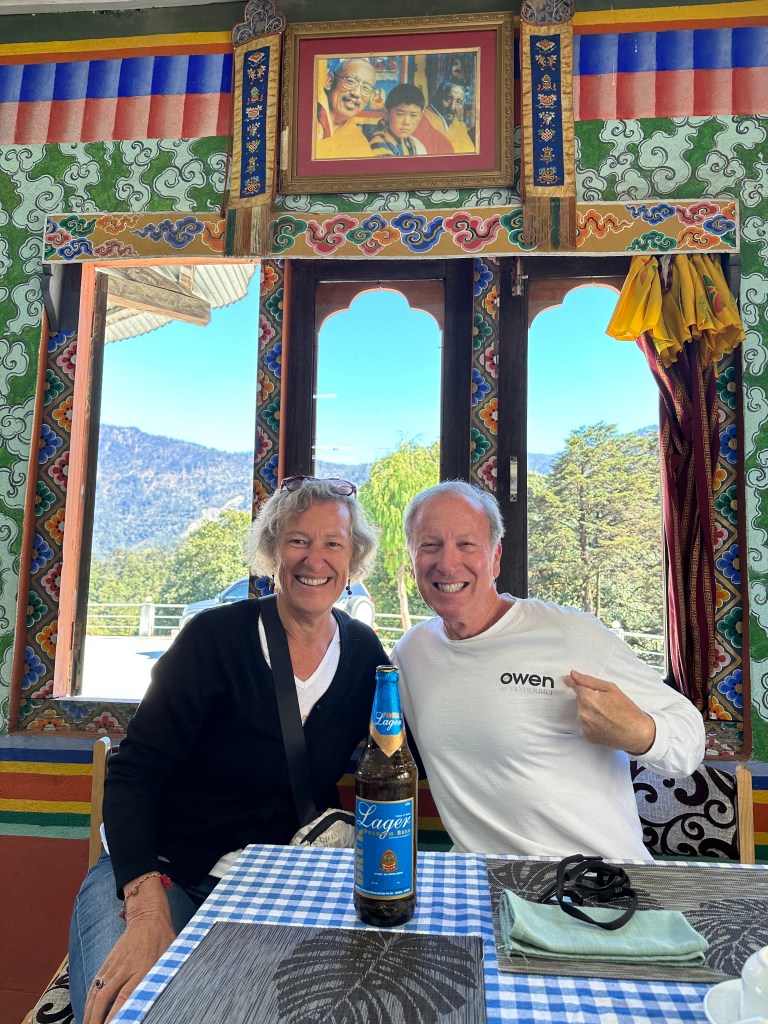
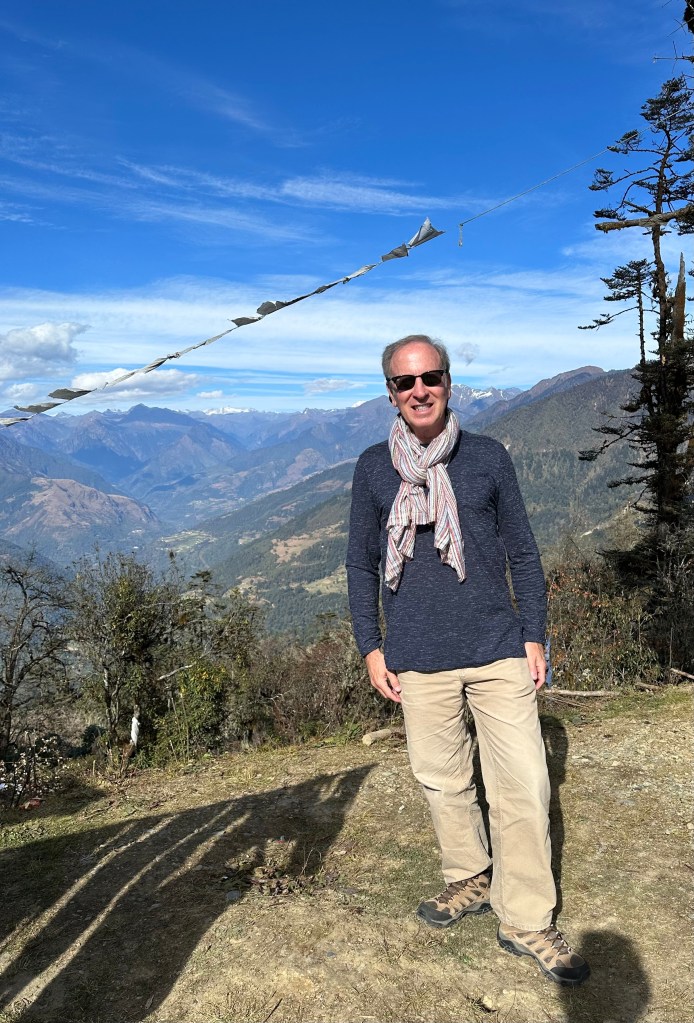
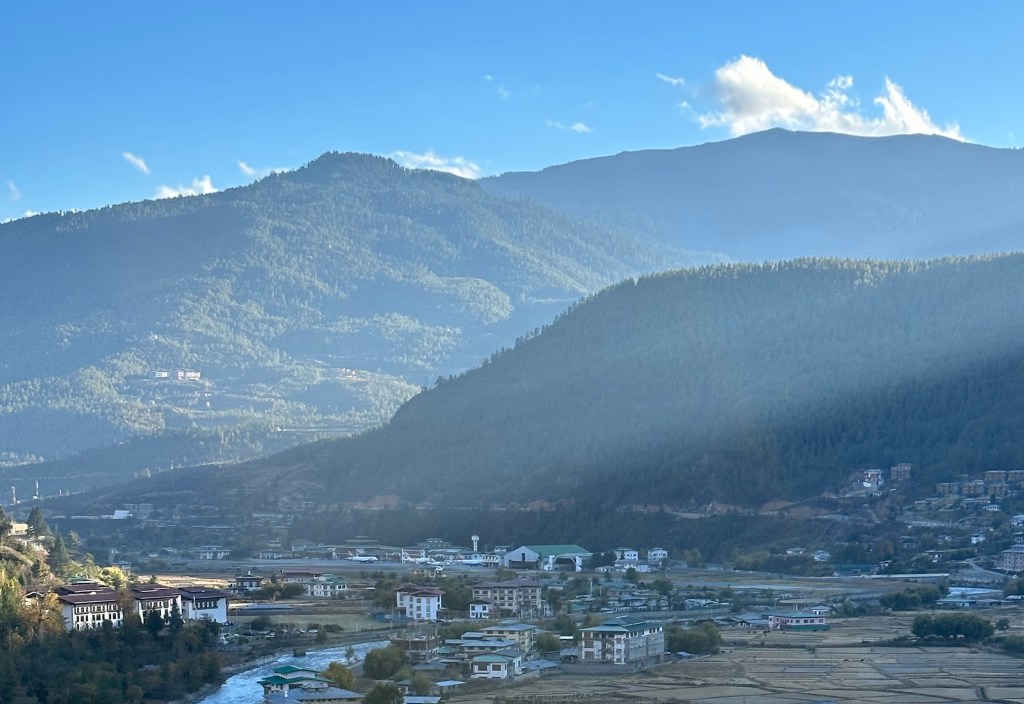
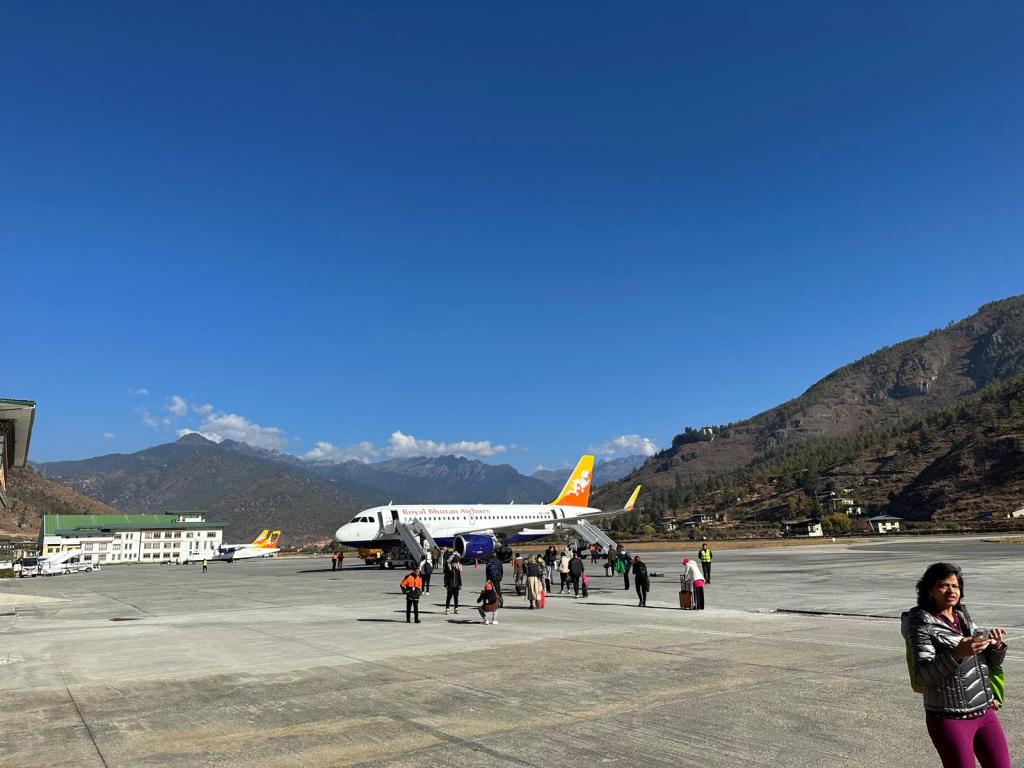
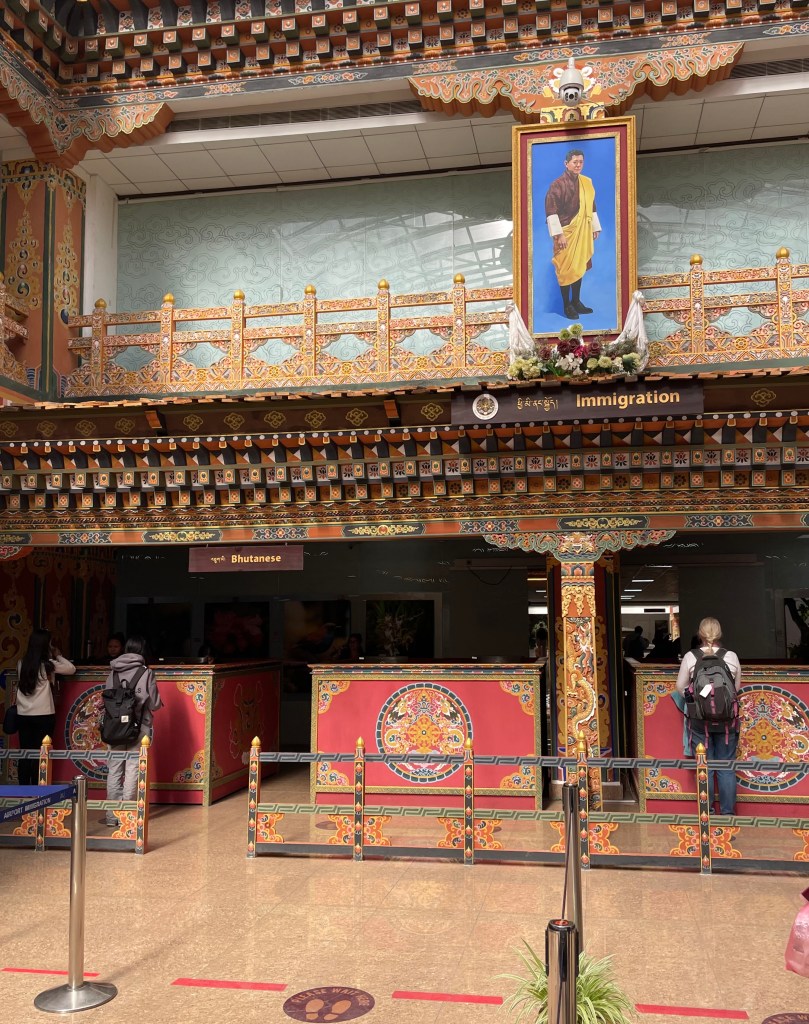
When Brad and I first landed in Paro, we loved everything we saw. We were grateful for landing safely at an airport where only a very few pilots can land or takeoff. There is no radar at the airfield, high mountains surround the runway, the altitude of over 7,000 feet restricts the performance of the aircraft, the pilot can only see the runway for a few brief minutes before landing, and they use different instrumentation then other airports – all making it one of the most dangerous airports in the world. We stepped off the airplane to beautiful blue skies and majestic mountains where ever we looked. The terminal was very pretty, built in the Bhutanese manner which we would see repeated throughout the country, multiple levels of notched and carved wood along the eaves and around the doors and windows, painted in array of brightly colored symbols. As we approached immigration, one open desk quickly grew into 3 then 5 and we expeditiously and politely got our passports stamped. The building was very clean and everything we needed was right there – rest rooms and ATM’s.

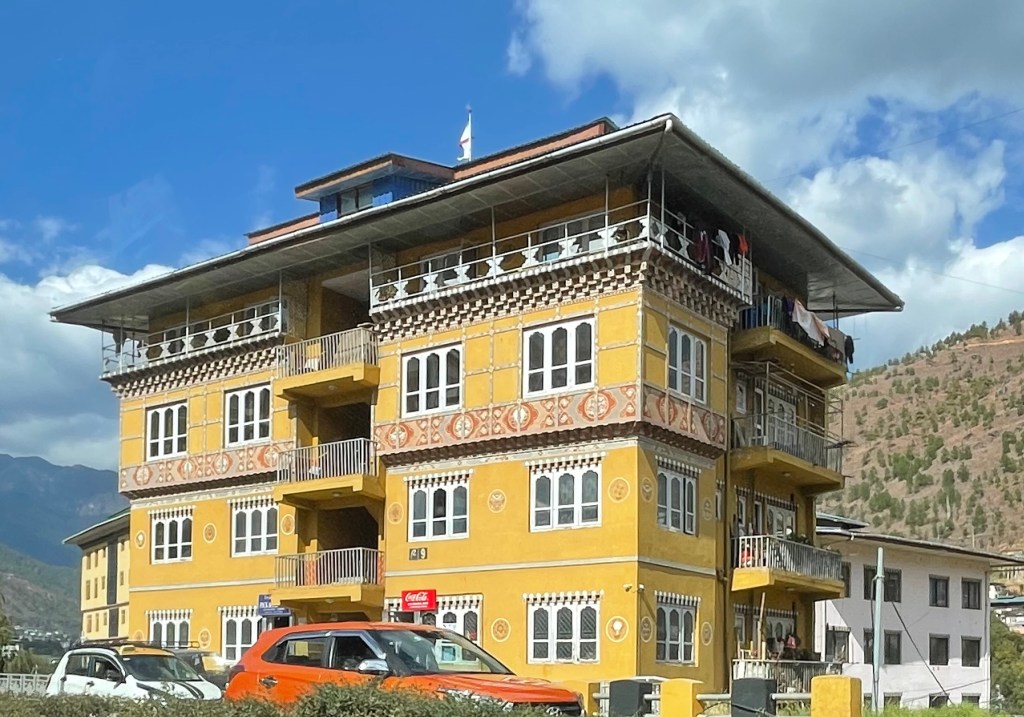
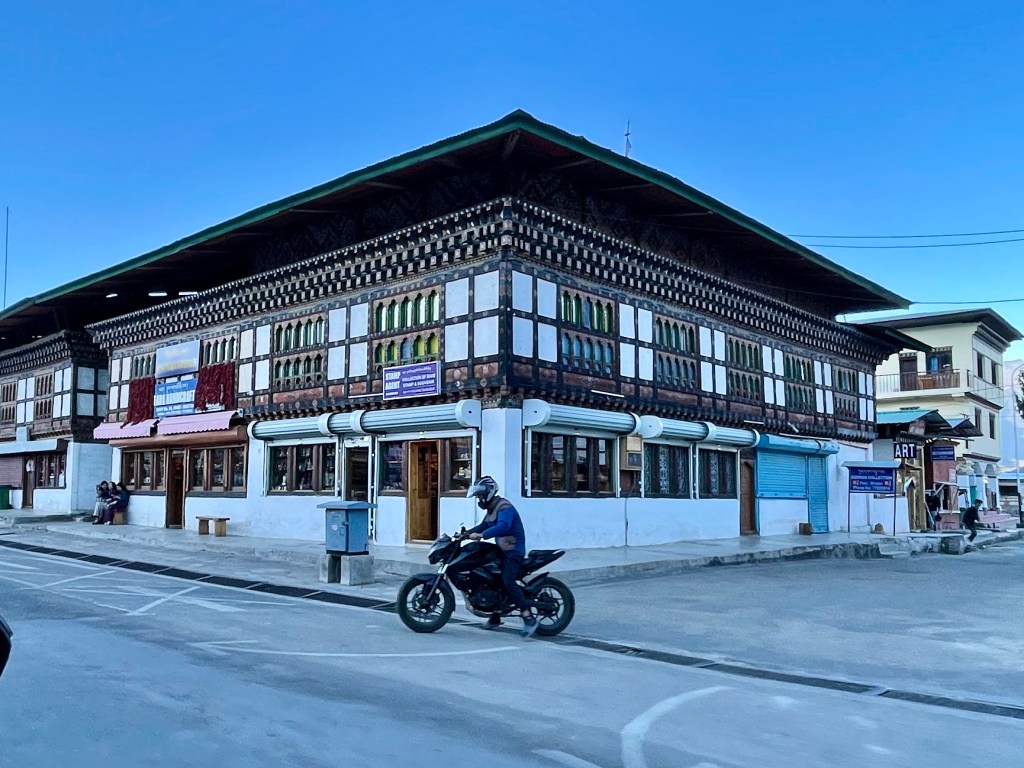
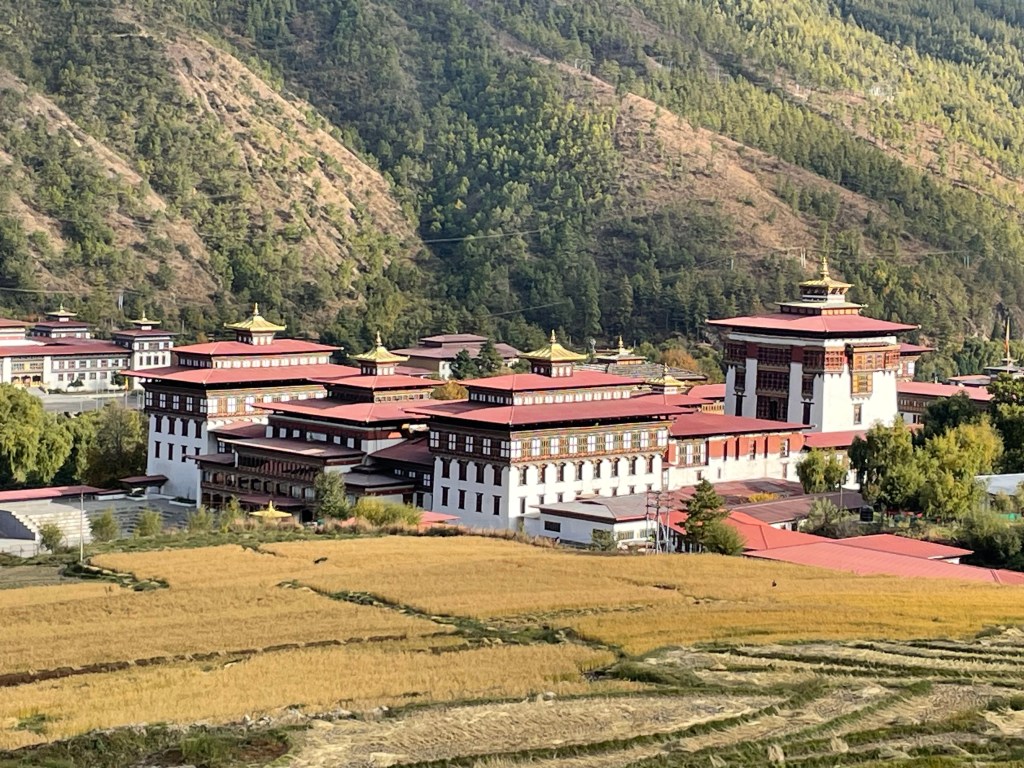
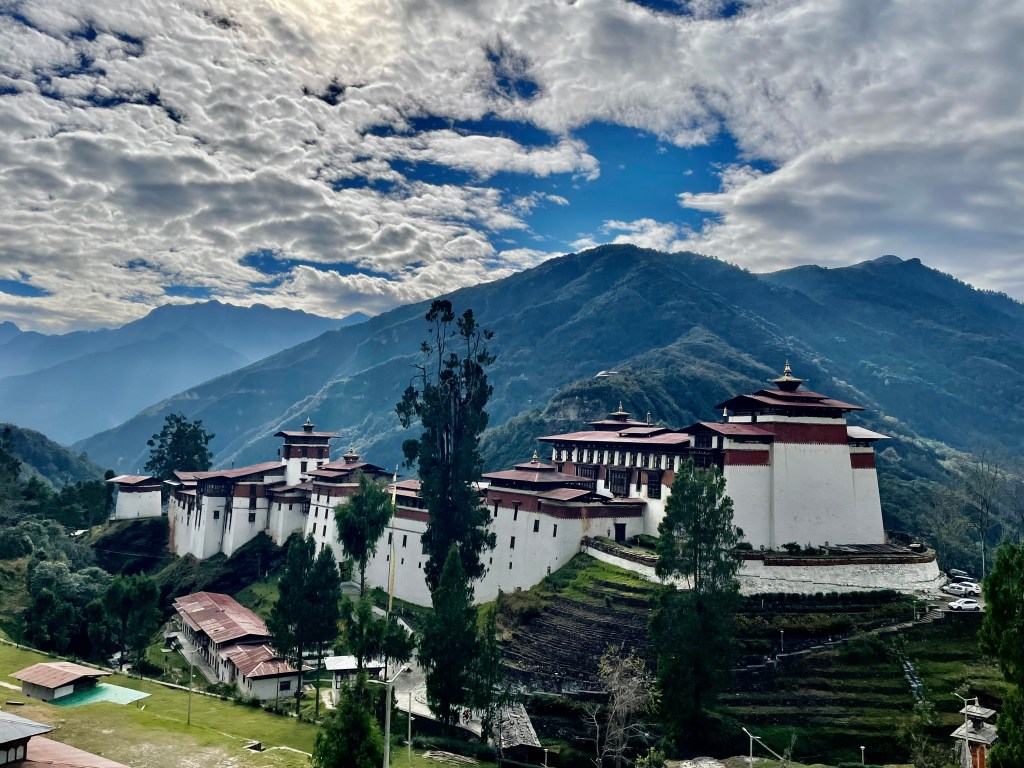
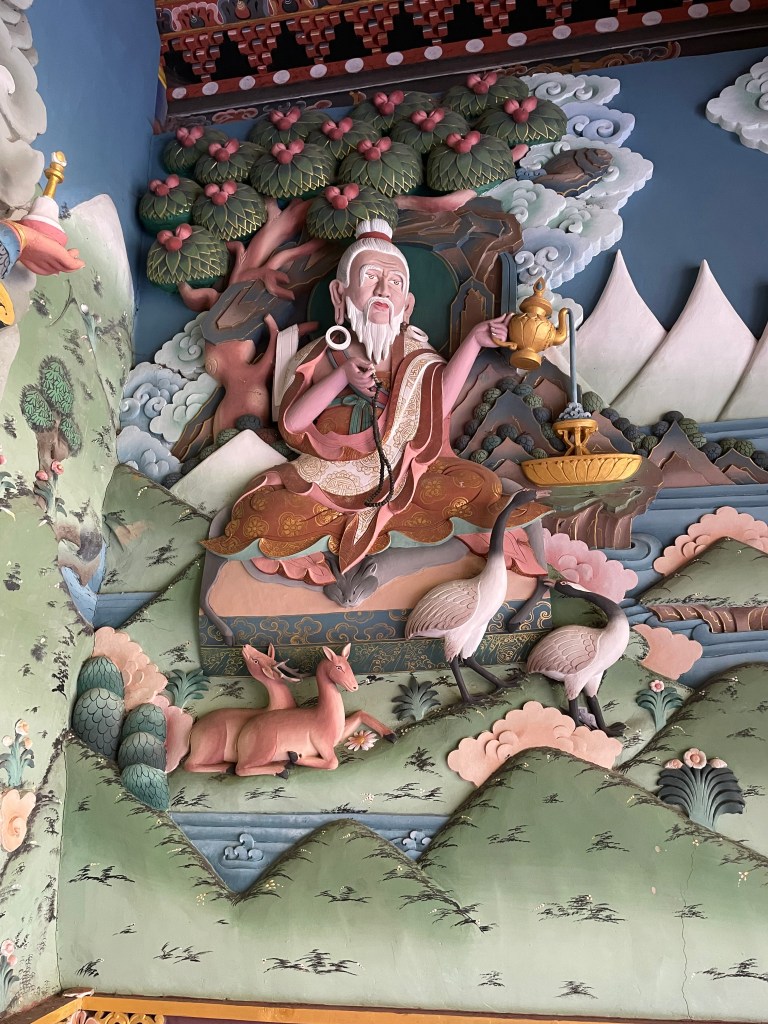
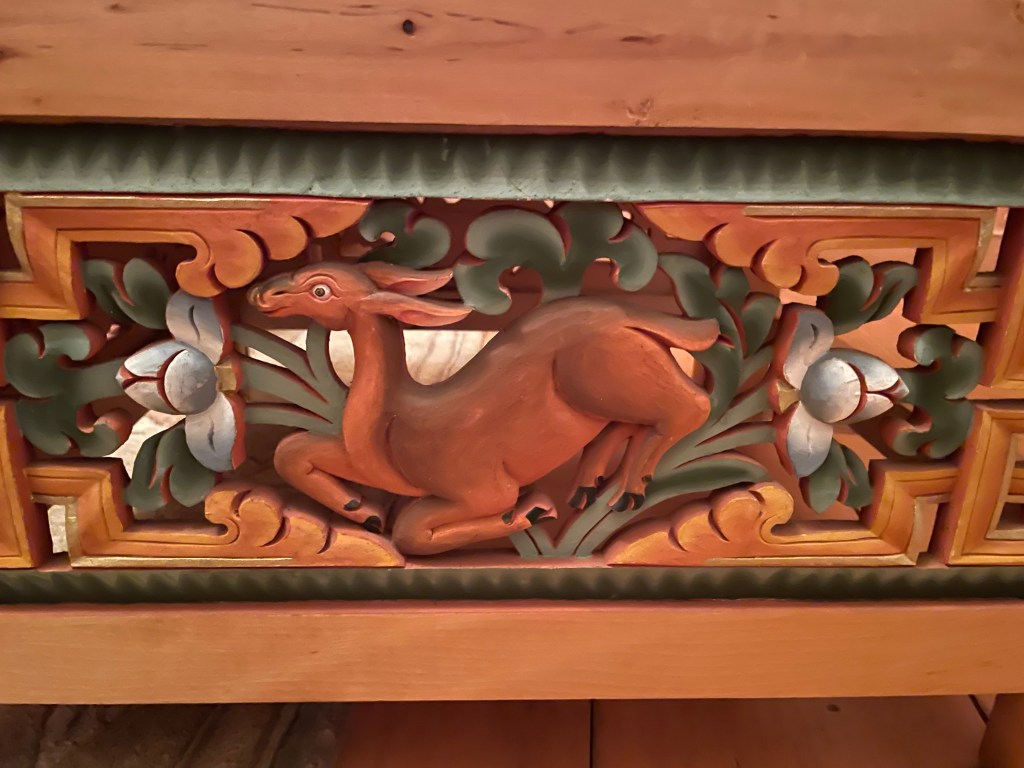
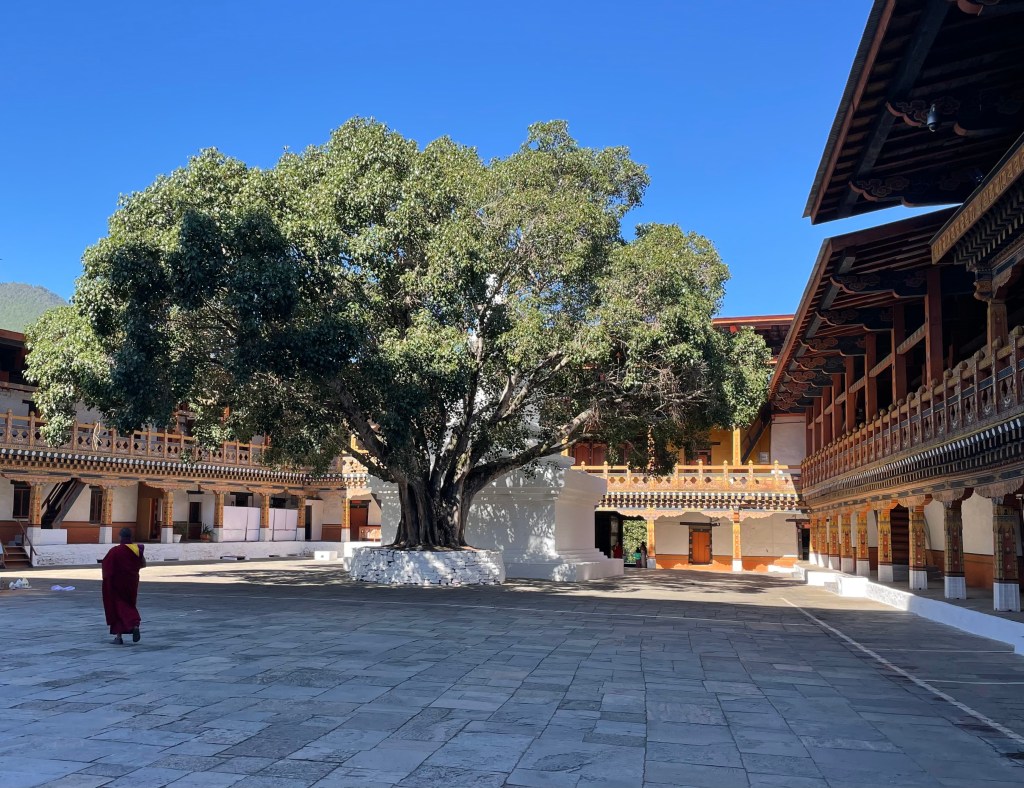
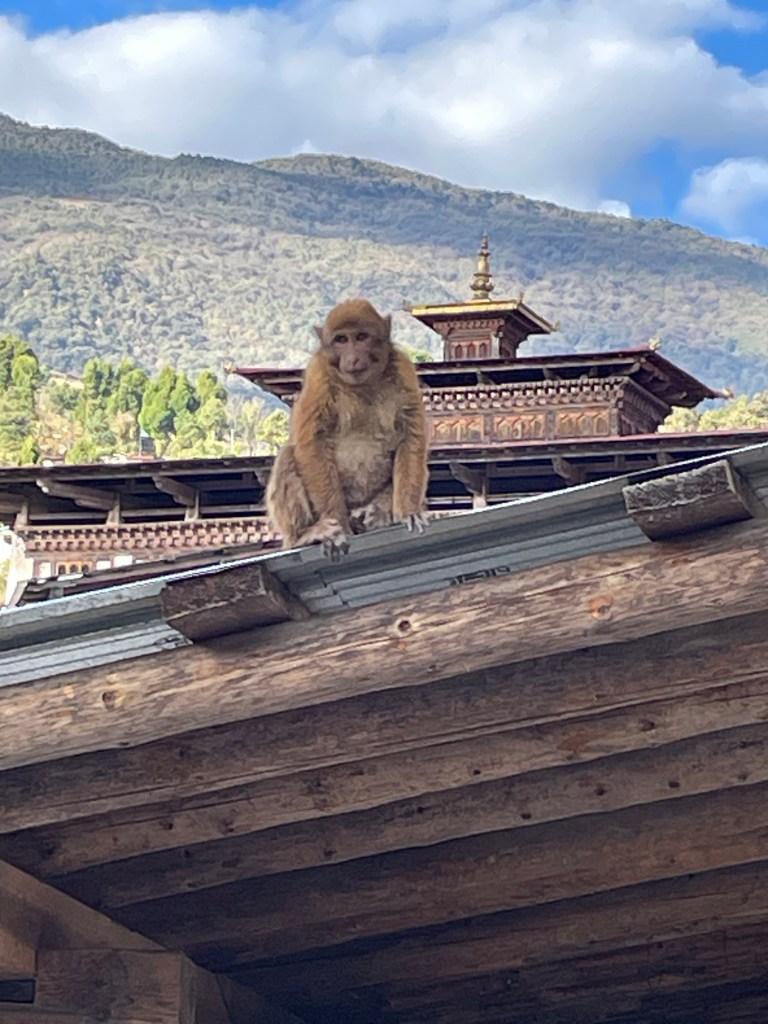
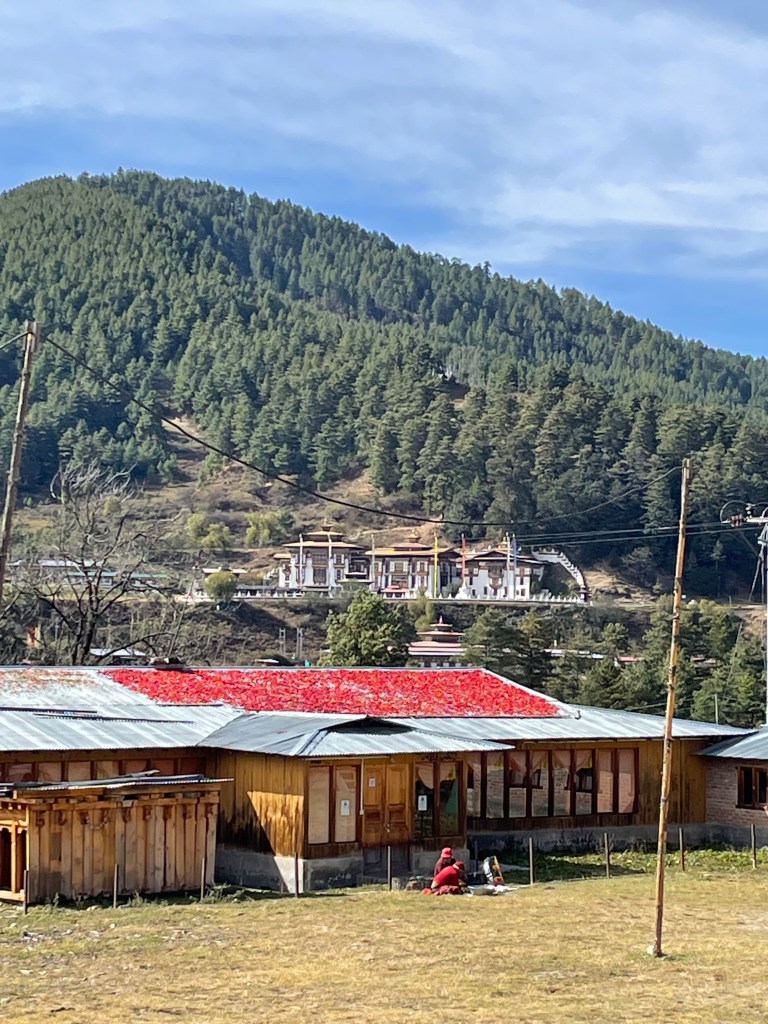
We visited Thimpu – the capital of Bhutan, Gantey, Bumthang, Trongsa, Punakha, and Paro – a nice variety of cities and villages. We explored 5 or 6 of the dzongs or fortresses built in the mid -1600’s by Ngawang Namgyal, a Buddhist lama, who unified Bhutan. The dzongs are large compounds with white buildings, red roofs and golden spires. All have been rebuilt sometime during their history after sustaining damage from fire or earthquakes, but the 17th century foundations are stalwart and used again. Originally built for defense, now half house the local government offices and the other half is inhabited by a community of monks. Each Dzong has a least one temple, usually several. You’re not allowed to take pictures in the temples or anywhere you have to remove your shoes actually. They are beautiful however, filled with statues of Buddha, the 2nd Buddha, the founder of Bhutan, and other prominent Buddhist figures in multiple incarnations and manifestations. The walls are covered with fascinating paintings depicting the many teachings of the Buddhist faith a well as the history of Buddha. Chungdu faithfully told us the stories as we viewed the vivid art. The colors are neither pastel, primary or royal but more muted, derived from natural ingredients and are very stunning. The pillars and doors are carved with more stories as well a birds, flowers and animals, painted with the same pallet. An amazing feast for the eyes.


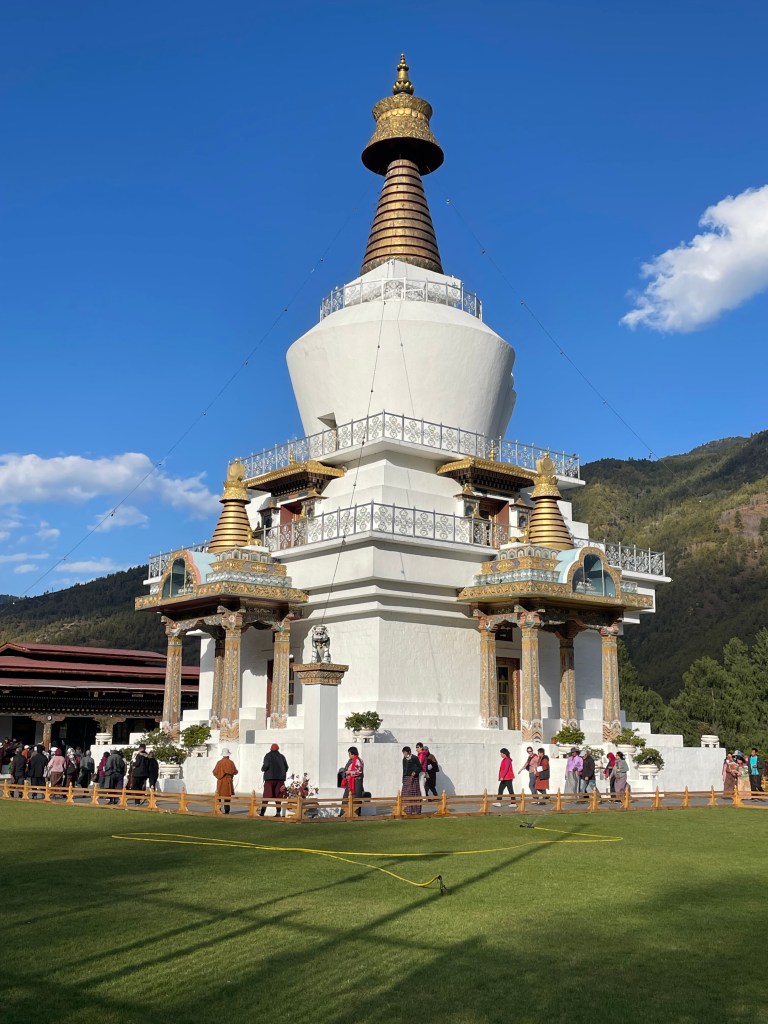
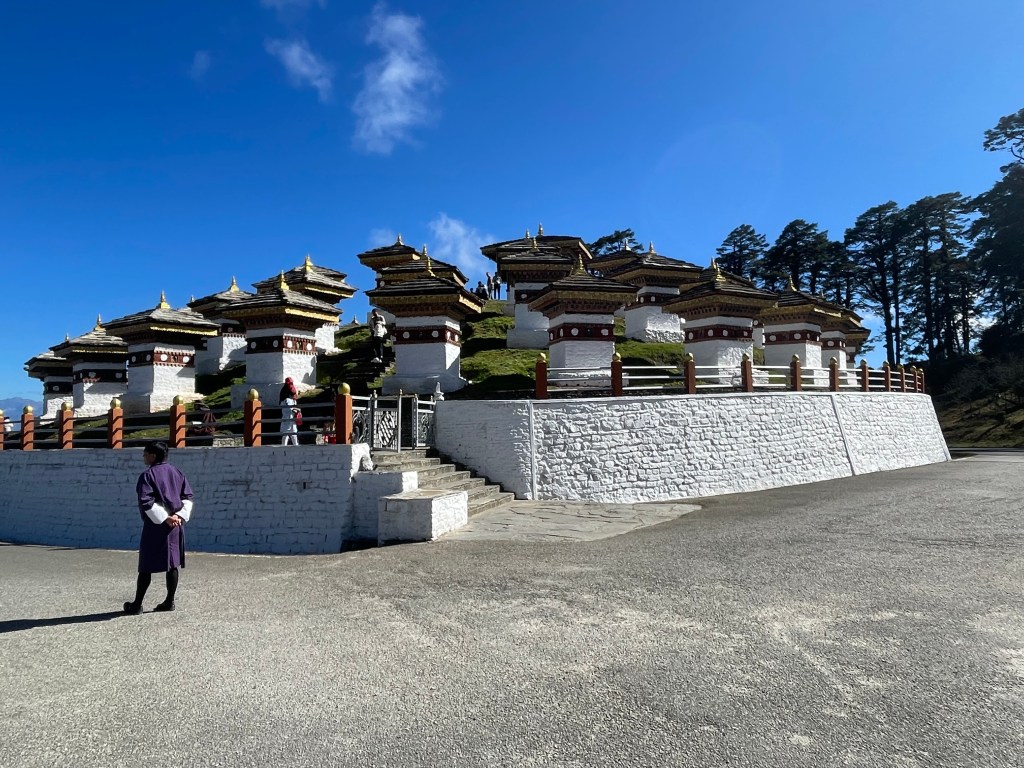
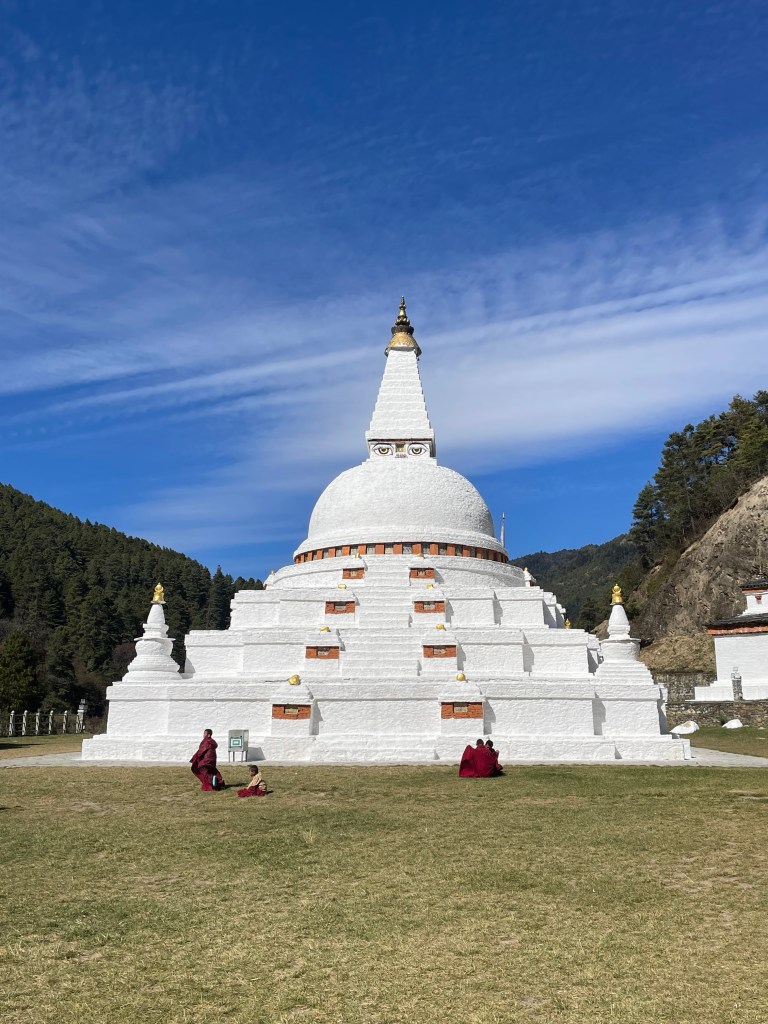
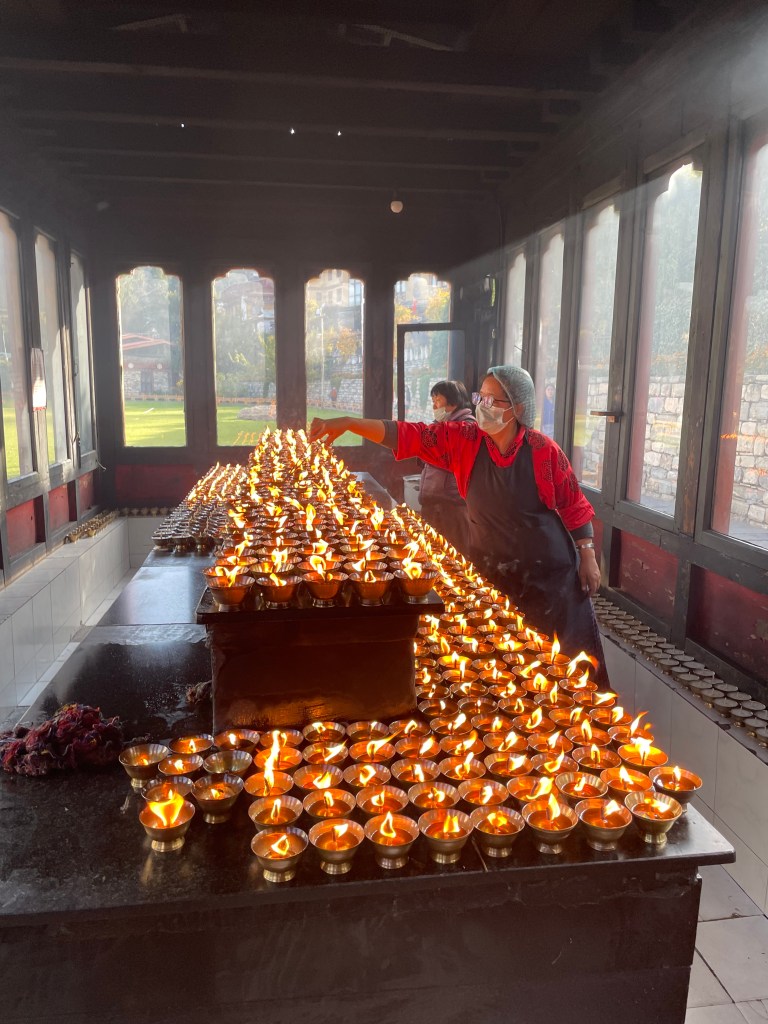
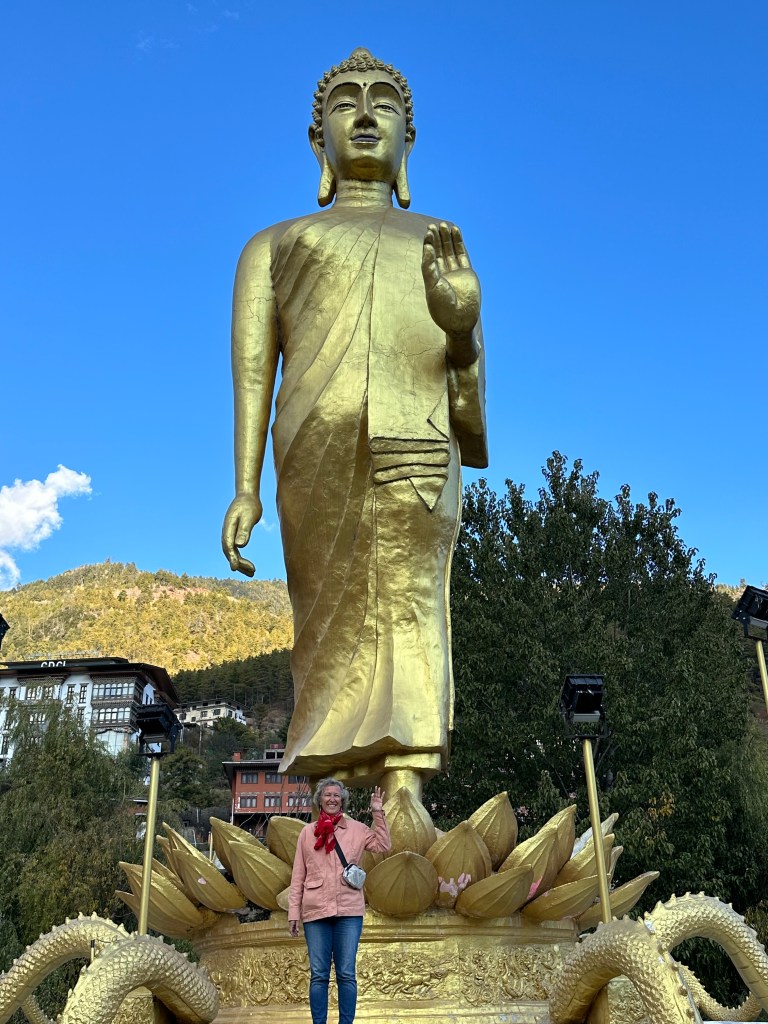
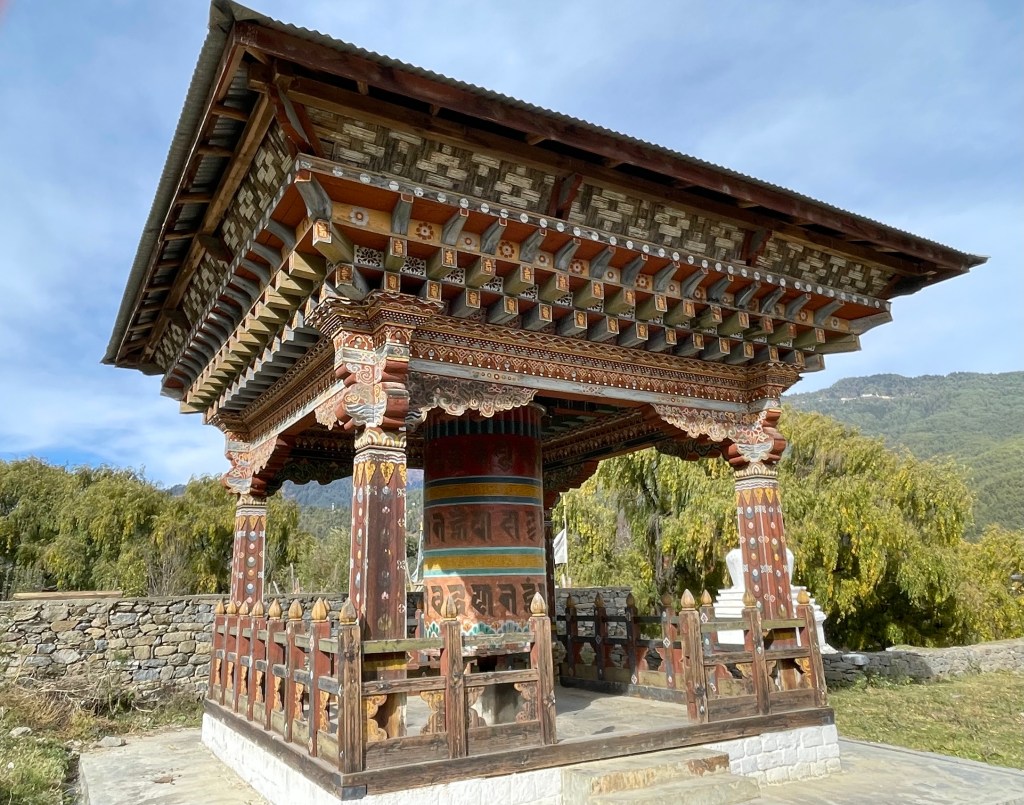
We also visited many stupas – a site of celebration and remembrance, often built on mountain tops. One had the Divine Madman’s underwear, a treasured relic, inside. The 108 stupas on top of the Dochula pass are to honor 11 soldiers who died in a war. The Buddha in Thimpu is the largest mountain top Buddha in the world. People come to the shrines, stupas and temples, making repeated rounds around the building while they pray. Three rotations is done fairly regularly, going or coming to work. Sometimes however, they do 108 circles. One hundred and eight is an auspicious number. Dozens of prayer wheels may line the sides of buildings and are spun while doing rotations. Larger ones are placed at entrances to prominent places, in parks, along road sides and other sites. They’re heavy and difficult to get started but by the time you finish three rounds, they’re spinning pretty easily.

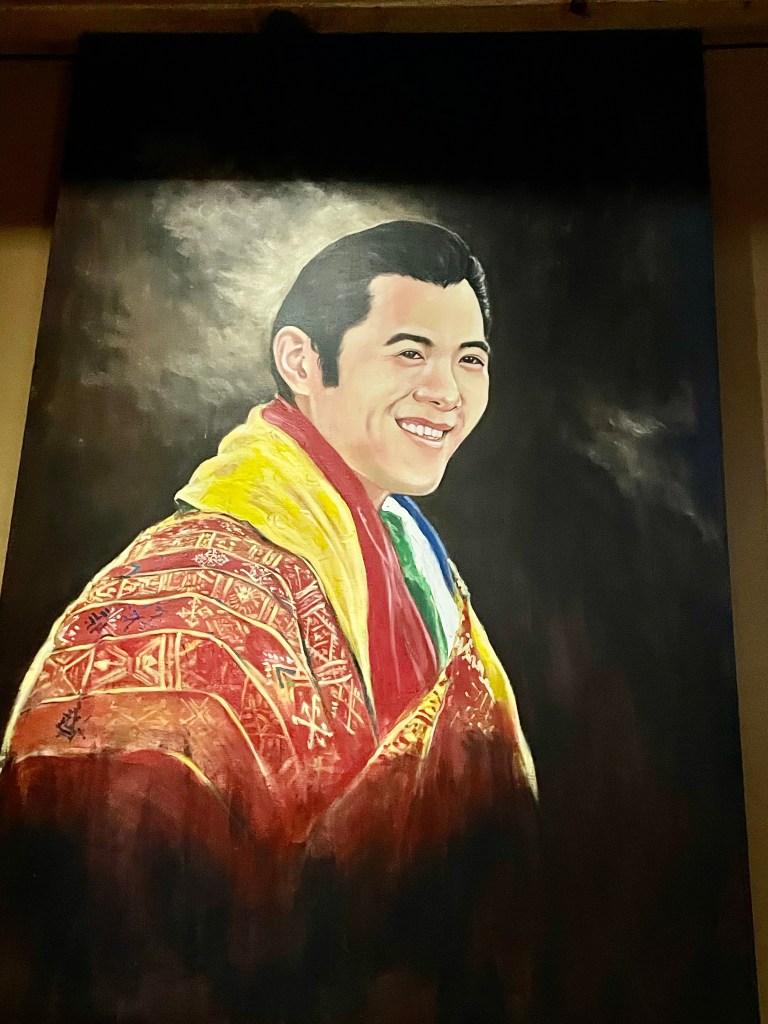
Bhutan is ruled by both a king and a chief abbott. Gyalpo Jigme Khesar Namgyel Wangchuck is the current and 5th king and is much beloved. You cannot not go anywhere without seeing a picture of him and his family – in hotels, temples, restaurants, historical sites and in personal homes. The monarchy was established in 1907 and with it the beginning of internal reforms and modern developments. In 2008, it became a democratic constitutional monarchy. The fourth king established the Gross National Happiness philosophy that guides the country. The government needs to consider 4 things as they lead – promote cultural tradition, preserve the environment, be economically sound, and demonstrate good government. To do this, the current king thinks 100 years in the future. Examples are giving farmers free electricity, seeds and support to start small businesses so that they stay on the farms. Sixty percent of their population of 700,000 people are farmers. Like many countries rural flight is a big issue with large numbers young people leaving to go to Australia or other parts of the globe. They must maintain at least 60% of their land in forest, it’s currently close to 70%. They do have a lot of natural resources but the king is unwilling to disrupt the land for short term gain, leaving nothing for future generations. Currently, the major sources of income are hydroelectric power that they sell to India and tourism. Tourist visas are $200/night, the fees goes to support the free schools and health care throughout the country.

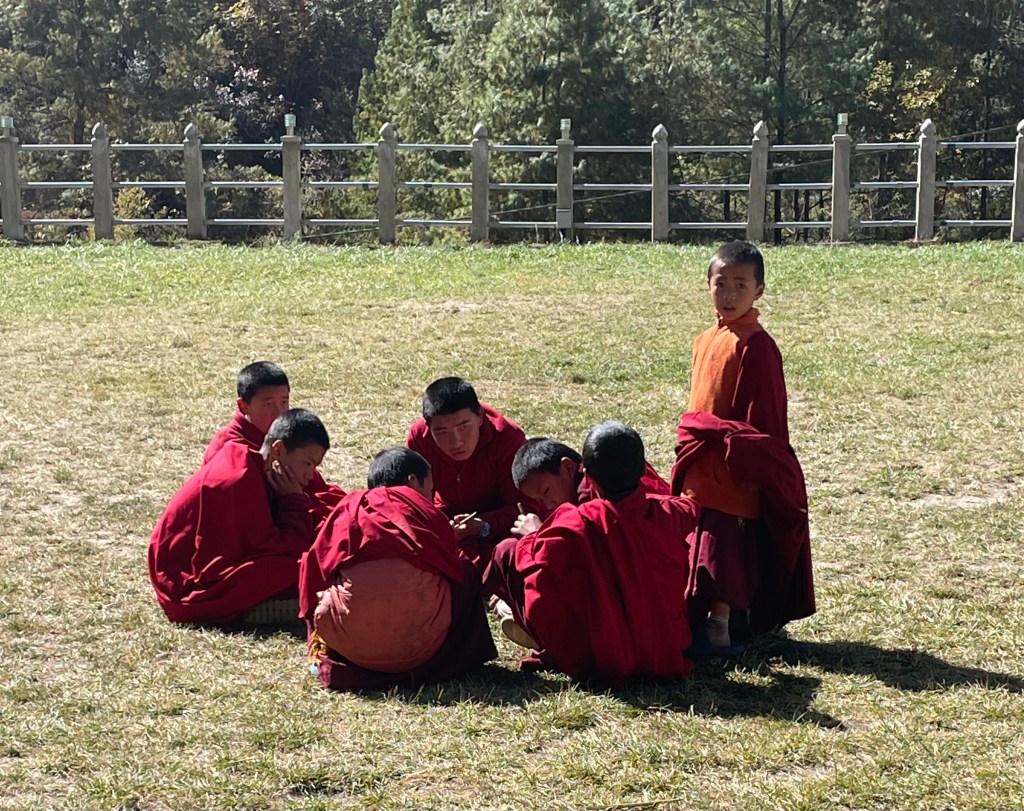
I guess I have to take a step back. Bhutan’s historical period begins at about 747 A.D., when Guru Rinpoche or the second Buddha, came from Tibet and introduced Buddhism to the country. While the king is only the 5th king, the chief abbott is number 70. About 75% of the people in Bhutan are Buddhist, the remaining 25% Hindu, mainly from Indian settlers. The red and saffron robes of Buddhist monks are seen everywhere – on planes, in restaurants, on the streets and of course in the dzongs. In the past, if a family had two sons, one would become a monk as a sort of tax. Now they join on a completely voluntary basis. I met with one monk to have an astrological reading done, one of the services they provide to the general population. It was quite interesting, given that I had no idea what to expect. He told me I was a good person, I am like a tree, I was a snake in a previous life – albeit a good snake, my color is green, my number is 1, the best day for me to make a decision is Monday and the worst is Tuesday and that I should follow the Buddha of compassion if I want to return to earth in my next life. Earth is good in Buddhist terms, you have a choice to be good here and hopefully earn your way to nirvana. He also said I would settle soon, being the gypsy that I am, that will bring a change to my life.

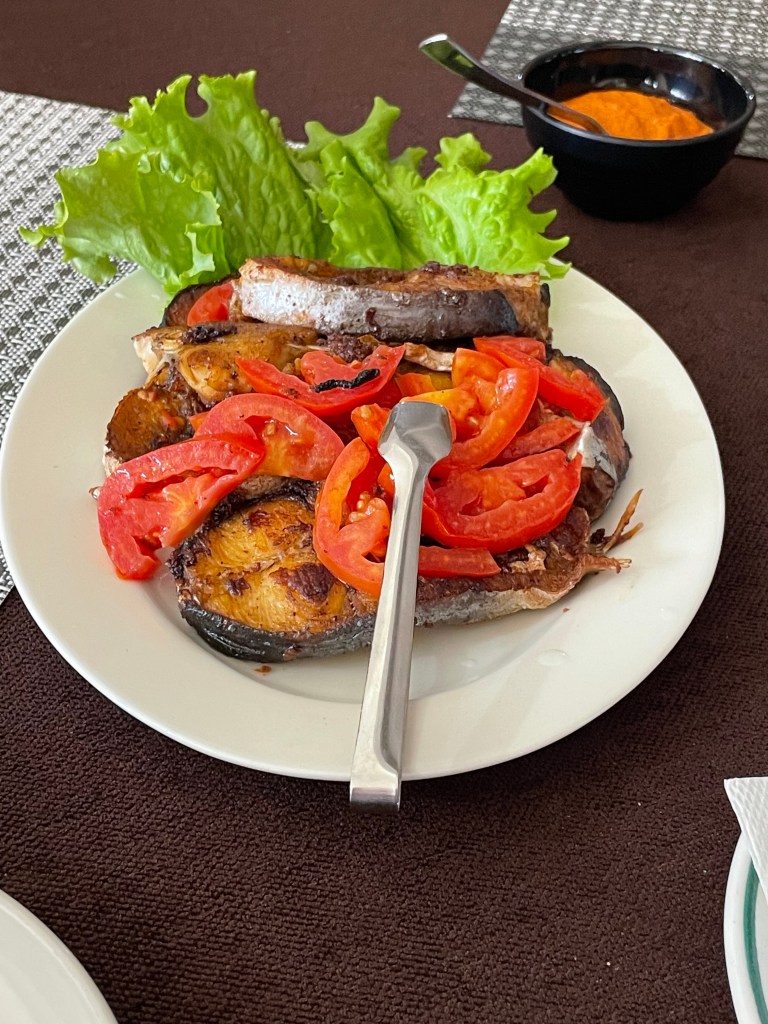
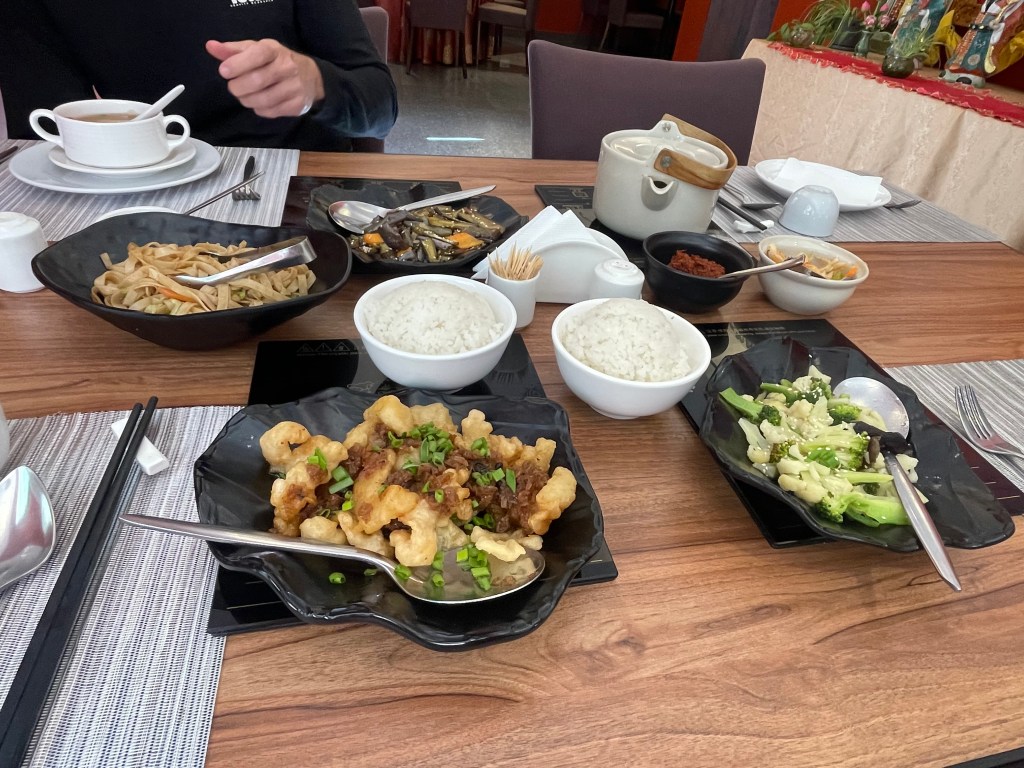
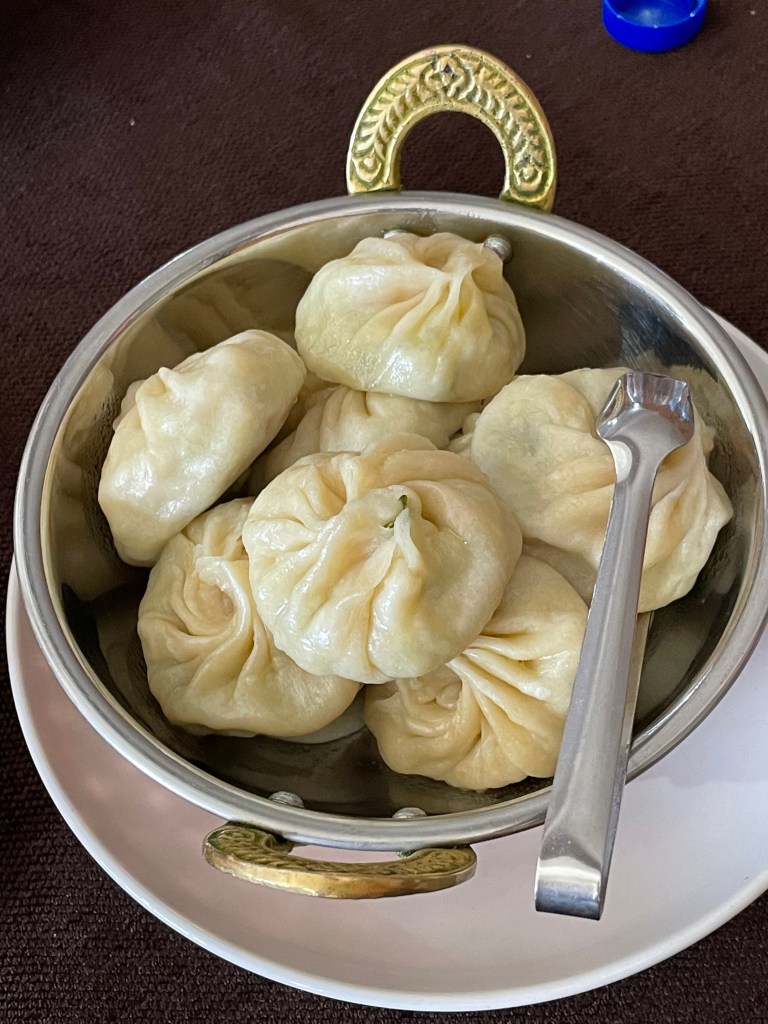
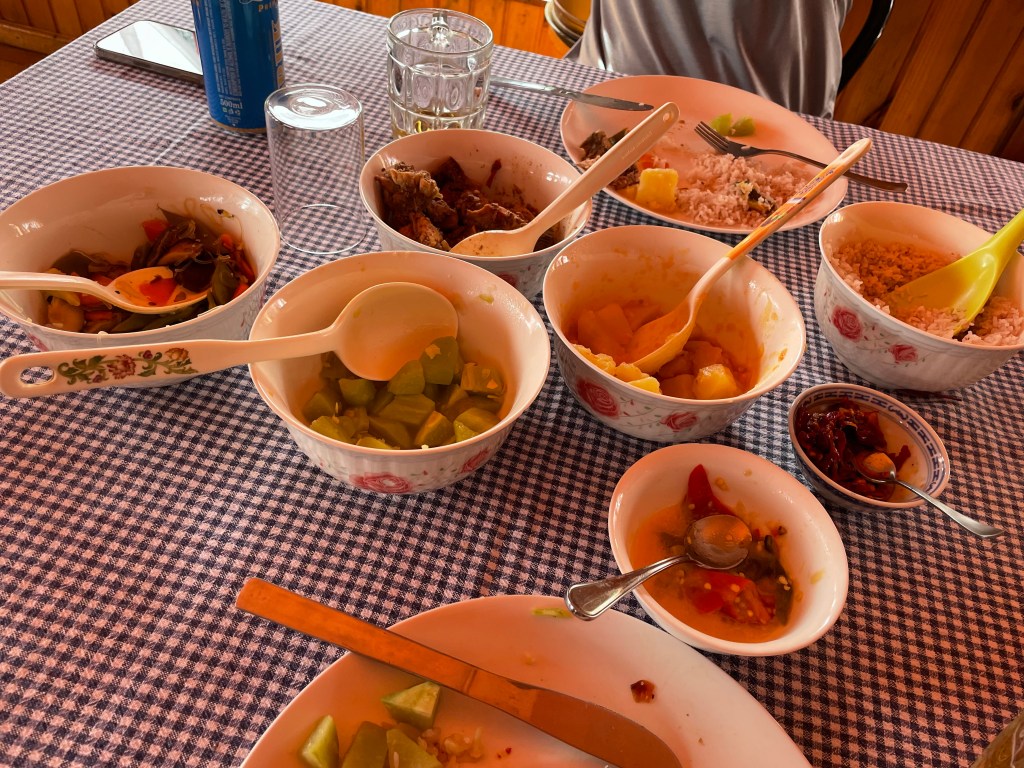
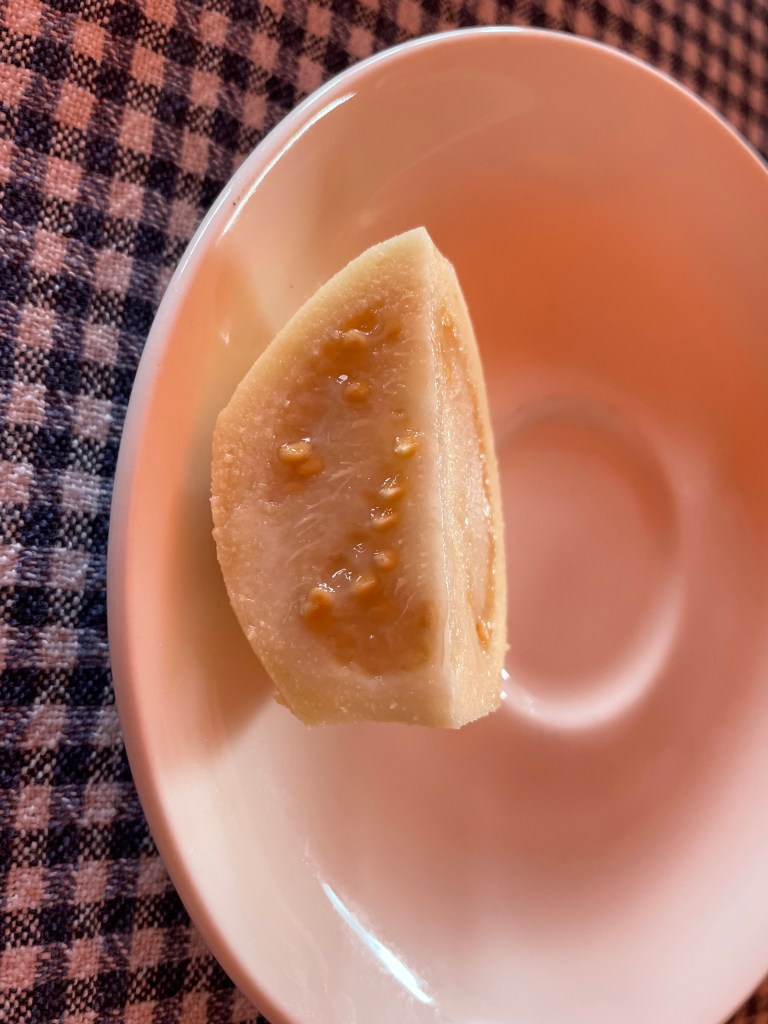
Although meat was readily available throughout Bhutan, many people are vegetarians, as Buddhists are not allowed to kill any living thing. They import most of their food from India, including meat and fish. Most of our meals were made up of rice, mixed vegetables, some type of meat or fish in a sauce, momos -dumplings, noodles, with fruit for dessert. Guavas were in season, so we had them more than once. Yum. At one lunch, we had banana fritters which were really good. Often the rice was red, a nuttier, tastier version of its white counterpart. It’s grow here and is a major source of income for farmers. Also, on the table was ema datse – chilis and cheese. It’s something you mix into your rice – though you can put it on anything, it can be quite hot however so best to start with a small portion. I liked it, even when my mouth was on fire. As in other places I have visited, our meals were feasts compared to the typical meals of the Bhutanese.

One of our most enjoyable meals was in the home of Linda and Namgay. Linda Leaming is originally from Nashville but has lived in Bhutan for almost 30 years. I was introduced to her by my friend, Judy Freudenthal, who knew her back in the day. Linda is an author and two of her books were my reading list for my stay in Bhutan – Married to Bhutan and A Field Guide to Happiness. I recommend both. Her husband Namgay is a thangka painter, he also restores old temples. Thangka paintings depict various Buddhas and Buddhist figures and are quite elaborate and elegant. The mandala he painted that hangs in their living room was amazingly detailed and stunning. Introduced to rockets at age 11, a really out of this world object in Bhutan in the 60’s, he has combined that love with his thangka skills to create fabulous otherworldly paintings. Check them out here – http://www.namgayrockets.com. In the small world category, I brought Brad with me to dinner and he and Linda have a lot of people in common, including his cousin who lives in Chicago. Namgay cooked a wonderful Bhutanese dinner which we throughly enjoyed.



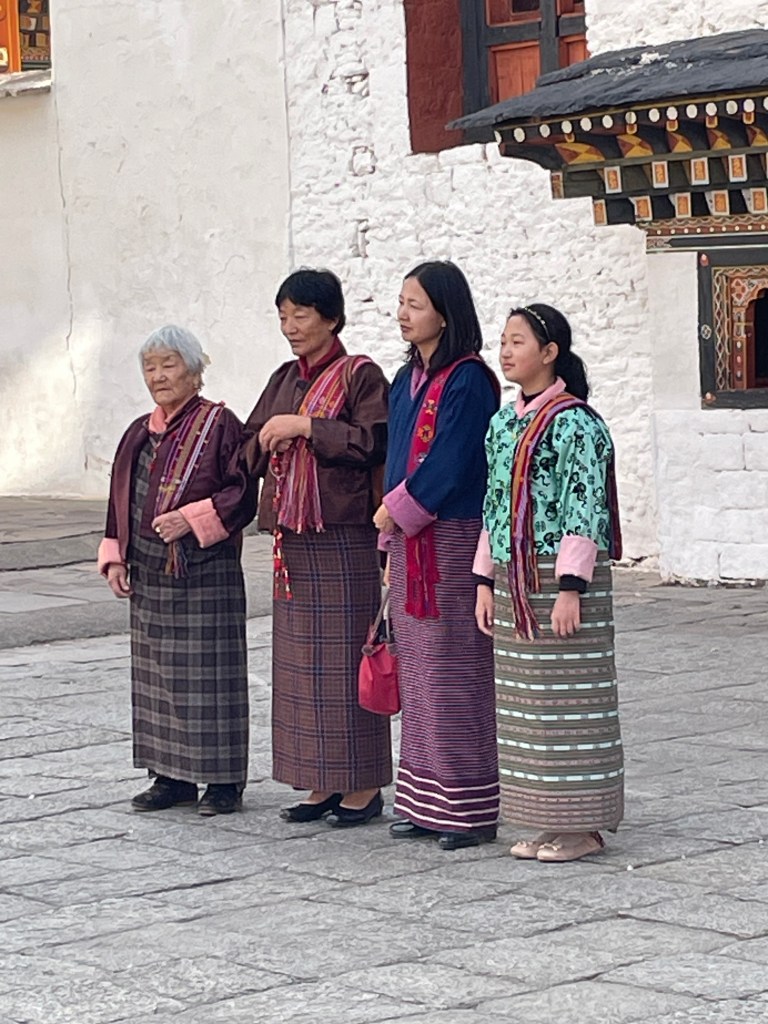
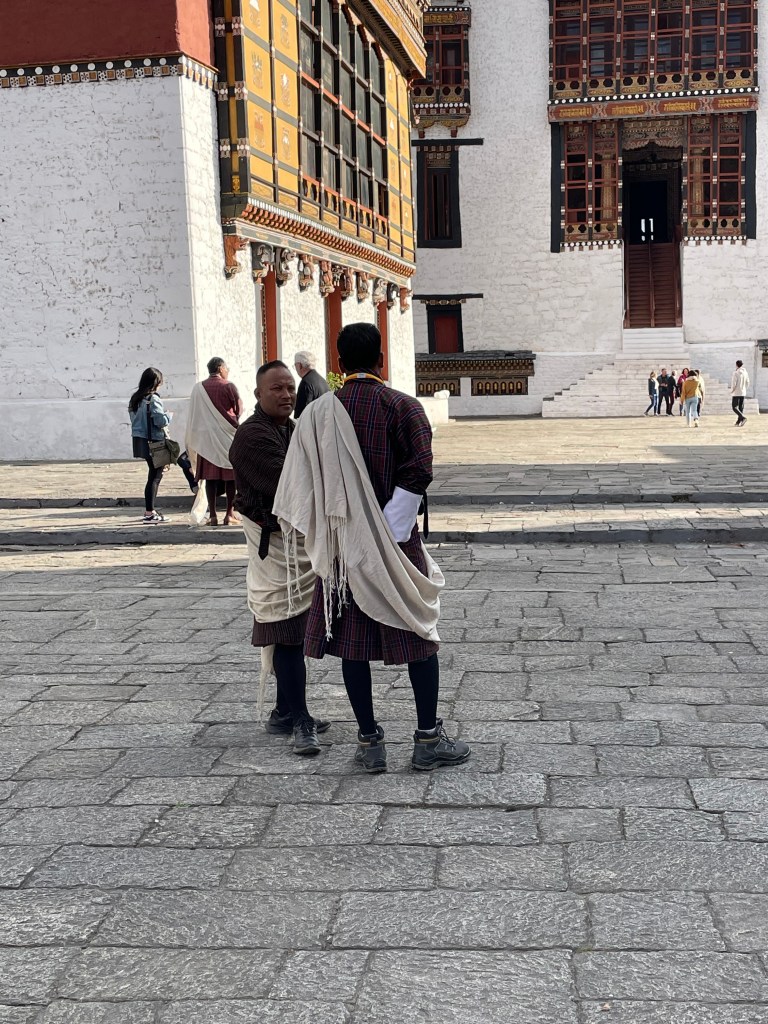
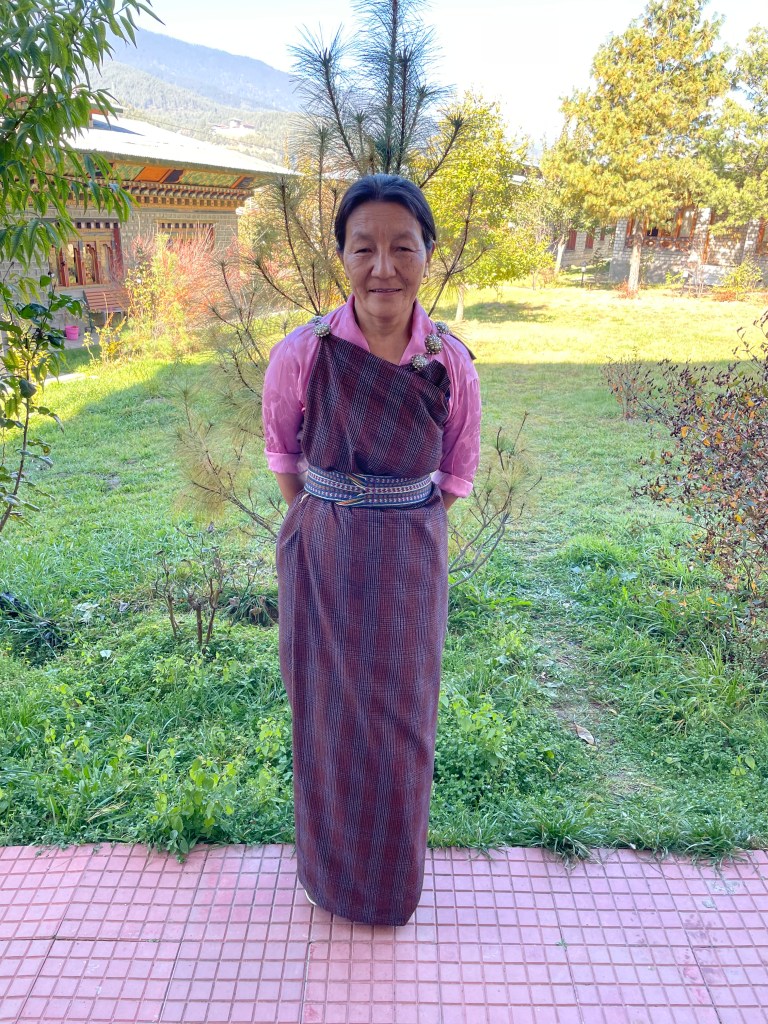
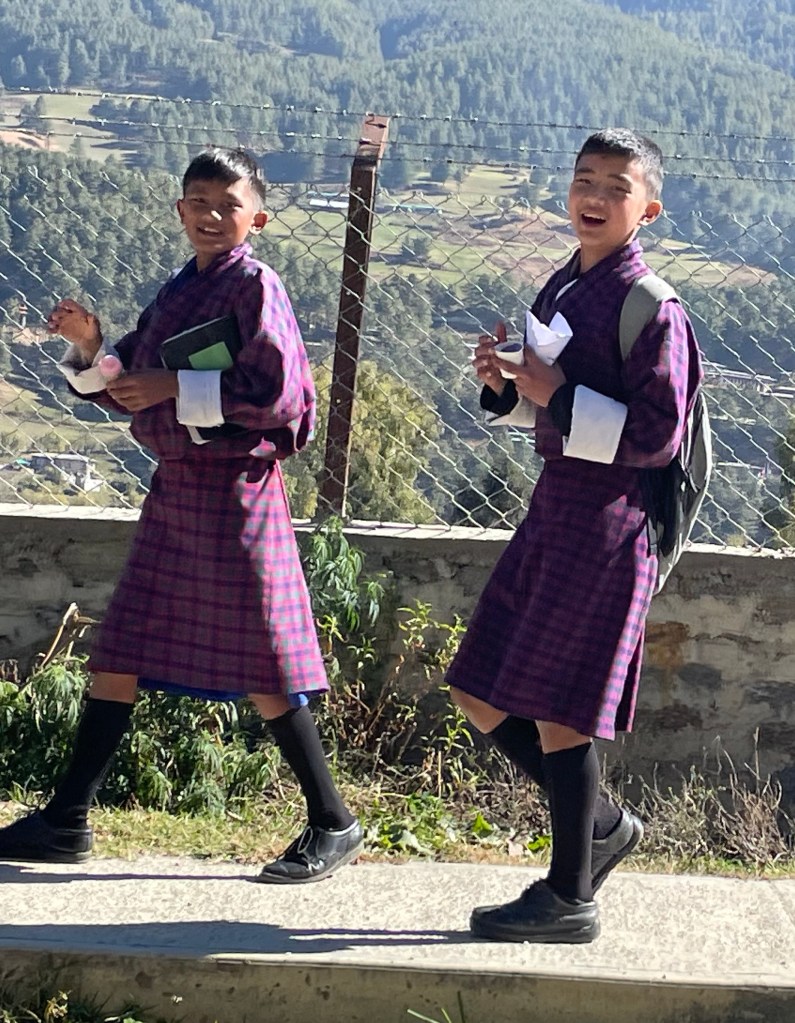
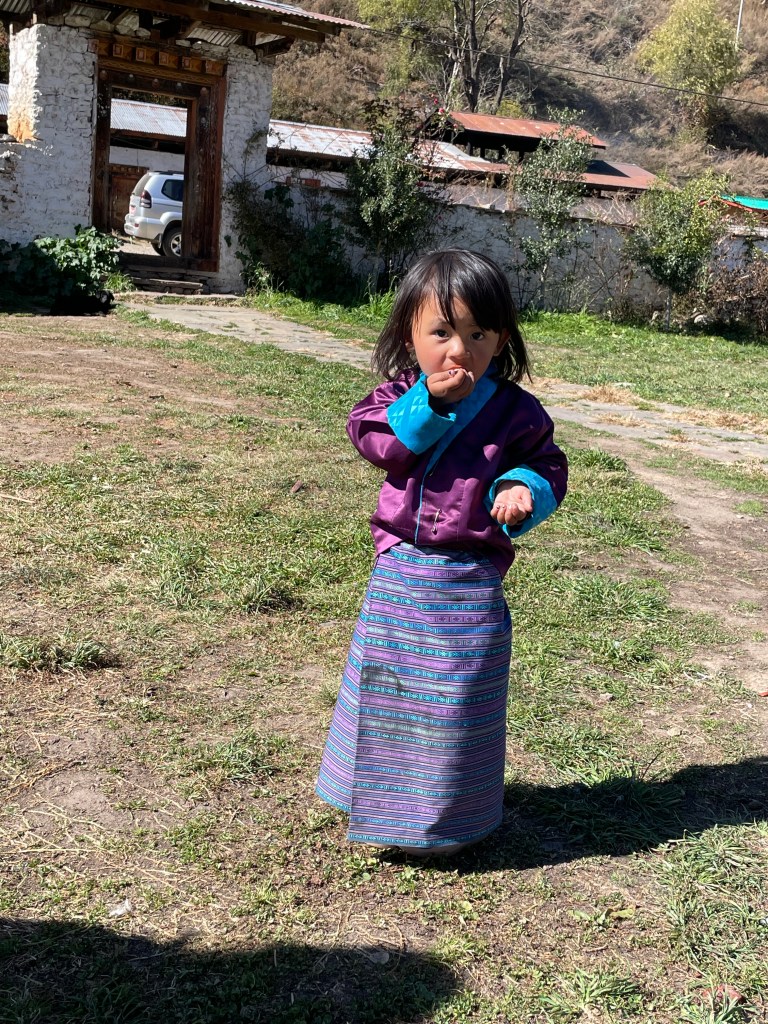
I loved the traditional clothing the people wear. Western clothing is seen but the Gho for men and Kira and Toego for women are the accepted and sometimes required business attire. They are also worn in schools and when visiting temples and. government offices. Even small children don the colorful apparel. The Kira is a long woven cloth wrapped around the body and traditionally secured with silver clasps over the shoulders, then an embroidered or woven belt is cinched at the waist. A toego is a short jacket, usually of silk, worn on top. More modern Kiras only go to the waist and are held in place by a hook and eye or maybe buttons. The Gho is a robe, again made of woven material, it crosses over the front, pleated in the back and held tightly with a woven belt. The front top of the garment is loose and used as a pocket for your cell phones, papers and other items. The gho hangs just to the bottom of the knees and knee socks or half socks, as they are called here, complete the ensemble. When entering the fortresses or any government building they also wear a shawl over one shoulder, which dips below the waist on the other side. Both forms of dress come in a variety of colors and patterns, some for ceremonial days quite elaborate. Our guide said the Gho is very comfortable, except the belt needs to be very tight in order to be used effectively as a pocket, so it feels good when you remove it.

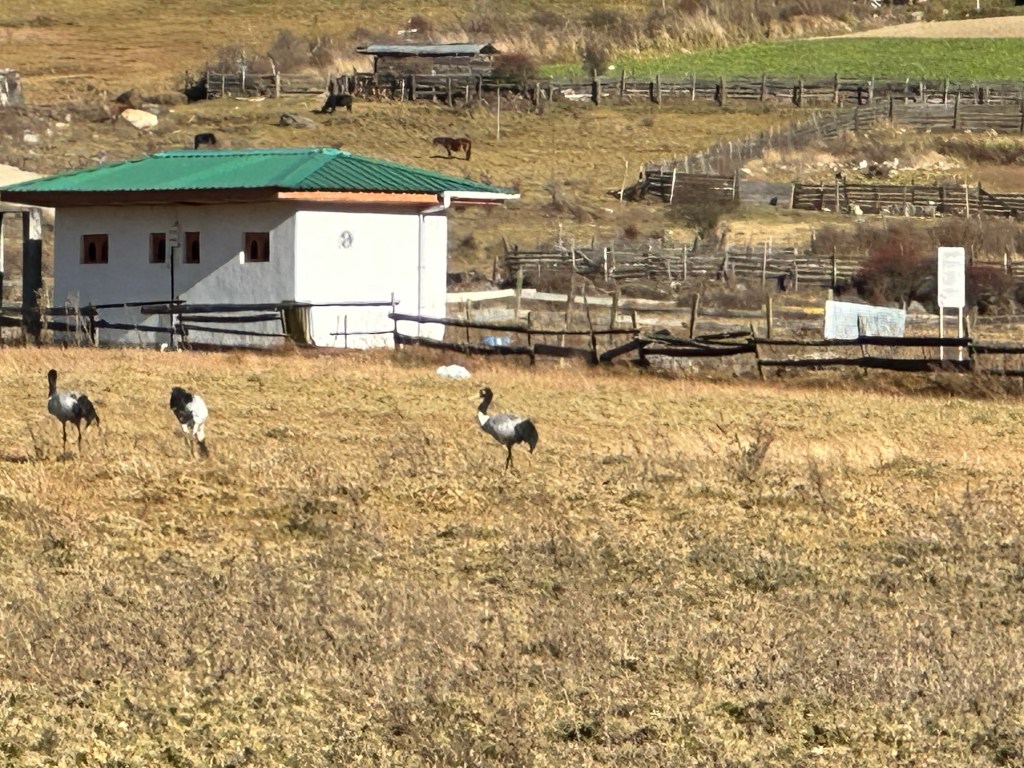
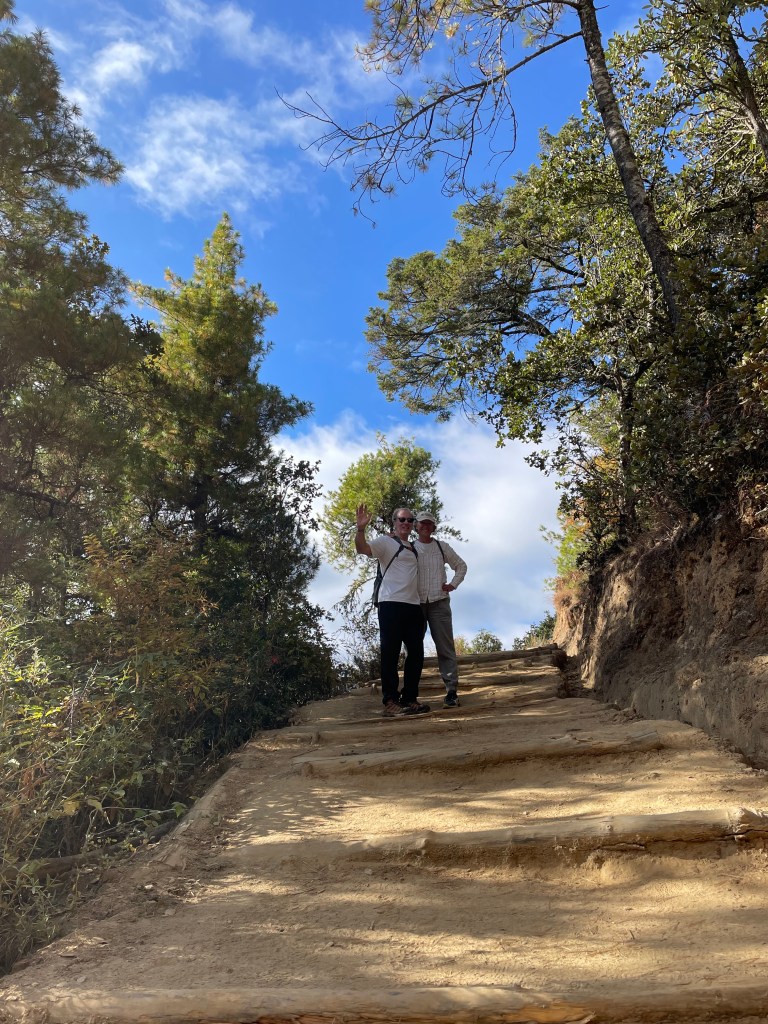
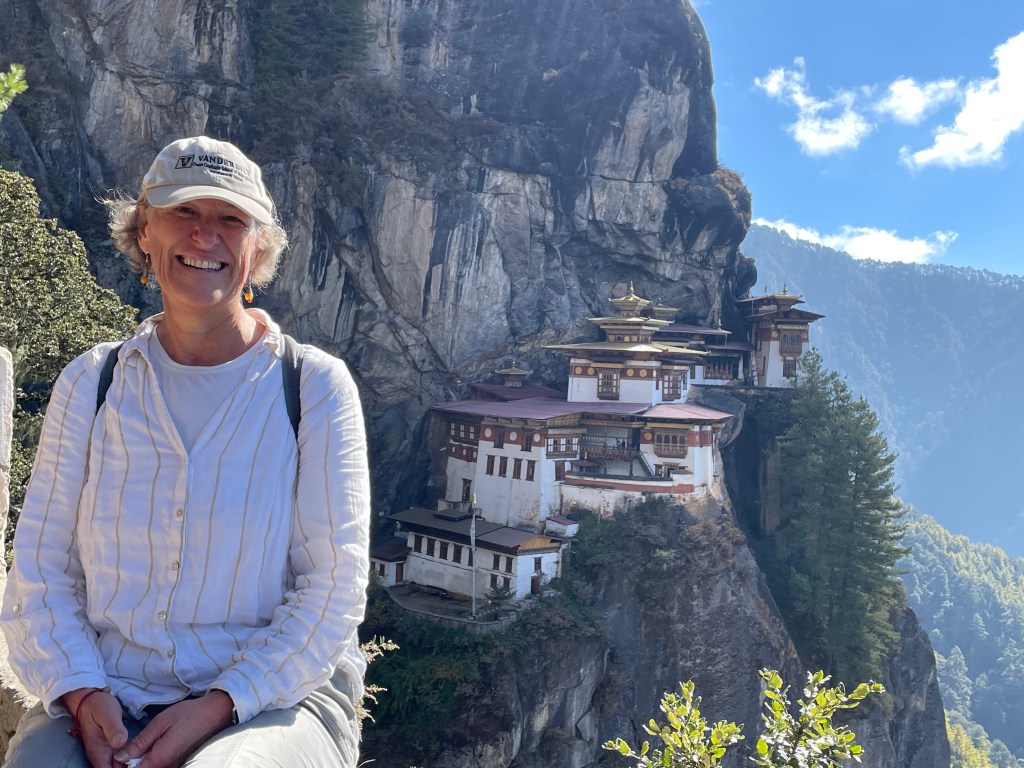
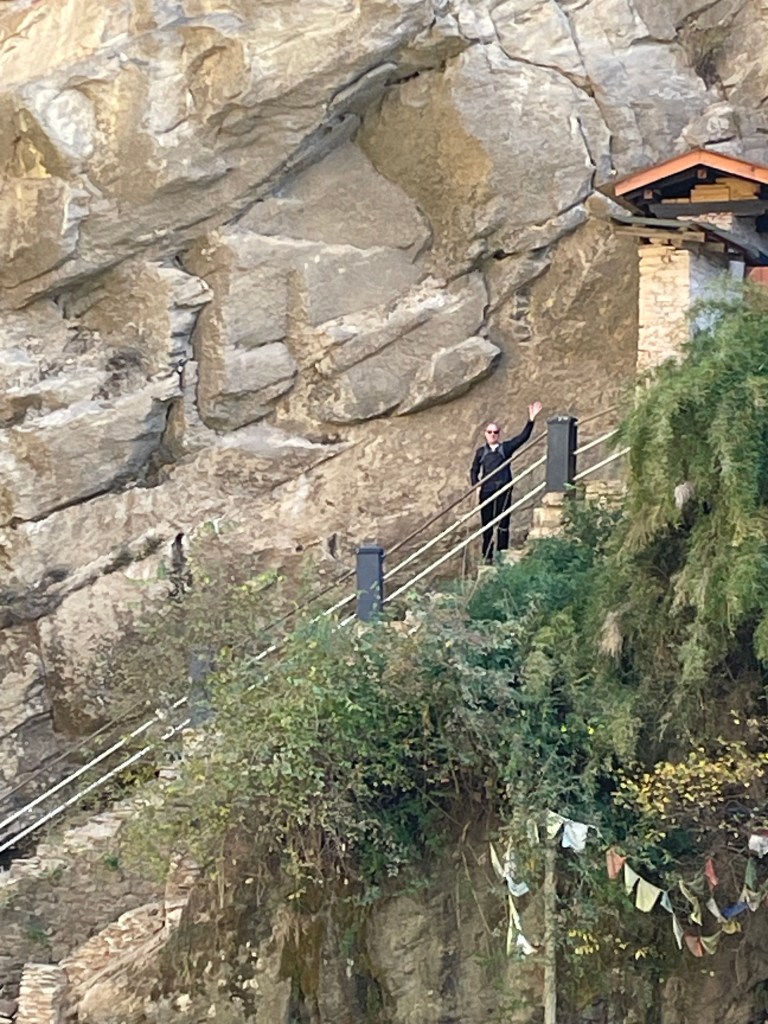
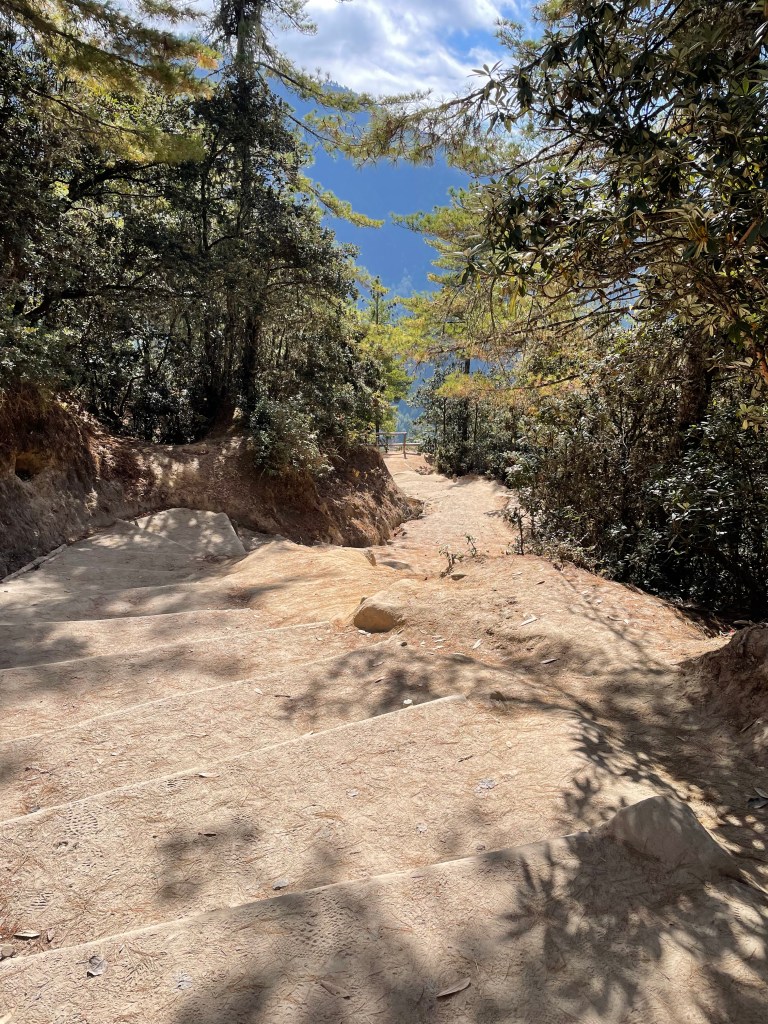
We did several hikes while we were here. The first one just after visiting a black necked crane winter nesting site. We ended up close to 10,000 feet but there wasn’t a lot of elevation gain. Still we panted due to the altitude. We hiked to one of the newest stupas – built for the current king by his mother to offset that fact that he was born in the year of the monkey. Apparently, that’s not a good year for kings to appear on earth. That excursion was a little steeper and really good training for our big hike. Other than needing to stop occasionally to catch my breathe, I didn’t have any issues until we climbed the three flights of stairs to the top of the building, then I got light-headed. Thankfully, I recovered quickly. Our final hike was to Tiger’s Nest, a set of temples built into the side of a mountain just over 10,000 feet up but with about 4,000 feet elevation gain. Brad and I agreed we would take it slow and enjoy the views as we trekked up the path. Chungdu was very patient as he strolled up with his hands behind his back or while texting on his phone, when he wasn’t taking amazing pictures of the views or of us. The full trip was only about 6 miles but the altitude provided a little harder workout than six miles at home. Just before we got to the temples, we went down 770 steps and then back up 100 or so more. I tried not to think about having to go backup those 770 steps, but it wasn’t too bad as a lot of people were coming down and we had to wait for them to pass. I was grateful for the delays. We walked under old man’s beard, a light green lichen that only grows when the air is pure. It was another one of the beautiful, warm days with bright blue skies that we enjoyed the whole time we were in Bhutan, making it a very pleasurable endeavor.





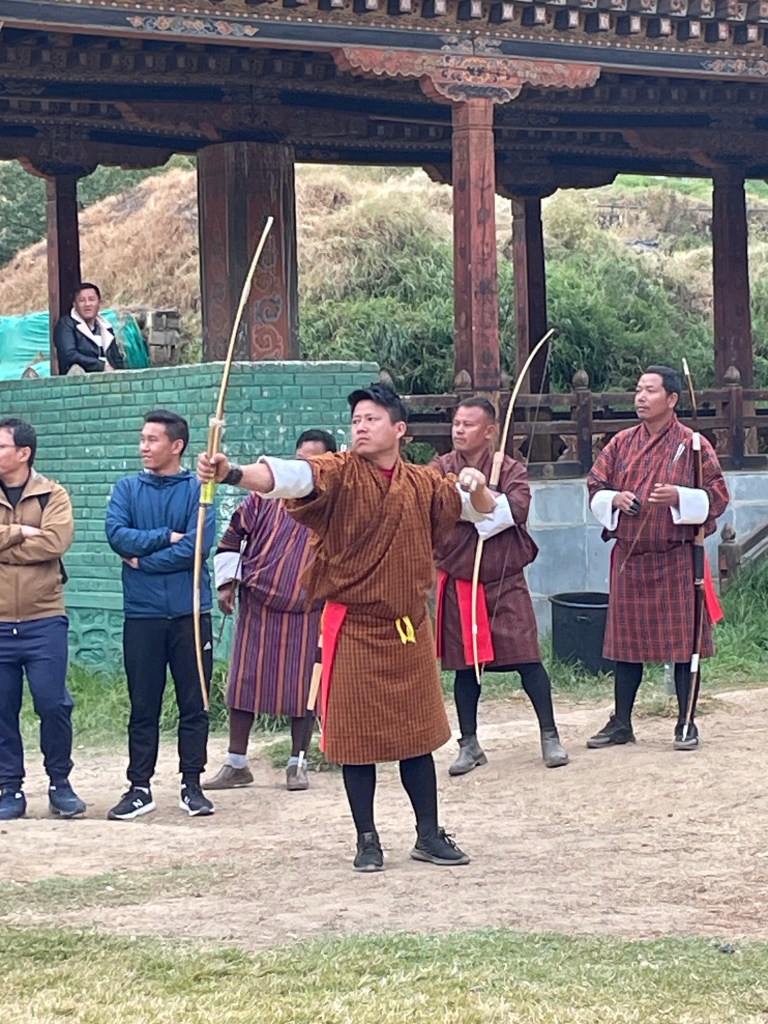
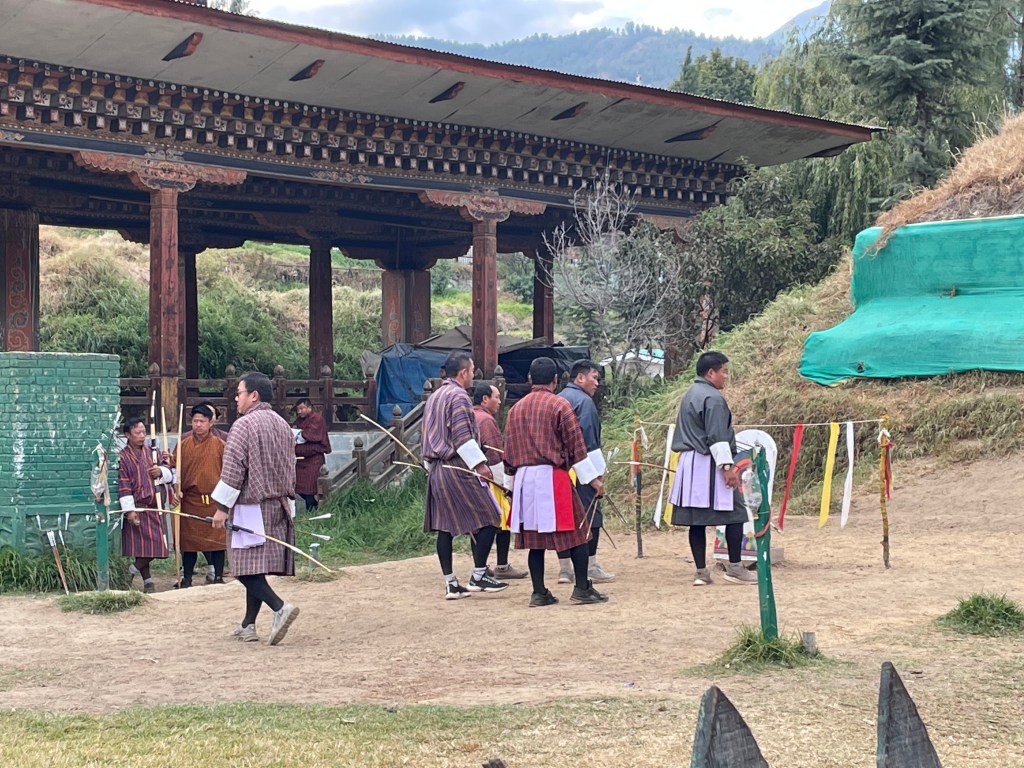
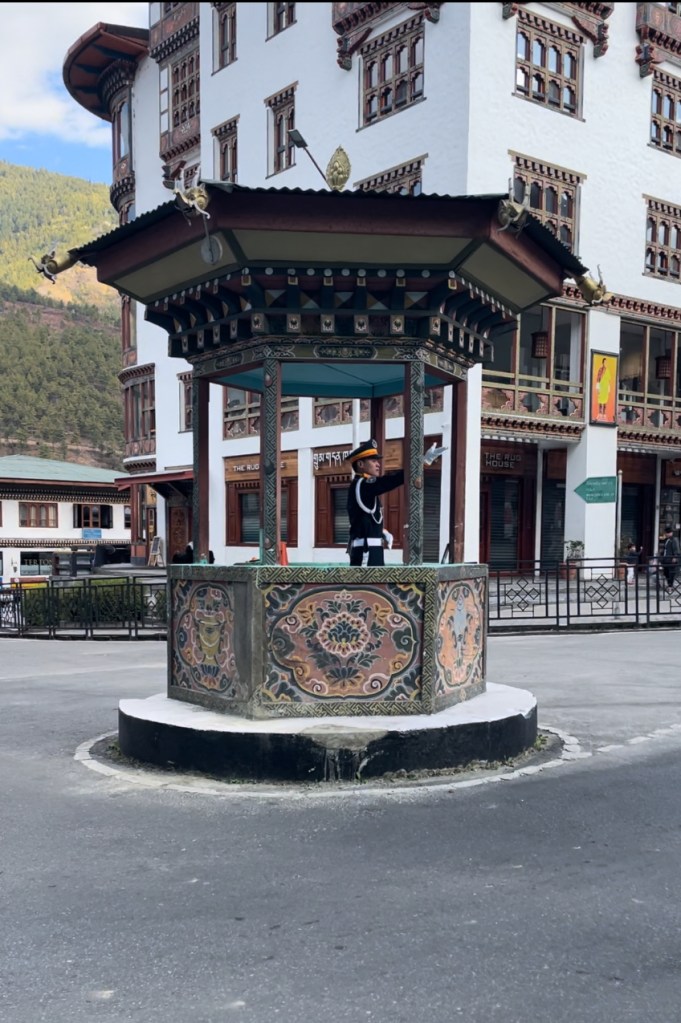
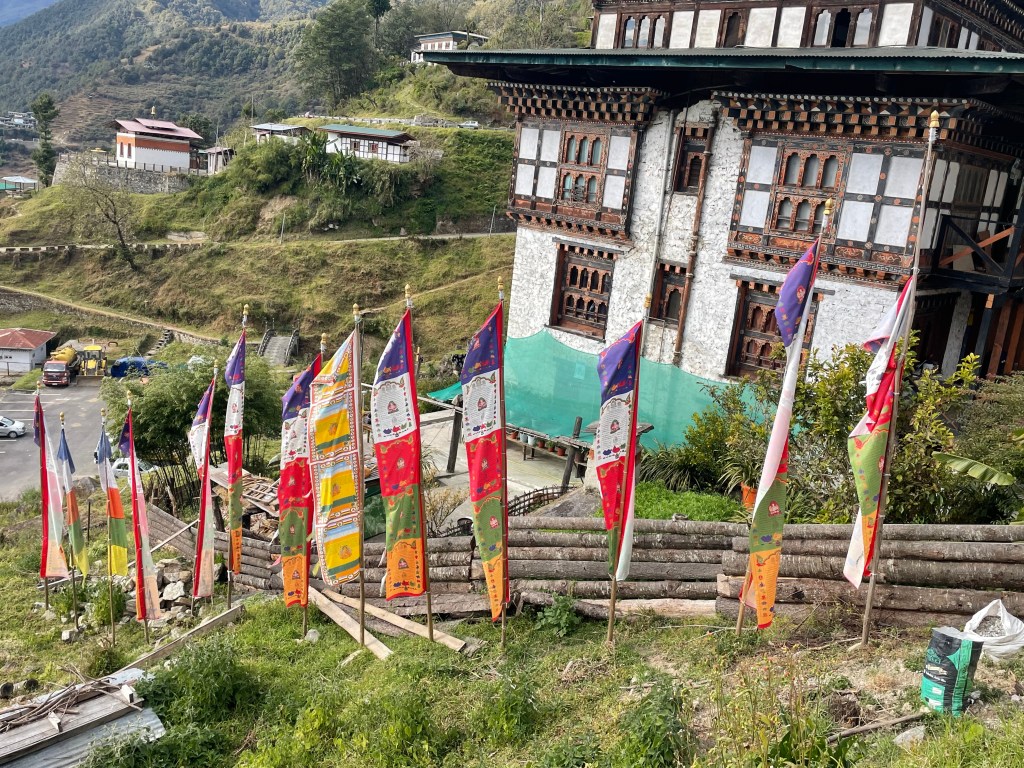
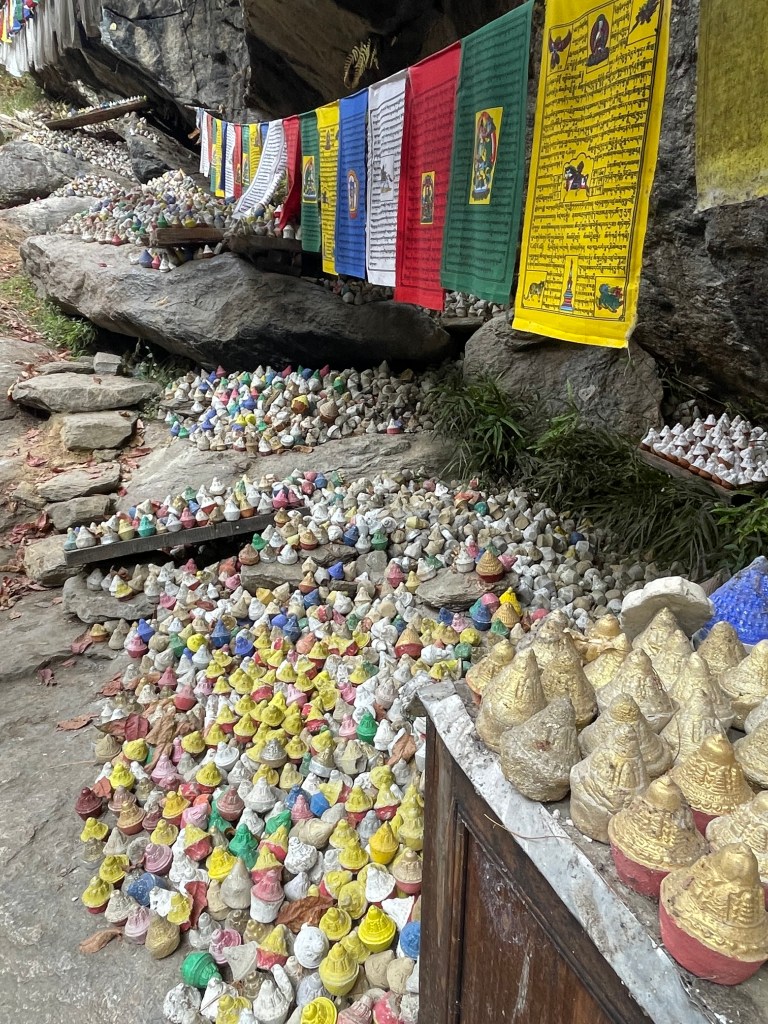
A few fun facts. Bhutan means high land. The country used to be called Druk which means dragon. It’s the only country whose capital doesn’t have a stop light, instead a uniformed officer directs traffic, from a small round covered building, through its main intersection. Archery is Bhutan’s national sport. We watched a match which was quite impressive. The small target they’re aiming at is 476 feet away and they hit it sometimes! When they do, the team members do a little victory dance. There are 5 national languages and 21 dialects are spoken. They got their first TV’s in the late 1990’s. Throughout the country there are 4 types of flags flying everywhere. One, are white flags posted on top of people’s homes for protection and good fortune. It is replaced once a year. Two, are 108 white flags planted in clusters on hillsides to honor those who have died. Three, are red, green, white, blue, and yellow prayer flags, usually hung on mountain tops so that the prayers can fly and spread. They come in various shapes and sizes. Red symbolizes fire, green water, white air and wind, blue sky and space, and yellow the earth. Chungdu told us all the prayer flags had been removed from the path to Tiger’s Nest just two weeks before we hiked, but yet the mountain was covered with them. And the final type of flag are ceremonial flags. All around the country you see little clay, cupcake looking things, called tsatsas tucked in crevices in the rocks, along side the road. They come in a variety of colors and are placed there as an offering for those that are sick. They have prayer wheels that are powered by fast flowing streams so they are on a constant cycle of invoking the loving and unconditional qualities of compassion.


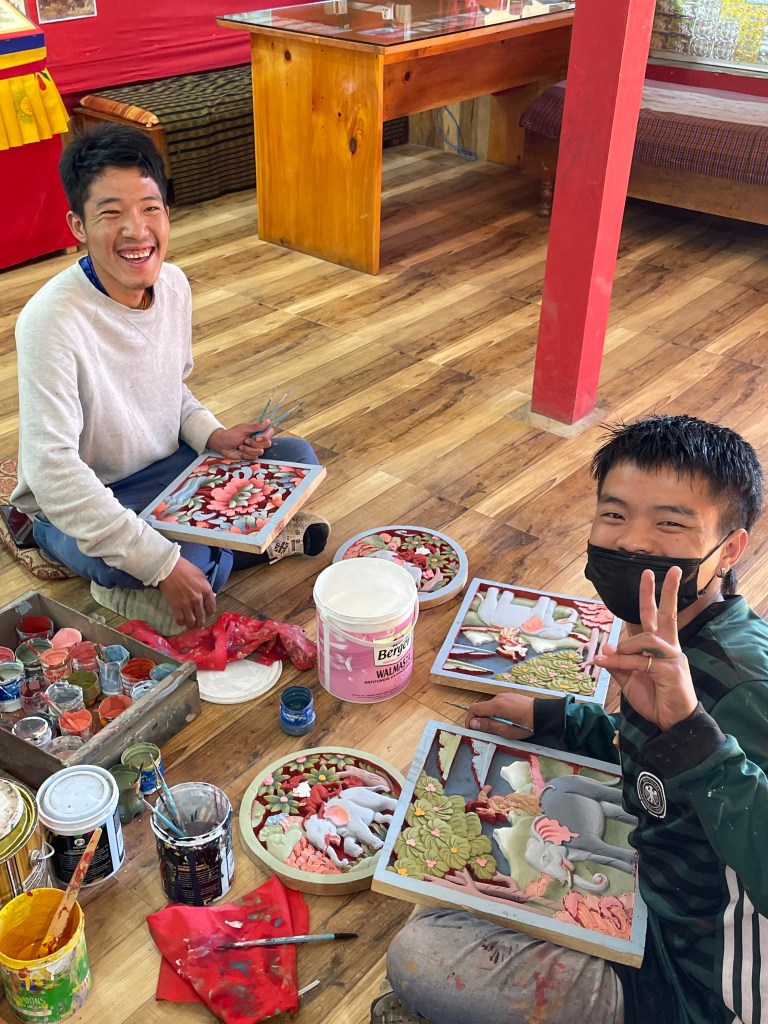
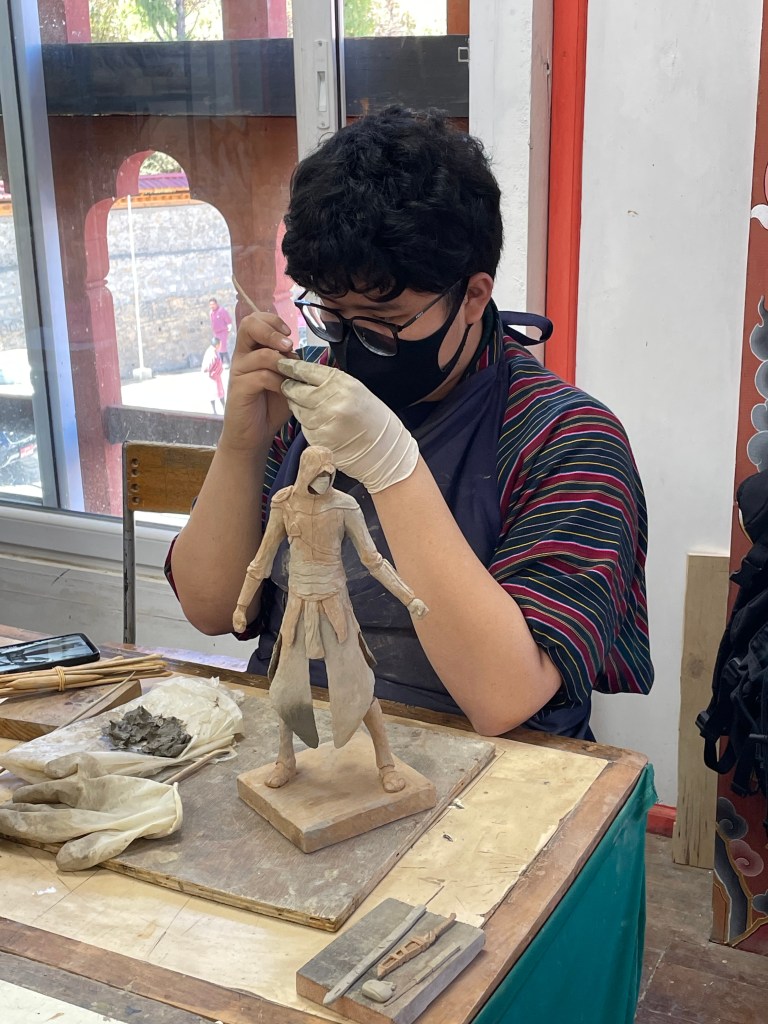
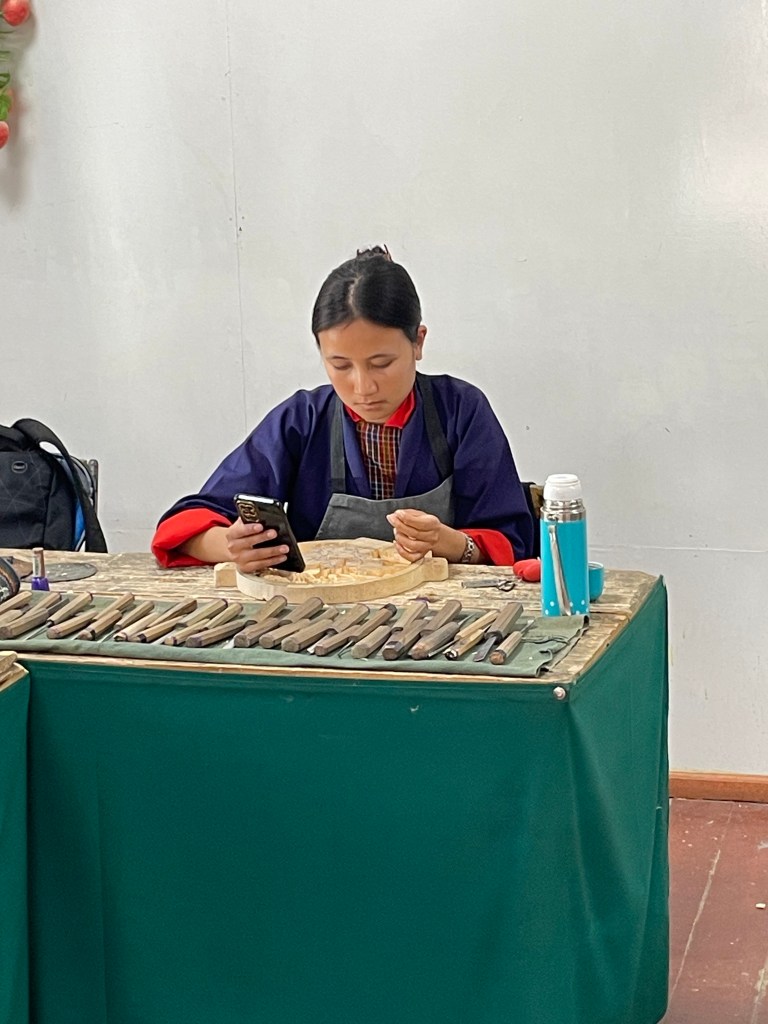
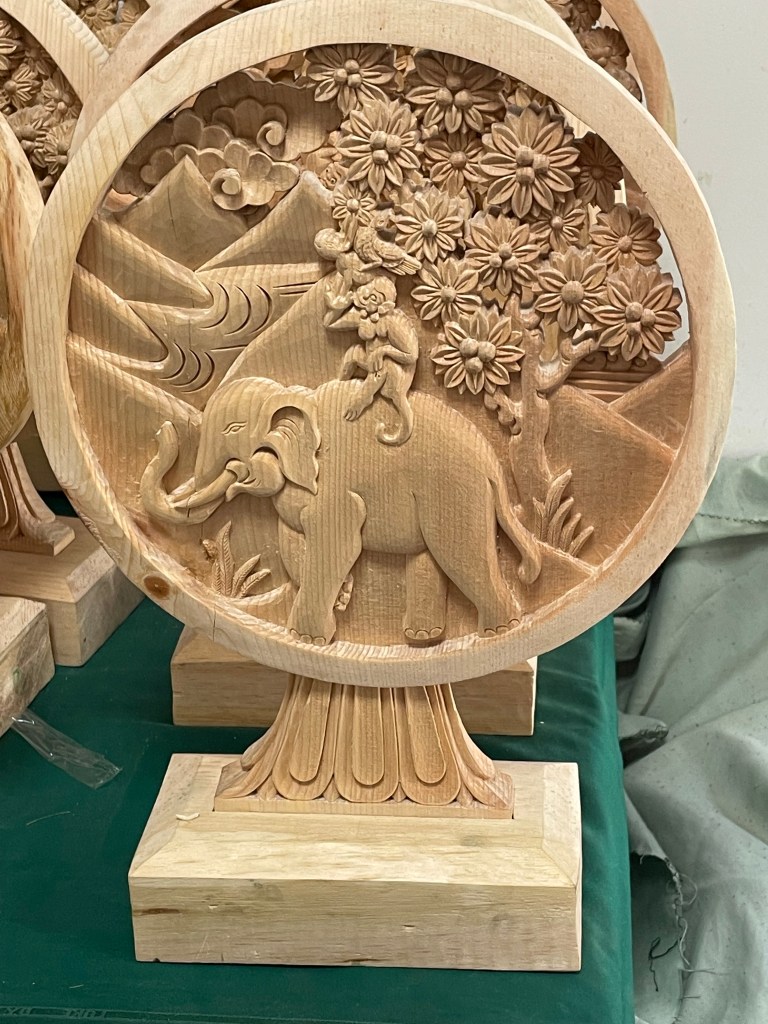
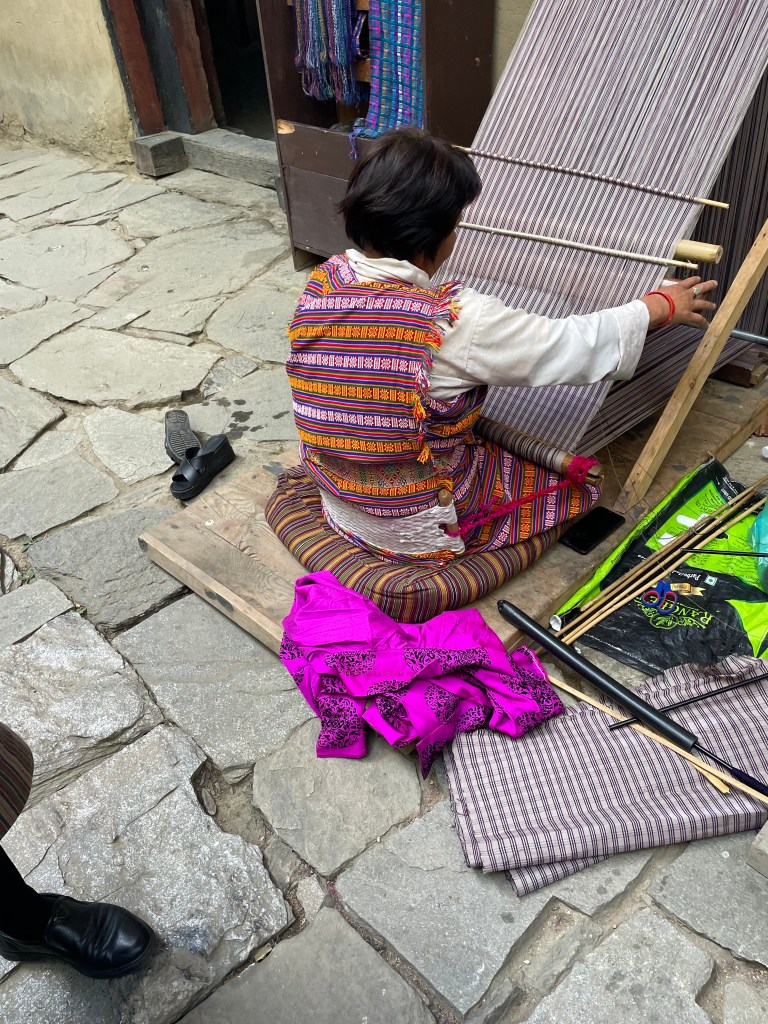
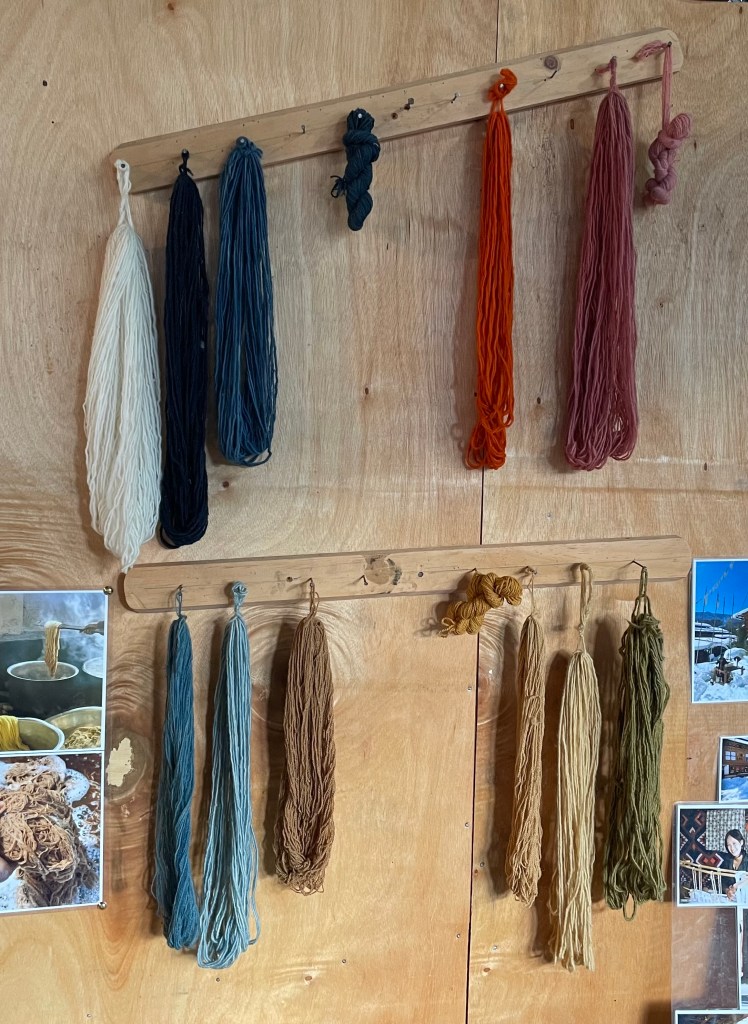
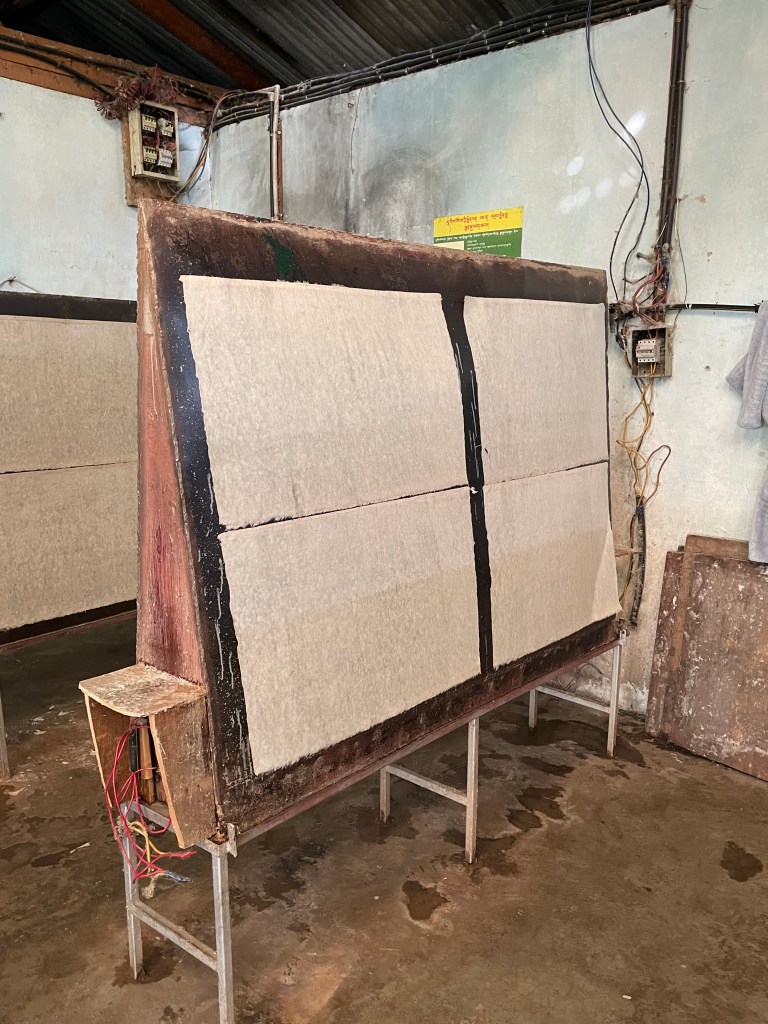
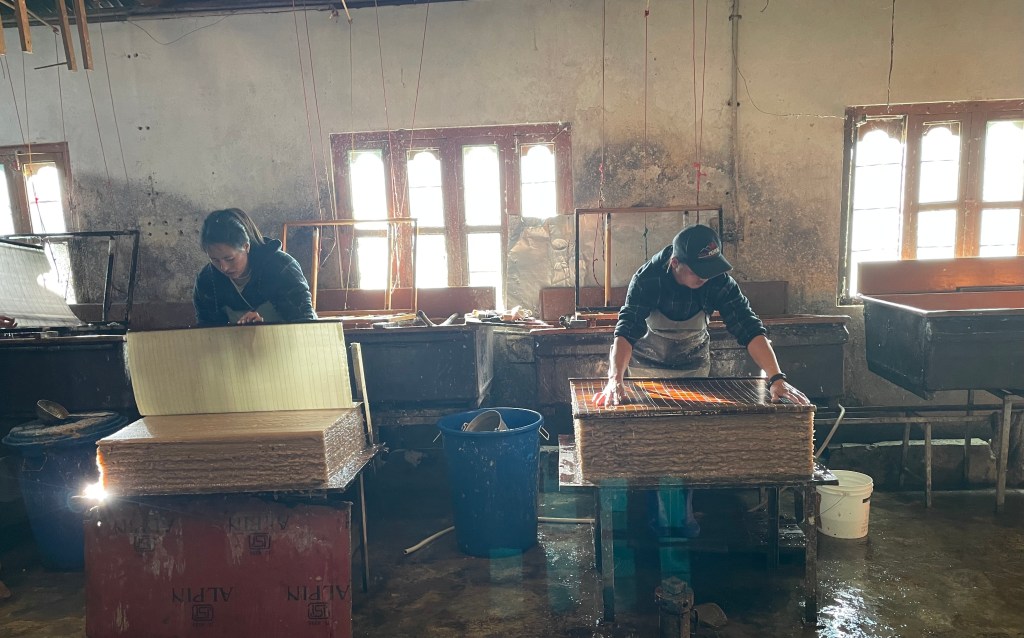
We visited the school where Namgay teaches and saw the students not only painting but also doing wood carving, sculpture, and tailoring. The school teaches 13 different crafts but the most studied are ones that have an economic future for the pupils. Students here go to school through 10th grade before choosing a course of study – science, commerce or art. We saw back brace weavers at work and learned how they make the various colors of yarn for the projects – again focusing on natural materials to dye the threads. They make paper by hand here using the bark of tree. The bark is softened, shredded, turned into pulp, shuttled over a frame until it settles into a flat sheet, and then dried.





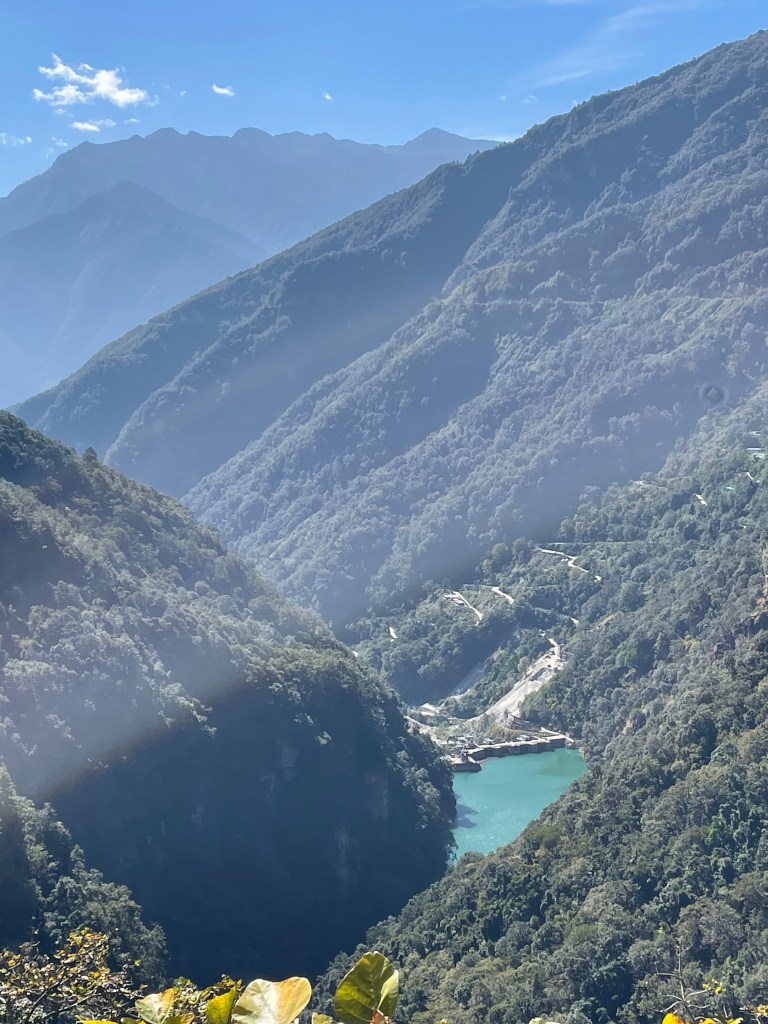
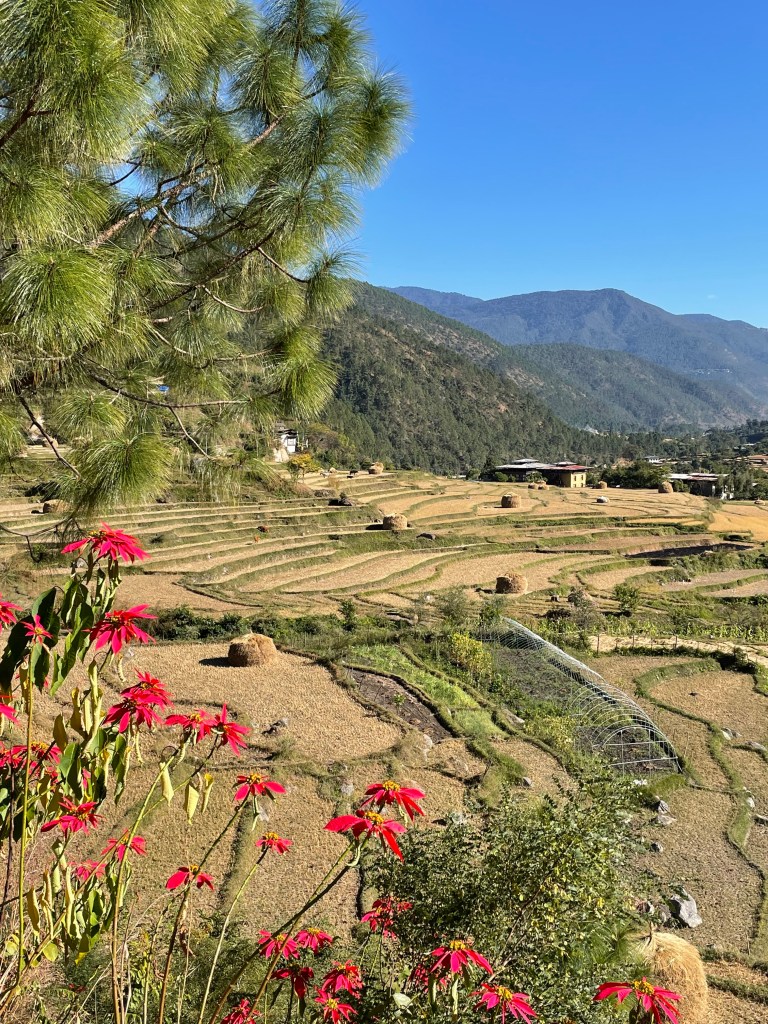
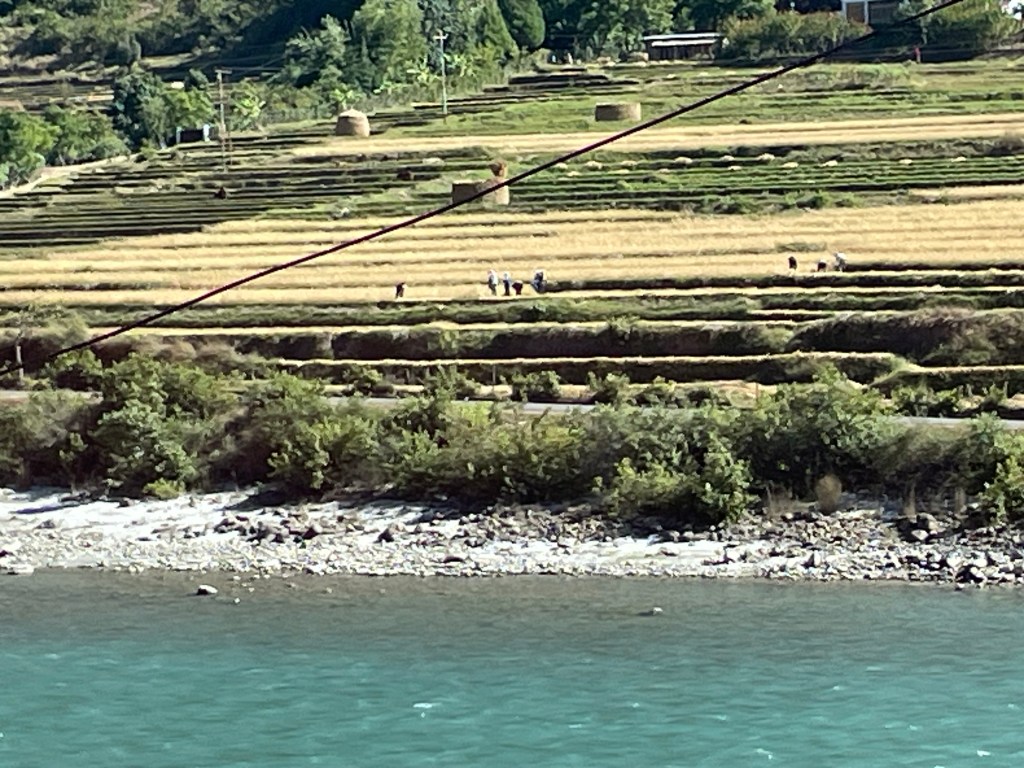
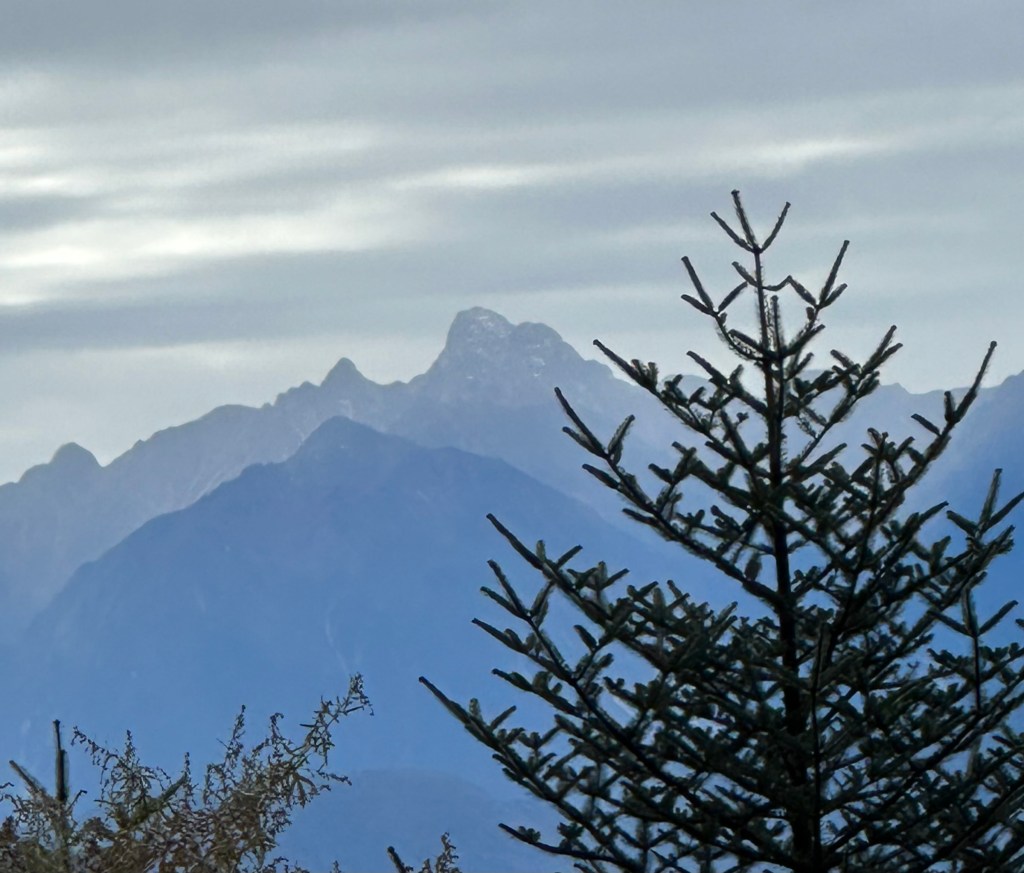
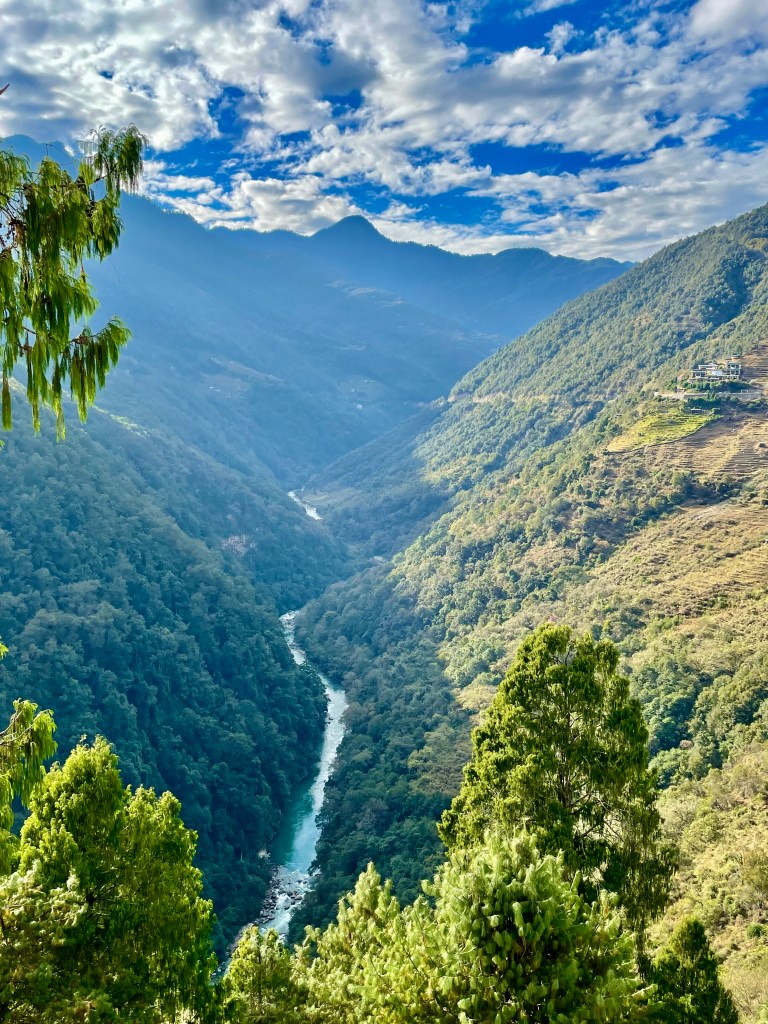
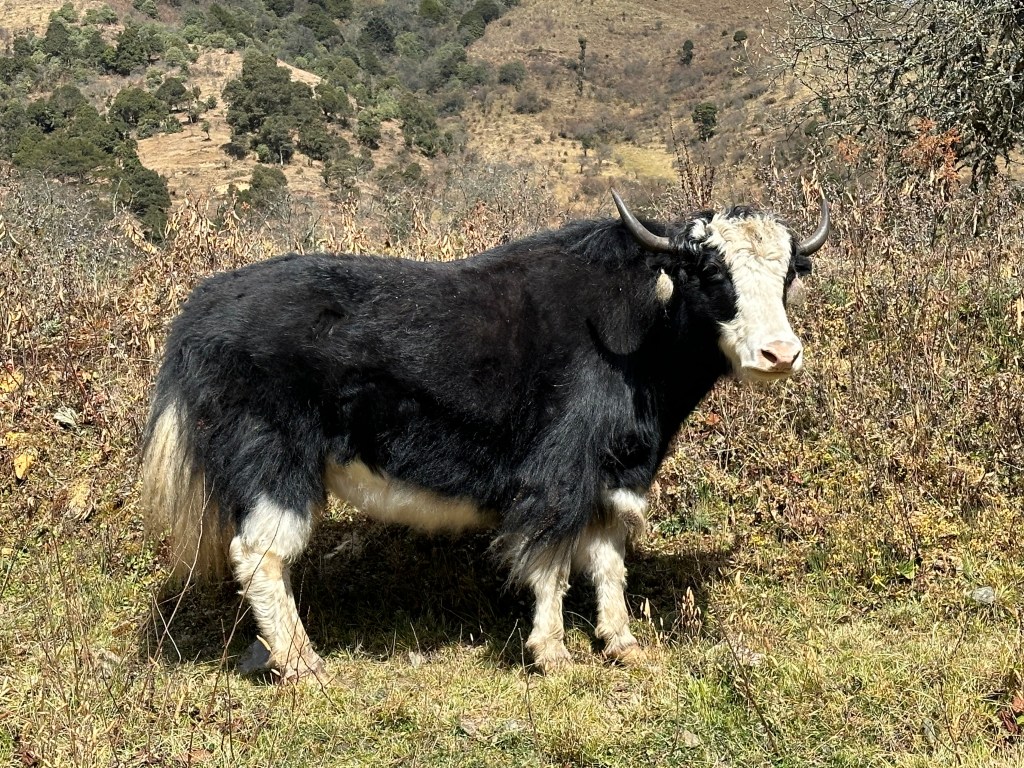
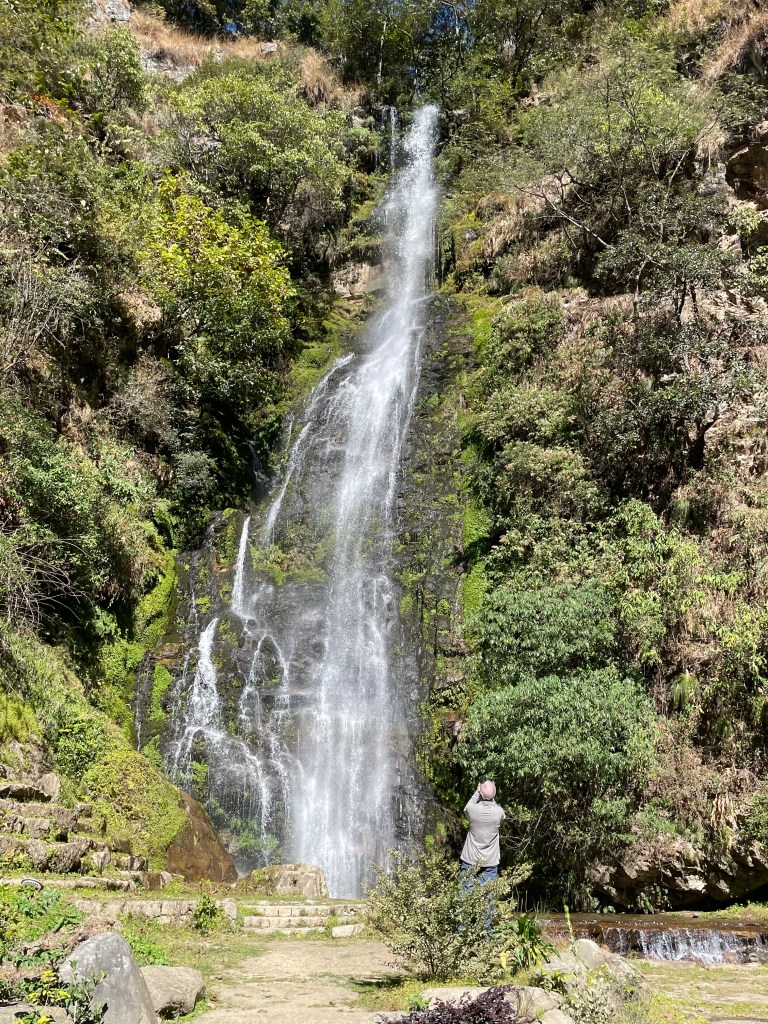
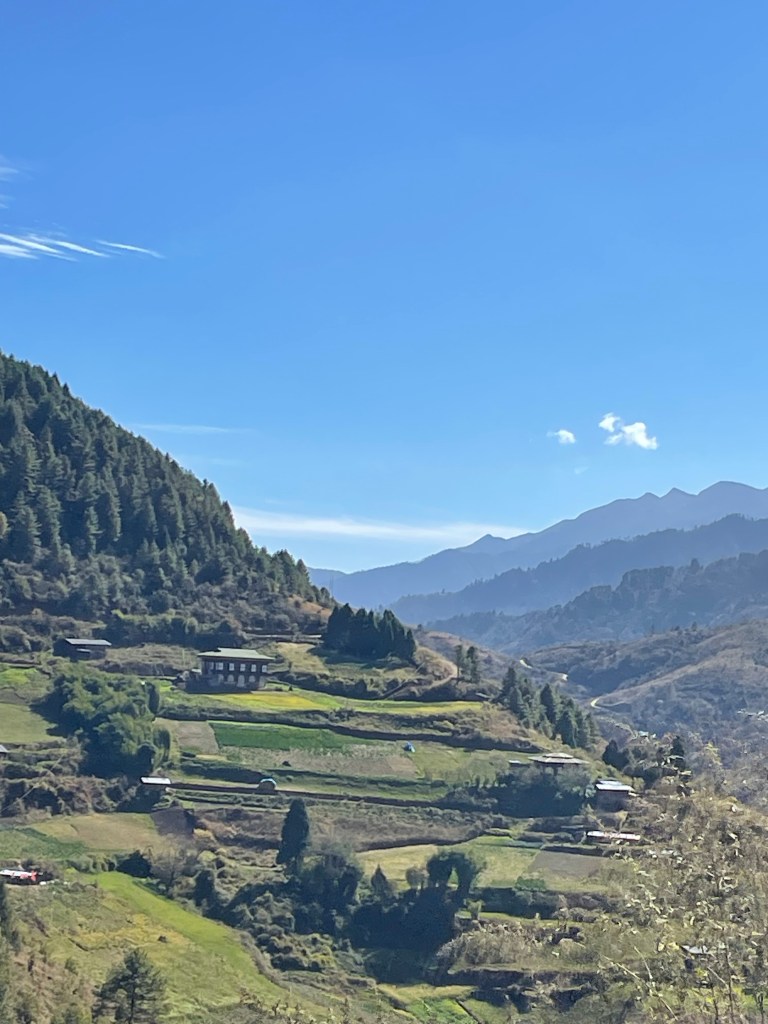
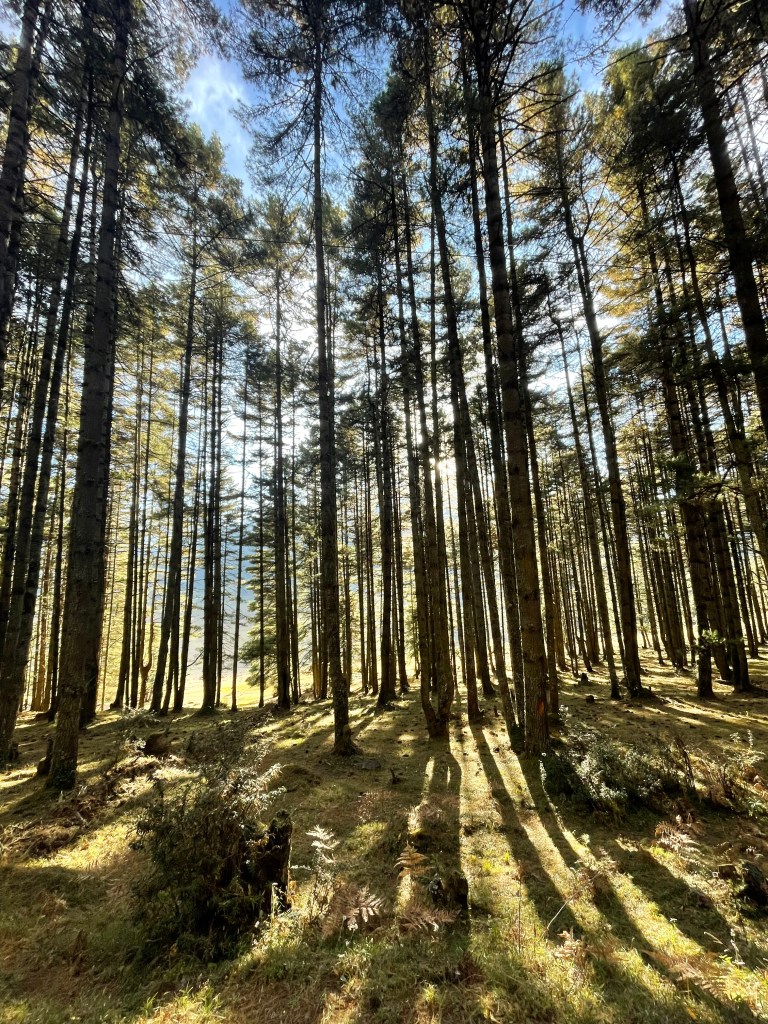
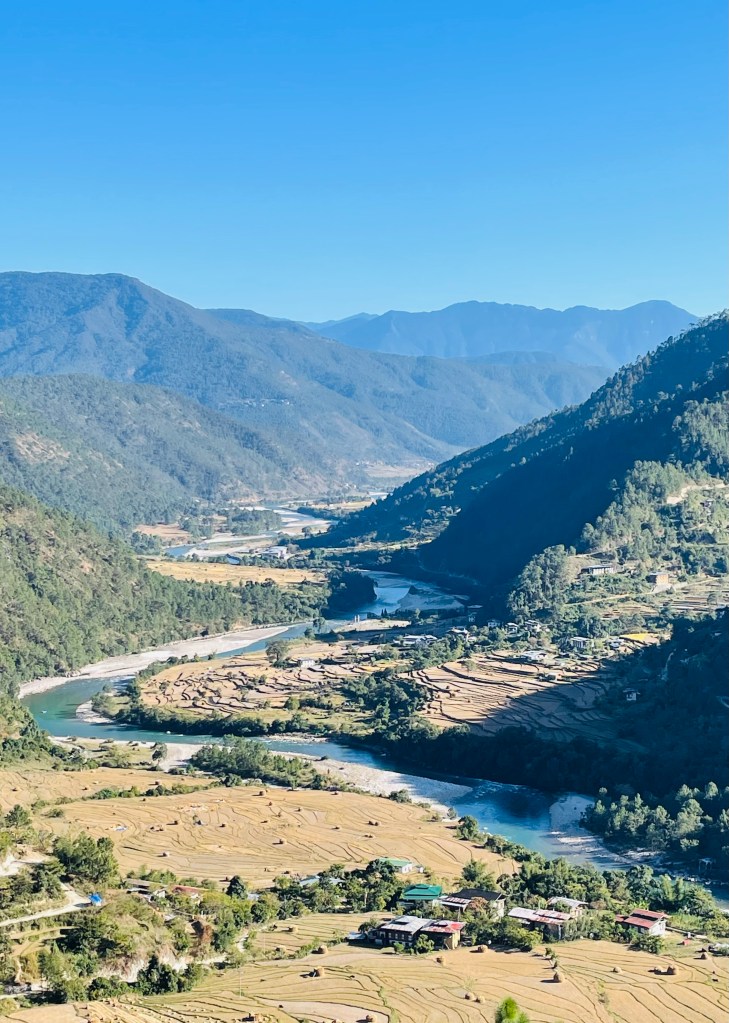
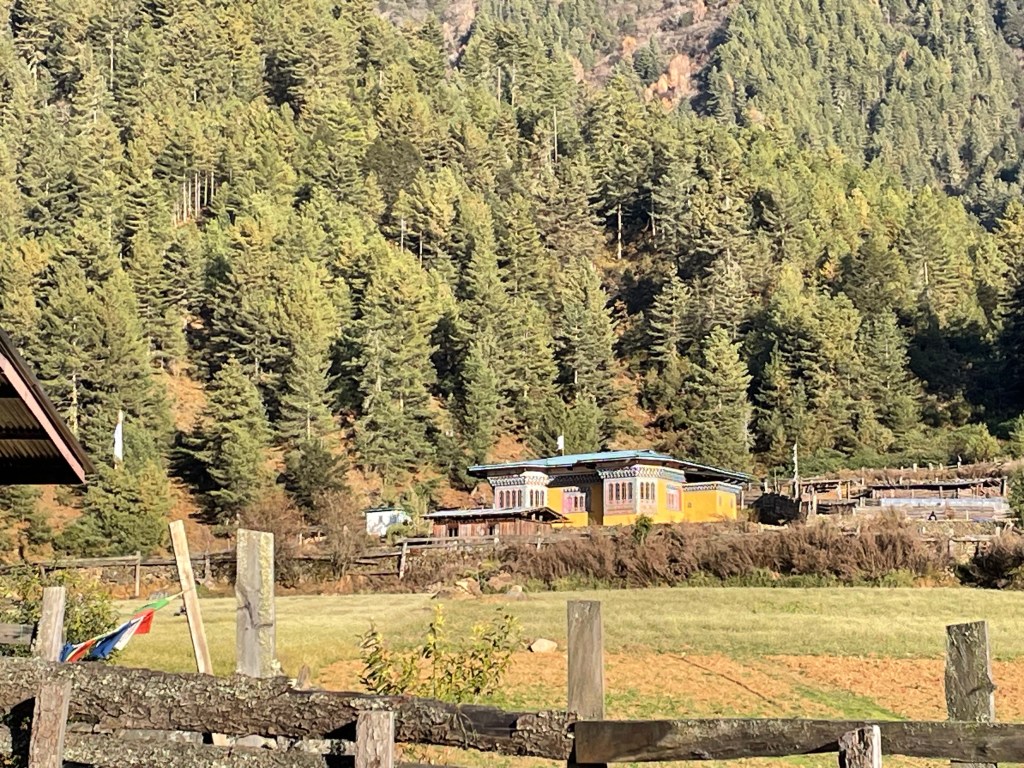
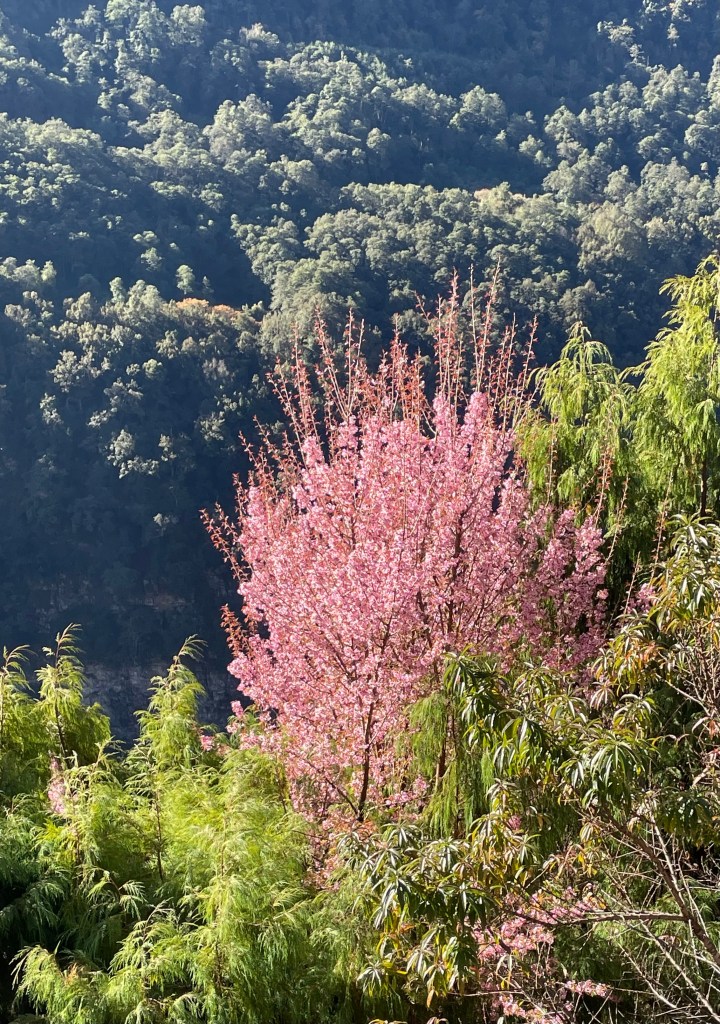
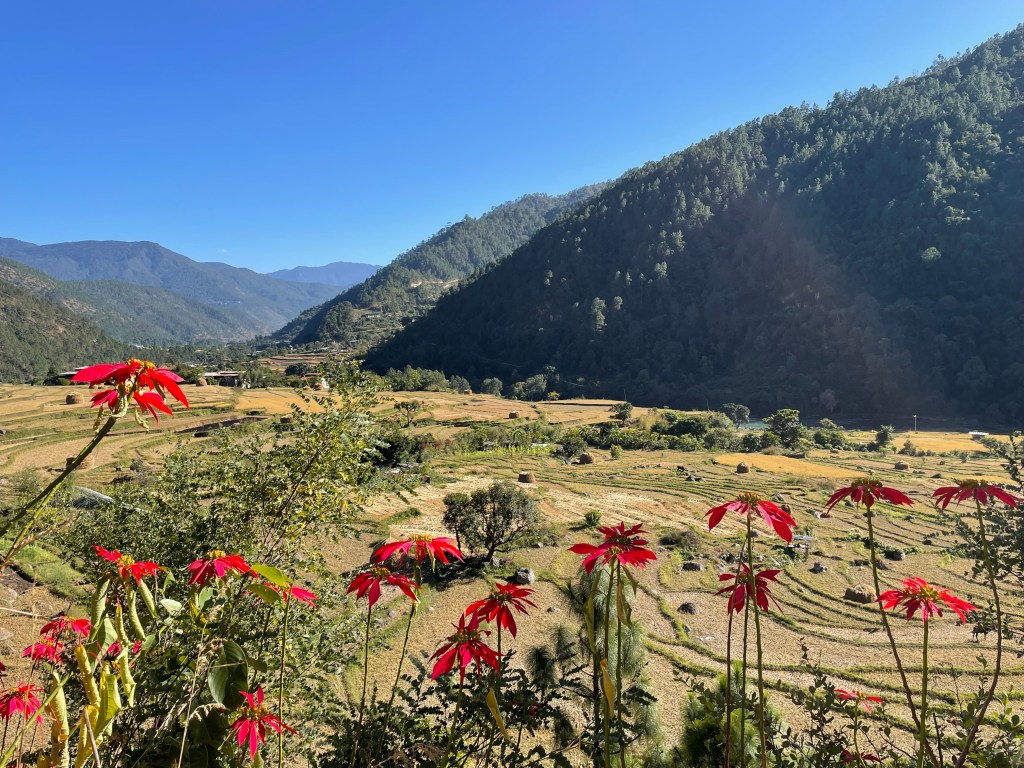
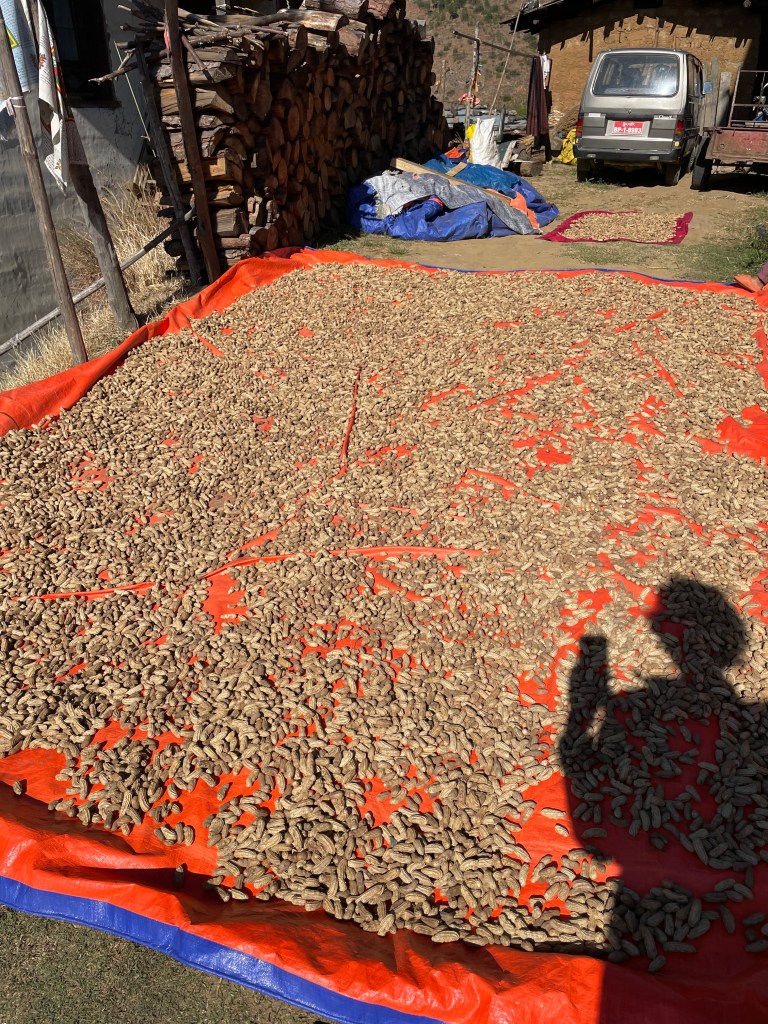
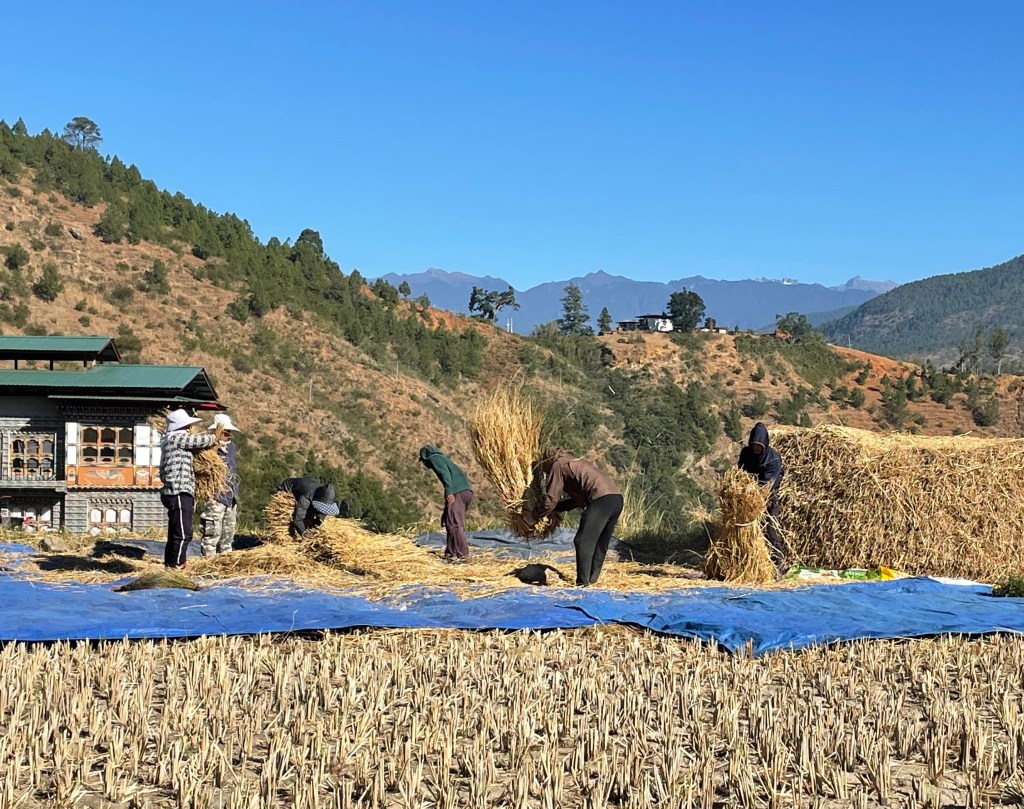
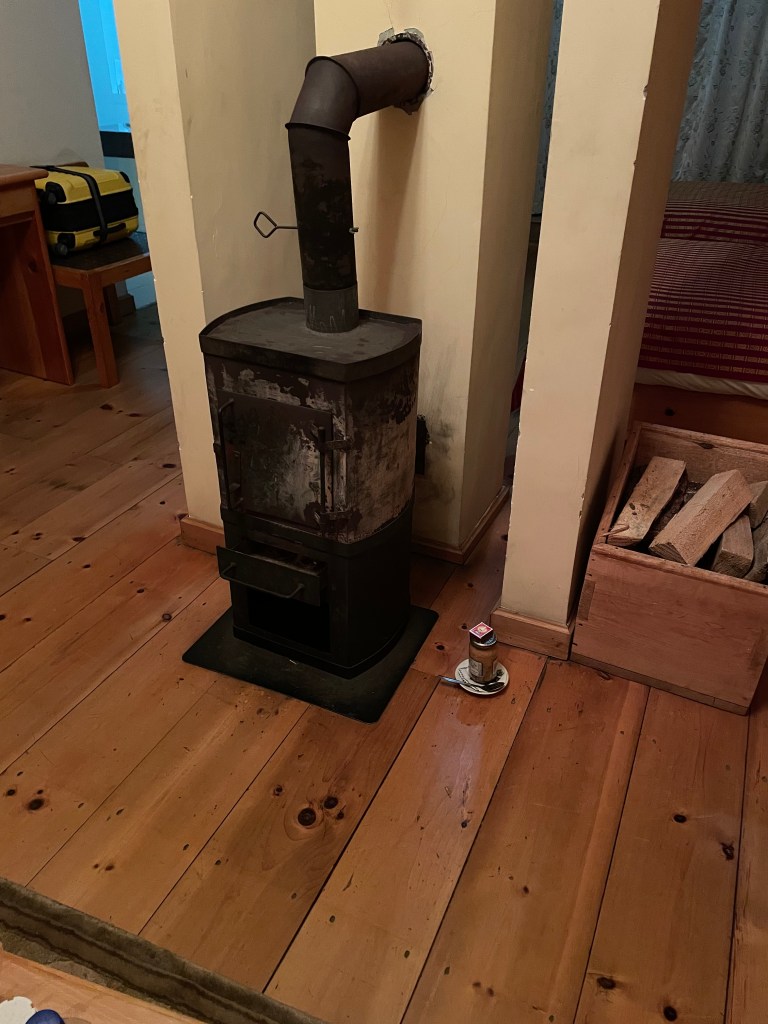
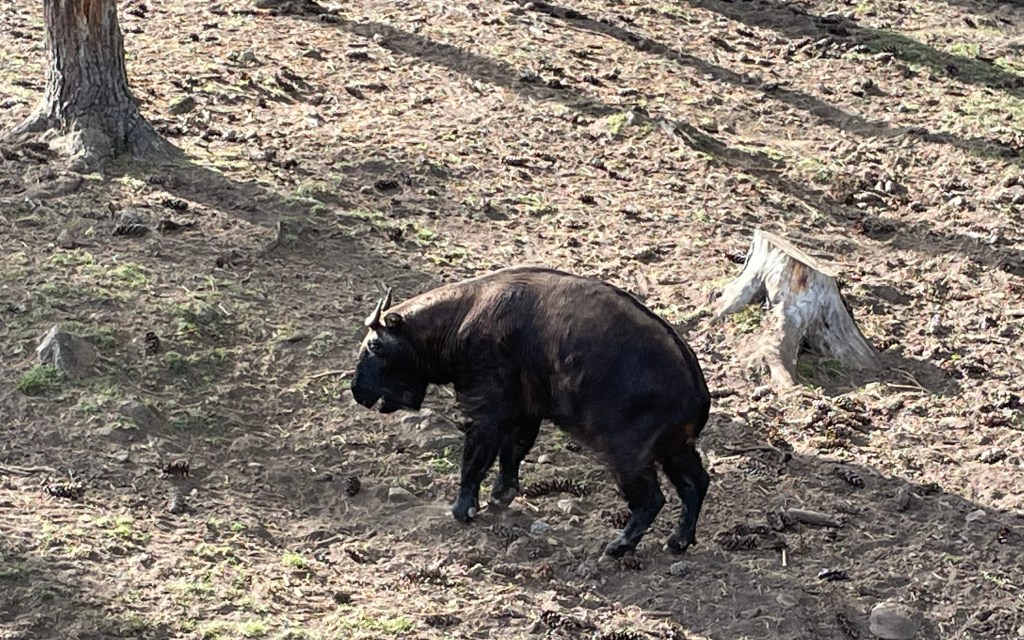
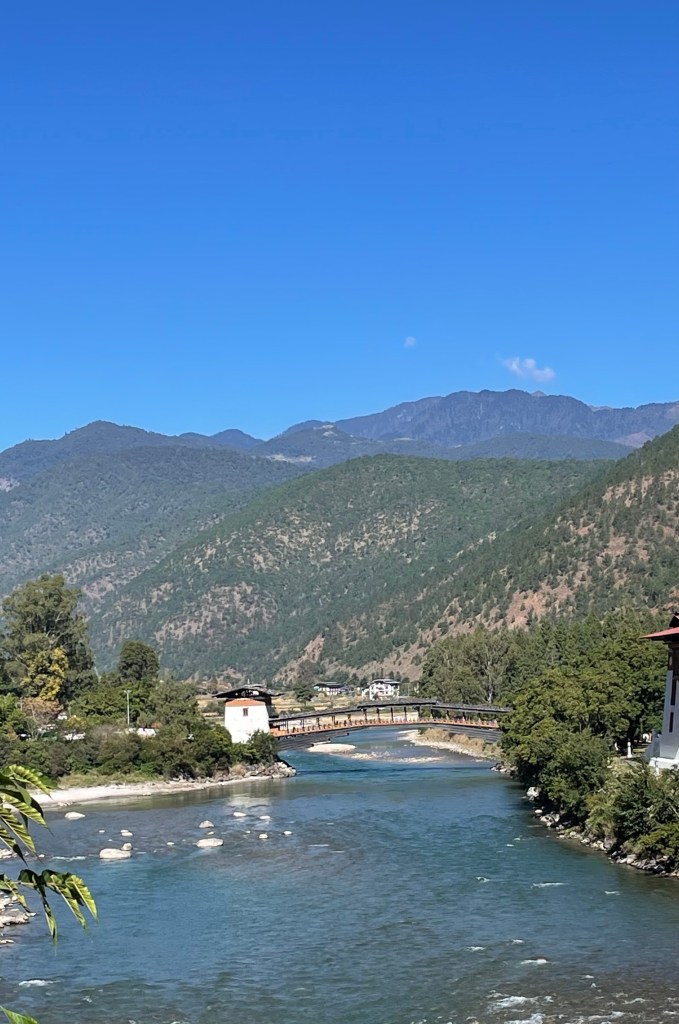
There are so many things I like about Bhutan and its people. It’s a gorgeous place with its mountains and valleys. Even in mid-November flowers were blooming-roses, cherry blossoms, bougainvillae, poinsettias -reminded me of Christmas, and others. I thought I would miss fall this year, my favorite time of year, but it felt like Bhutan was just entering that season. Leaves were beginning to change color; rice, potatoes, chili peppers, peanuts and turnips were being harvested; and the nights were cool – well cold actually. There was frost on the ground at least one morning. And of course it coincided with the nights where our hotel rooms were heated with wood burning stoves. I’m actually pretty good at keeping a fire going – well, after some instruction. I like the decorated houses and the rushing rivers. I find it fascinating that their national animal, the takin, was created by a Divine Madman from the head of a goat and a body of a cow. I applaud the country philosophy of happiness and although they may not be high on the happiness scale as measured in the global view, trying to achieve a balance between the four elements is admirable. I chuckled viewing phallus symbols displayed everywhere, but here it’s a sign of good luck. I adore that they love and respect their king. I appreciate the struggle they’re going through to modernize the country without losing who they are. It’s sits in the middle of two large and powerful nations – China and India, so straddling those tensions must be hard, But they have hundreds if not thousands of monks praying each day for peace and so far it seems to be working. It’s a land that believes in mystery and magic. The people were very kind and patient. The majority seemed to respect their traditions but unfortunately this is changing. I resonated with a lot of the Buddhist philosophy as it was told to me.



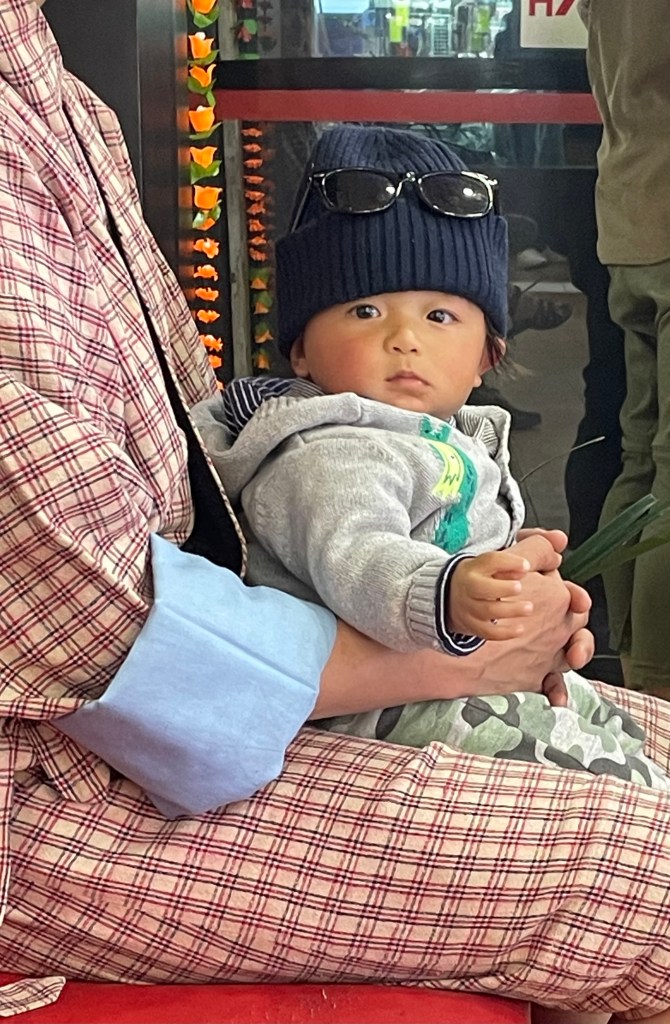
Chungdu shared this with us and it made so much sense to me, I thought I’d share it with you.
The most selfish one letter word is “I”. I stands for expectations. I should be treated like this, I should be loved like this, I should be dealt with like this, I should be respected like this, I should be given this many marks, I should not be given this. We are always leading a life of super high expectations. Everything revolves around my opinions, my desires, my likes and dislikes. I want this, I want that, I don’t want this. Do you think life will be a very happy life when it revolves around “I”? From a child we are grown like this. We only learn to take and everyone has to fulfill my expectations. When the president of the United States, JFK, gave his first presidential speech, his words rumbled into the public address system when he said, “Ask not what your country can do for you, ask what you can do for your country.” So we are saying, ask not what God can do for us, ask what you we can do for God. No one is going to do that, because the “I” is so big. My expectations, my desires, my things are so powerful that even when we go to temple and pray all we are are doing is asking. The more we lead a life of “I”, our life will be frustrating, because people don’t exist in this world to fulfill our expectations. Therefore, the most selfish one letter word is “I”, which stands for expectations. We have to avoid this word. How do we avoid this word? Be realistic in our expectations. Having expectations is not a problem, but understand not everyone will fulfill your expectations. Secondly, avoid this word “I” by turning to serve others. You know why? Because when you want to be served, you are dependent on other people and they may not want to serve you. When you want to serve, who can stop you? When you want respect, people may not respect you. But when you give respect, who can stop you? When you want to be loved, you may not be loved. But when you want to give love, who can stop you? Therefore, learn to take a journey from “I” to “You”. The more you want, the more you’re going to be frustrated, the more you want to give, the more happy you will be.
Next Up: Thailand and Laos


 Where in the World is Debra Grimes?